


Not All Bell Peppers Are Equal: Why Red Beats Green in Your Dog's Bowl
Every bell pepper is safe for dogs, but they are not the same treat. Color tracks ripeness, and ripeness tracks nutrition, so a red pepper is a meaningfully better snack than a green one. Here is how to serve each.

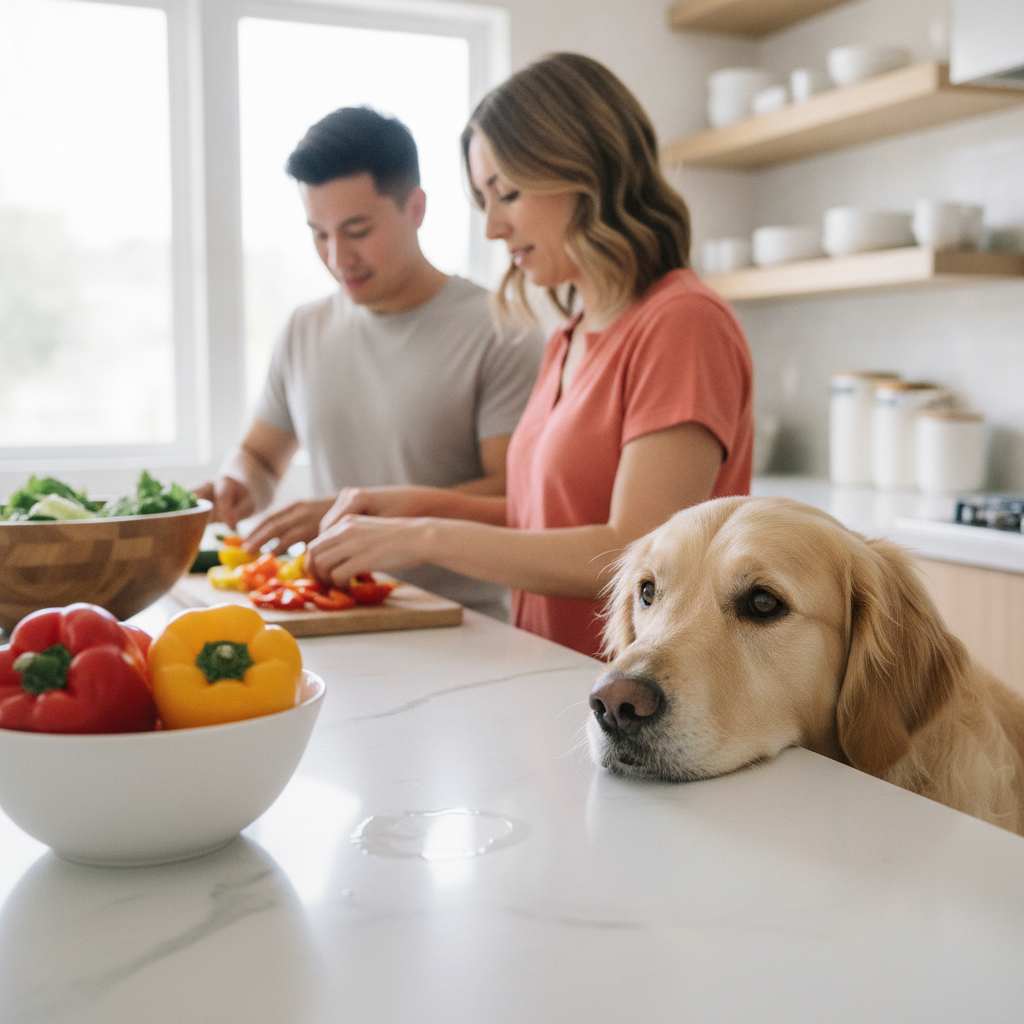
Ask whether dogs can eat bell peppers and the answer is an easy yes, all colors, non-toxic, safe in moderation. But that yes hides something more useful that most guides skip: bell peppers are not interchangeable. The color on the outside is a direct readout of ripeness, and ripeness drives the nutrition inside. A red bell pepper is not just a differently colored green one. It is a riper, sweeter, meaningfully more nutrient-dense treat. If you are going to bother sharing peppers with your dog, it is worth knowing which one earns the spot in the bowl.
So this is not another “peppers are safe” article. It is a short guide to choosing the right pepper, and to the one pepper cousin that is a genuine hard no.
Color is ripeness, and ripeness is nutrition
Green, yellow, orange, and red bell peppers are frequently the same plant at different stages. Green is the unripe pepper, picked early, a little bitter. Left on the plant, it matures through yellow and orange to red, growing sweeter and accumulating more vitamins as it goes. That is why the color is not cosmetic for your dog, it tracks how much nutrition you are actually handing over.
Here is the practical ranking for a dog’s treat:
- Red (best). The ripest and most nutrient-dense. Highest in vitamin A for eye health and the richest in vitamin C, an antioxidant. Usually the sweetest, so most dogs prefer it too.
- Orange and yellow (very good). A step down from red but well ahead of green, and pleasantly sweet.
- Green (fine, least exciting). Perfectly safe and lowest in calories, but the least ripe, least sweet, and lowest in vitamins. Some dogs find it bitter and turn it down.
Across all colors, bell peppers stay low in calories and fat while carrying vitamins C and E (antioxidants that support healthy aging), vitamin K for blood clotting, and vitamin B6 for red-blood-cell production. That combination, real nutrients with very little calorie cost, is what makes them a smart treat for a dog watching their weight.
Bell peppers are one of the snacks I actively recommend, especially for pups carrying a little extra weight. If a client asks which to buy, I tell them red. It is the ripest, so it packs the most vitamin A and C, and dogs usually like it best. The only firm boundary is staying in the sweet-pepper family, because capsaicin in hot peppers is genuinely hard on a dog’s gut.
The one hard boundary: skip the hot peppers
Every bell pepper is safe. Their spicy relatives are not. Jalapeños, chili peppers, cayenne, and anything else that sends you reaching for a glass of milk contain capsaicin, the compound that makes them hot. Capsaicin irritates a dog’s digestive tract and can trigger real vomiting, diarrhea, and stomach pain. There is no “mild spicy” that is okay. The clean rule is sweet peppers only, and if you are ever unsure whether a pepper is sweet or hot, leave it out.
How to serve them, and how much
You do not need to dress bell peppers up. In fact you should not, because the usual add-ons cause more harm than the pepper does good. Garlic and onion are toxic in large enough amounts, and butter or oil just add calories and the risk of an upset stomach. Serve them plain instead:
- Remove the stem and seeds, and wash the pepper well.
- Cut into bite-sized pieces so there is no choking risk.
- Serve raw, or lightly cooked with nothing added. Raw works just as well with less effort, and softening them makes no safety difference.
Keep the amount modest, since bell peppers are high in water and fiber and too much can loosen a dog’s stool:
| Dog’s size | A reasonable pepper serving, every few days |
|---|---|
| Small (under 20 lb) | A couple of bite-sized pieces |
| Medium (20–50 lb) | A small handful of pieces |
| Large (over 50 lb) | Up to about a quarter cup |
Watch for the occasional dog who disagrees
Non-toxic does not mean every dog tolerates them. After the first serving, watch for digestive upset, vomiting, diarrhea, or a dip in appetite, which usually clears on its own within a day or two. A bigger reaction, itchy or rashy skin, or digestive trouble that lingers past a couple of days, means you should stop feeding peppers and check in with your vet.
If peppers are not a hit
Plenty of dogs turn their noses up, and that is fine, because dogs on a complete, balanced diet do not need vegetables at all. If you want another low-calorie treat to try, safe options include apples, broccoli, cucumbers, carrots, green beans, berries, sweet potatoes, peas, pumpkin and other squashes, and zucchini. Wash whatever you choose, remove seeds, pits, and cores, and feed in moderation.
The bottom line
Bell peppers are a safe, low-calorie, vitamin-rich treat in every color, but they are not equal. Color tracks ripeness, and ripeness tracks nutrition, so red is the best pick, followed by orange and yellow, with green trailing as the safe-but-least-exciting option. Serve them plain and in small amounts, watch a new dog for any digestive pushback, and hold one firm line: sweet peppers only, never the hot ones.
References
- Merck Veterinary Manual. “Capsaicin.” https://www.merckvetmanual.com/pharmacology/systemic-pharmacotherapeutics-of-the-integumentary-system/pharmacotherapeutics-of-the-skin-in-animals
- U.S. Department of Agriculture, FoodData Central. “Peppers, sweet, red, raw.” https://fdc.nal.usda.gov/
- Cummings Veterinary Medical Center, Tufts University, Clinical Nutrition Service. “The Truth About Treats.” https://vetnutrition.tufts.edu/2016/09/the-truth-about-treats/
Common questions
Which color bell pepper is best for dogs?
Red. Because color tracks ripeness, a red bell pepper carries the most vitamin A and C of the colors. Green is the least ripe and least nutrient-dense, though still perfectly safe.
Can dogs eat hot peppers like jalapeños?
No. Hot peppers contain capsaicin, which irritates a dog's digestive tract and can cause vomiting, diarrhea, and stomach pain. The safe rule is sweet peppers only.
How much bell pepper can a dog have?
Keep it small: a few pieces for a small dog, up to about a quarter cup for a large dog, every few days. Too much of the water and fiber can bring on loose stool.
Not a substitute for your vet. Our guidance is educational. For urgent symptoms, contact a vet or emergency clinic right away. Editorial standards
Dr. Park is a board-certified emergency and critical care specialist. She reviews our health and safety content for clinical accuracy and contributes guides on recognising urgent conditions. Her focus is helping owners act quickly and correctly when it matters most.
Meet our experts ↗Keep reading
 FoodProduce Is a Treat, Not a Topping: 11 Fruits and Veggies, Served RightDr. Mara Chen · 9 min
 FoodSpinach for Dogs: One Compound Decides Whether It's a Superfood or a SkipDr. Ravi Mehta · 6 min
 Food7 Foods the Internet Swears Are Bad for Dogs. They Aren't.Dr. Amara Solis · 6 min
 FoodPork and Dogs: The Meat Is Fine, the Way We Cook It Isn'tDr. Mara Chen · 5 min
 FoodThe People Foods That Actually Do Something for Your DogDr. Amara Solis · 7 min
 Food"Lactose Intolerant" Is the Wrong Question About Your Dog and DairyDr. Ravi Mehta · 7 min