


The Painter Who Hides Her Cats in the Dark
Bambou Gili's twilight canvases hum in blue, green, and purple, and a cat is almost always watching. The artist explains how her felines became the quiet emotional center of her work.
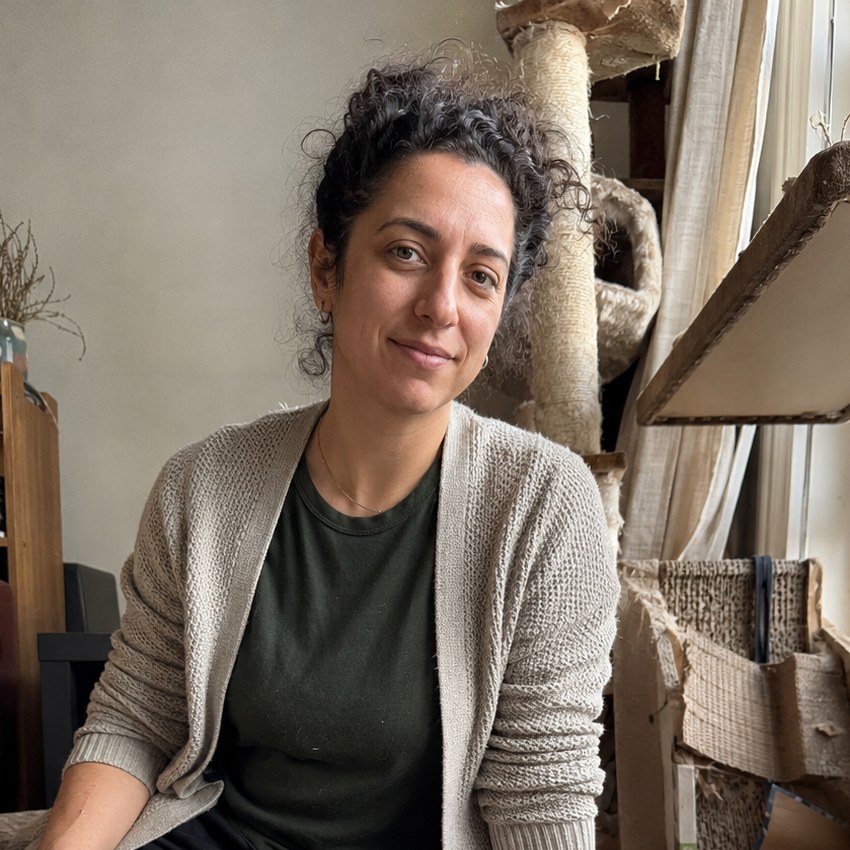
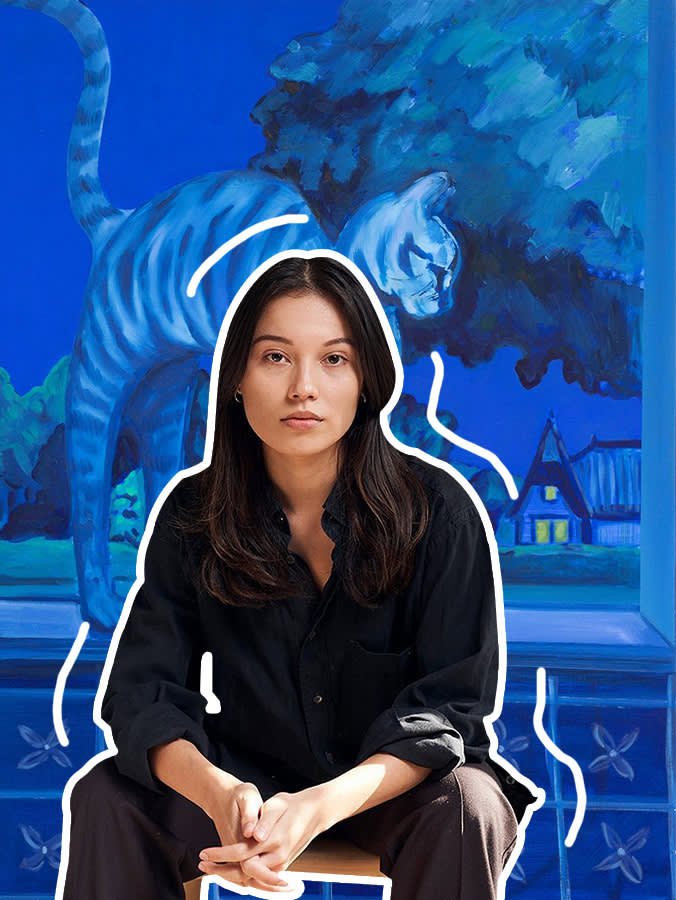
Look at a Bambou Gili painting long enough and you start hunting for the cat. It is usually there, perched on a windowsill, peering down at a bather, hurrying through a vet’s waiting room, half-dissolved into the blue dark. For the New York-born artist, currently having a real moment on the contemporary scene, cats are not decoration. They are the device she uses to smuggle feeling into a frame, the small watchful presence that turns a painted room into a private, slightly haunted one.
Gili’s canvases hum in saturated hues of blue, green, and purple and take on the kind of modern, exposed themes that are hard to paint without tipping into cliché: isolation, vulnerability, race, playfulness, intrigue. Her work was recently featured at the prestigious Deitch gallery in Los Angeles, and her first solo exhibition opens at LA’s Night Gallery next year. We talked with her about night, memory, and the goofy logistics of sharing a studio with two opinionated cats. What follows is built around three things her work keeps returning to.
Night as a place where reality loosens
Gili paints the dark on purpose. Daylight, she points out, is bossy: it “defines the shapes of our surroundings” with unforgiving clarity. Night does the opposite. “At night, light bends and contorts familiar shapes and transforms the world according to whatever silhouettes the brain can make sense of,” she says. The same moonlit yard can read as an “ethereal dreamscape” if you feel peaceful or an “eerie shadowland” if you feel paranoid; the viewer’s own psychology finishes the painting.
That ambiguity is also why night is, for her, the best laboratory for color. Her nighttime color studies are ongoing, almost meditative: “I imagine I will spend years observing, and hopefully mastering, the depiction of natural light as it appears at all hours.” She is in no rush, slowly folding new color spectrums into her palette as she goes.
The cats are memory, not models
The cats in Gili’s paintings are rarely posed from life. They are pulled from observation and memory, which is why they feel less like pets and more like presences. The clearest example is “Ophelia in the Tub” (2019), in which a ghostly cat watches over a bather. That cat is Chichi, Gili’s childhood companion, who used to guard the tub during her baths and who died around the time the painting was made. “I was pretty heartbroken, which is why the cat is very ghost-like in that painting,” she says. She wanted Chichi “looking over Ophelia in a private moment.”
Her current rescues turn up too, true to their real personalities. Mo, a shy, graceful tabby who saves most of her affection for Gili and her partner, stars in “Blue Kitchen” (2021). Marmalade, the foster-fail ginger, makes his cameo in “Vet Odyssey” (2022), the painting unveiled at Frieze London that made anxious cat parents everywhere wince in recognition. Marm is the opposite of Mo: “a ridiculously affectionate ginger, a big licker with an extremely loud purr.” Gili and her partner found the Reddit thread “One Orange Braincell” and decided it summed him up perfectly. “Cats have such distinct, indelible personalities,” she says, and she suspects every cat in her paintings traces back, on some level, to one she has watched or remembered.
When a 2 a.m. note becomes a painting (and a public-service reminder)
Gili keeps a journal by her bed. She was an insomniac when she was younger; now she prefers to work in daylight and uses night to reflect, sketch, and catch the strange images that surface as she winds down. A journal lives within reach of her pillow to trap the strange ideas and half-dreamed images before they dissolve; whatever survives the night gets attempted in the studio the next day. Reading before bed, she adds, sets her up “for great dreaming.”
The notes are not always legible, and they are sometimes very weird, which she counts as a feature. One morning she woke up next to a scrawled line: “Grapes are bad for dogs.” She googled it, was amazed it was true, and the thought of an animal in peril sent her to Goya’s drowning-dog painting, “The Dog (El Perro),” which became the emotional seed of “Vet Odyssey.”
The scrawl, as it happens, is good advice worth repeating in daylight. Grapes and raisins are genuinely toxic to dogs, and the ASPCA Animal Poison Control Center notes the same risk extends to cats, though cats are far less likely to eat them. Even small amounts can trigger sudden kidney failure, and there is no reliably “safe” dose, so the rule is simply none. If your cat or dog eats grapes or raisins, treat it as urgent and call your vet or poison control. A painter’s midnight note turns out to be sound household policy.
The studio remains cat-free (for now)
Given how central her cats are to the work, you might assume they hold court in the studio. They do not, and the reason is refreshingly practical. “I dream of the day I will introduce Mo to the studio,” Gili says. For now, though, the cats treat her materials as a playground, and oil paint, solvents, and pigment have no business near fur that gets licked. Oil paints, solvents, and pigments are no place for a curious cat, so instead she commutes back into the house several times a day for kiss breaks. Asked whether the visits double as research for new work, she allows a hopeful “Maybe!” The cats, it seems, will keep showing up on the canvas whether or not they are ever allowed near the easel.
References
Sasha Ford is a certified cat behaviour consultant who has worked with shelters, catteries, and private clients across the country. They review all feline behaviour content at The Pet Times, with expertise in multi-cat households, indoor enrichment, and stress-related disorders.
Meet our experts ↗Keep reading
 LivingYour Cat Picks the Foot of the Bed on Purpose. Here's the LogicClaire Sutton · 6 min
 LivingWhy Agathe Singer Paints Every Cat as a Person, Never a PatternNina Vasquez · 6 min
 LivingMy Cat Has Never Once Felt Awkward. I'm Taking Notes.Sasha Ford · 5 min
 LivingHer Cat Has a Meow for Everything. It Rewired How She Makes Music.Jordan Ellis · 4 min
 LivingHow Many Cats Is Too Many? Vets Say You're Asking the Wrong Question.Nina Vasquez · 7 min
 LivingCan Cats Sense When Death Is Near? Inside the Mystery of Oscar the CatTom Hadley · 7 min