


Why a Stick Fails Every Test a Safe Puppy Chew Has to Pass
The problem isn't that your puppy chews, chewing is a need. It's that a stick is a found object, not a chosen one, and it flunks all four things a safe chew must be.

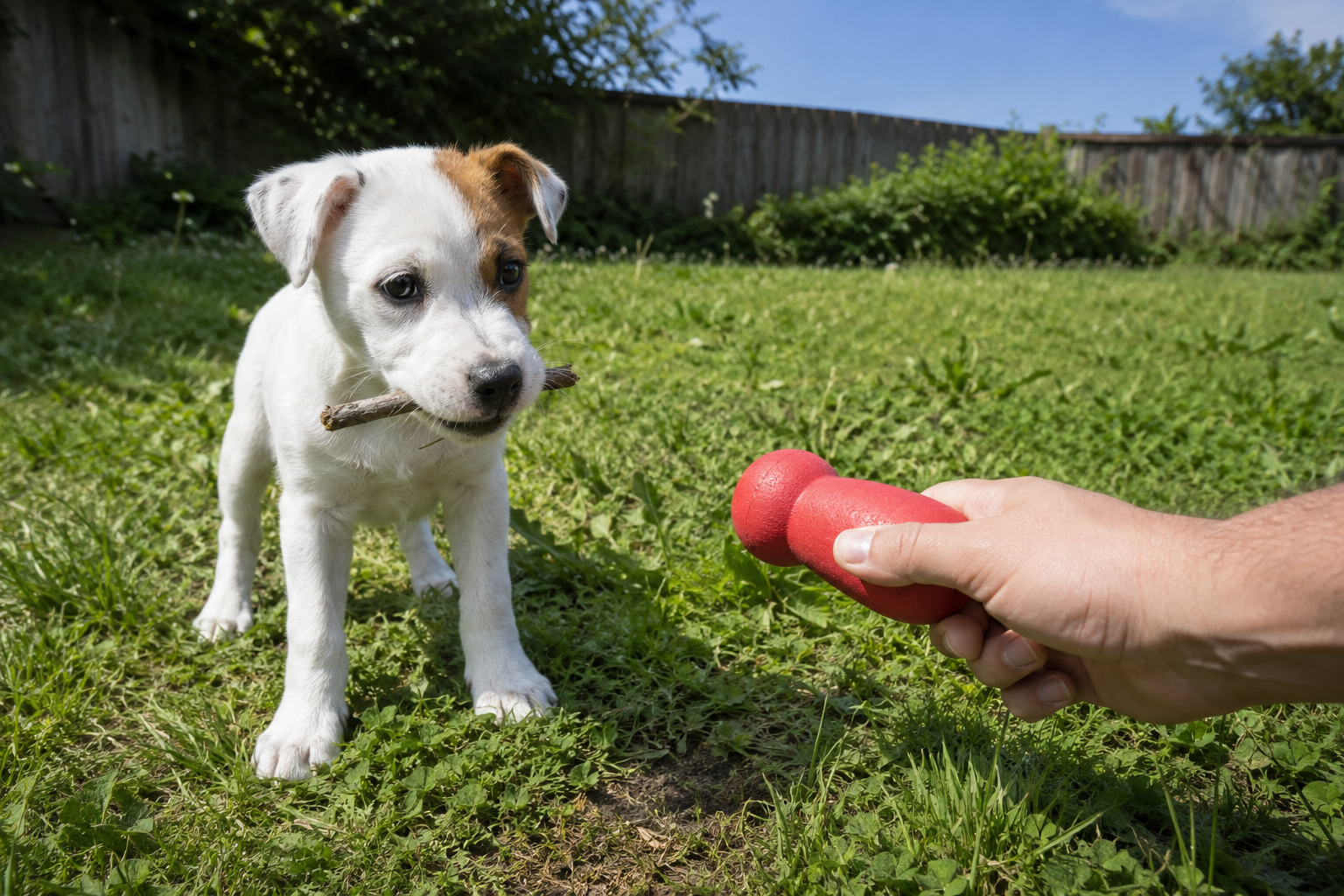
A young dog trotting across the yard with a stick in its jaws is such a classic image that the risk hides in plain sight. Owners see the chewing and worry they need to stop the chewing, but that is the wrong target. Chewing is a genuine biological need for a puppy, especially a teething one, and trying to suppress it is both futile and unfair. The real problem is narrower and more useful to understand: a stick is a found object, not a chosen one. A good chew toy is something you select for specific safety properties. A stick is whatever the puppy happened to pick up off the ground, and it fails every single test a safe chew is supposed to pass. Look at those tests one by one and the case against sticks makes itself.
Why puppies grab sticks in the first place
Start with the drive, because you are going to redirect it, not defeat it. Puppies explore the world mouth-first, so grabbing and gnawing whatever is outside is normal. Some chew out of boredom or learned habit, some are after the sensation itself, the texture, the heft of a branch, the crunch, and teething puppies chew because pressure on sore gums genuinely soothes them. All of that is healthy. The urge is fine. The object is the problem.
The four tests a safe chew must pass, and how a stick flunks each
Here is the framework worth carrying to the pet-store aisle and the backyard alike. A chew is only safe if it is the right size, the right hardness, non-splintering, and non-toxic. A stick misses on all four.
Test 1: the right size, so it can’t choke or block
A safe chew is sized so a puppy cannot swallow it whole or snap off a gulpable chunk. A “stick” is unpredictable by definition, a slim twig, a fat branch, a stray kebab skewer, a chunk of plank, and a puppy will happily bite off a piece of any of them. A splinter or a broken-off segment can lodge in the airway and become a genuine choking emergency, or travel down and get stuck in the esophagus, stomach, or intestine. A tiny twig might soften in stomach acid and pass; a sharp fragment can puncture the intestinal wall, leak gut contents, and cause a life-threatening infection.
Test 2: the right hardness, so it can’t crack a tooth
A safe chew flexes and “gives” instead of shattering a tooth. Wood does the opposite. A hard enough stick can fracture a tooth outright, and this is worse than it sounds in a puppy. Prematurely losing a baby tooth is painful even though it was destined to fall out. Breaking an adult tooth is a bigger problem, often requiring repair or extraction and setting up long-term dental trouble.
Test 3: non-splintering, so it can’t lacerate
A safe chew does not produce sharp edges. Sticks specialize in them. Splintered ends puncture and lacerate the soft tissue of the mouth, gums, tongue, and palate. Vets regularly see puppies rushed in with a stick wedged across the roof of the mouth or between the teeth, sometimes an easy fix, sometimes a damaging injury. And because both the mouth and the stick are full of bacteria, these wounds infect readily.
Test 4: non-toxic, so it can’t poison
A safe chew is made of a known, inert material. A stick’s makeup is a mystery. Moldy wood can carry harmful fungi. Wood treated with pesticides, fertilizers, or preservatives poses a chemical threat if chewed. And the tree species itself can matter: black walnut, for instance, is toxic to dogs and can trigger vomiting and muscle tremors. You cannot inspect a random stick for any of this.
When the chewing itself is the warning sign
Redirecting a stick is routine. But a puppy who compulsively chews and eats everything in sight, not just sticks, may be signaling something deeper. Pica, the persistent eating of non-food items, can stem from a medical cause like a nutritional deficiency or a behavioral one like anxiety. If your puppy is fixated on swallowing inedible objects, mention it to your vet. And whenever your puppy has been chewing sticks outdoors, watch for the signs a stick has done harm: mouth pain, bleeding from the mouth, gagging, heavy drooling, trouble swallowing, vomiting, abdominal pain, or straining to defecate. Any of these earns a same-day call.
Redirecting the drive, not fighting it
Because the urge is legitimate, the fix is substitution, not suppression.
- Don’t accidentally reward it. Fetch is great bonding, but throw an appropriate toy, never a stick. Tossing a stick in play and then forbidding sticks later sends a puppy a confusing mixed message.
- Limit access. During a peak-mouthy phase, walk in areas with less vegetation and clear fallen sticks from your yard so there is simply less to grab.
- Teach “drop it.” A reliable “drop it,” or a related cue like “leave it,” is one of the most valuable safety tools you can build, because it makes a puppy release something dangerous before they can swallow it.
- Offer a chew that passes all four tests. Give the drive somewhere legitimate to go, sized right, soft enough to flex, non-splintering, made of a safe material, and supervise every session.
So what does pass all four tests?
The right chew toy eases teething and burns restless energy without any of the stick’s failure modes. Look for one big enough that it cannot be gulped but manageable enough to actually work, made to flex rather than crack teeth, and built not to break into swallowable pieces. That combination knocks out choking, tooth fractures, and blockages at once. Introduce any new toy under supervision.
Bully sticks deserve a specific caveat, because owners often reach for them as the “natural” alternative. They are rock-hard and too tough for puppy teeth, meaning they flunk the hardness test, can fracture teeth, and shed choke-sized pieces. If you want to offer one, wait until your dog has all their adult teeth, at least six months old, and never leave them unsupervised with it. For a young puppy, softer and supervised wins every time.
I tell new puppy owners the chew aisle is where good intentions go wrong. The instinct to hand a teething pup something hard and satisfying is right, but ‘hard and satisfying’ is exactly what cracks a tooth or splinters into the gut. Don’t fight the chewing. Just make sure the thing in their mouth is one you chose on purpose, not one they found on the ground.
What recent cases add
Veterinary case reports keep underscoring how far a “just a stick” injury can go. A 2024 case followed a dog whose wooden fragment migrated into a deep neck abscess near major blood vessels, turning a backyard chew into a complex surgical problem. Wood now sits alongside bones, rawhide, and hard dental chews on the short list of materials most likely to cause oral and esophageal foreign-body injuries. The takeaway has only sharpened: redirect the impulse to a purpose-built toy, and treat a hard mouth hit, sudden gagging, heavy drooling, or a refusal to eat as reason for a same-day vet visit, not a wait-and-see.
References
- Volk, A. V., et al. “Development of Presumptive Sialadenosis Following a Chronic Oropharyngeal Stick Injury in a Dog.” Journal of the American Animal Hospital Association, 2024. https://pubmed.ncbi.nlm.nih.gov/38394695/
- “Clinical Signs Associated With Ingestion of Black Walnut Tree (Juglans nigra) Wood, Nuts, and Hulls in Dogs: 93 Cases (2001–2012).” JAVMA. https://avmajournals.avma.org/view/journals/javma/journal-javma.xml
- UC Davis Veterinary Medicine. “Unusual Eating Habits in Dogs and Cats.” https://healthtopics.vetmed.ucdavis.edu/
Common questions
What are the signs a stick has hurt my puppy?
Watch for mouth pain, bleeding from the mouth, gagging, heavy drooling, trouble swallowing, vomiting, abdominal pain, or straining to defecate. Any of these after stick-chewing warrants a same-day vet call.
What makes a chew toy actually safe?
It should be sized so it can't be swallowed whole, soft enough that it flexes rather than fracturing a tooth, and durable enough that it won't break into swallowable pieces, and it should always be used under supervision.
Can puppies have bully sticks?
Not young ones. Bully sticks are rock-hard and can crack puppy teeth, and broken-off pieces can choke a dog or lodge in the gut. Wait until your dog has all their adult teeth, around six months, and never leave them unsupervised with one.
Not a substitute for your vet. Our guidance is educational. For urgent symptoms, contact a vet or emergency clinic right away. Editorial standards
Dr. Mehta is a board-certified veterinary nutritionist who evaluates pet food formulations, ingredient quality, and the science behind dietary trends. He writes and reviews all nutrition content at The Pet Times, including our food rankings and feeding guides.
Meet our experts ↗Keep reading
 Health & WellnessNever Put a 2-Week-Old Puppy in the Bath. The Water Isn't the Danger, the Cold Is.Dr. Lena Park · 6 min
 Health & WellnessThe Puppy Teething Timeline Is the Easy Part. These Three Problems Aren'tDr. Mara Chen · 8 min
 TrainingThe Puddle on Your Bed Has a Size. That's Half the Diagnosis.Dr. Lena Park · 8 min
 Health & WellnessStop Watching Your Puppy Breathe. Start Counting.Dr. Lena Park · 8 min
 First DaysYour Puppy Wants a Bully Stick. Their Teeth Aren't Ready.Dr. Mara Chen · 6 min
 First DaysYour Puppy's First Vet Visit Is Won Before You Leave the HouseDr. Ravi Mehta · 8 min