


The One Thing Anna Wintour Doesn't Control Is Her Dogs
Fashion's most controlled woman chose its least controllable breed and gets up at 2 a.m. for a crying puppy. In Anna: The Biography, that contradiction is the real portrait.

Affiliate disclosure. This article contains affiliate links. We may earn a small commission if you buy through a link, at no extra cost to you. How we handle recommendations.
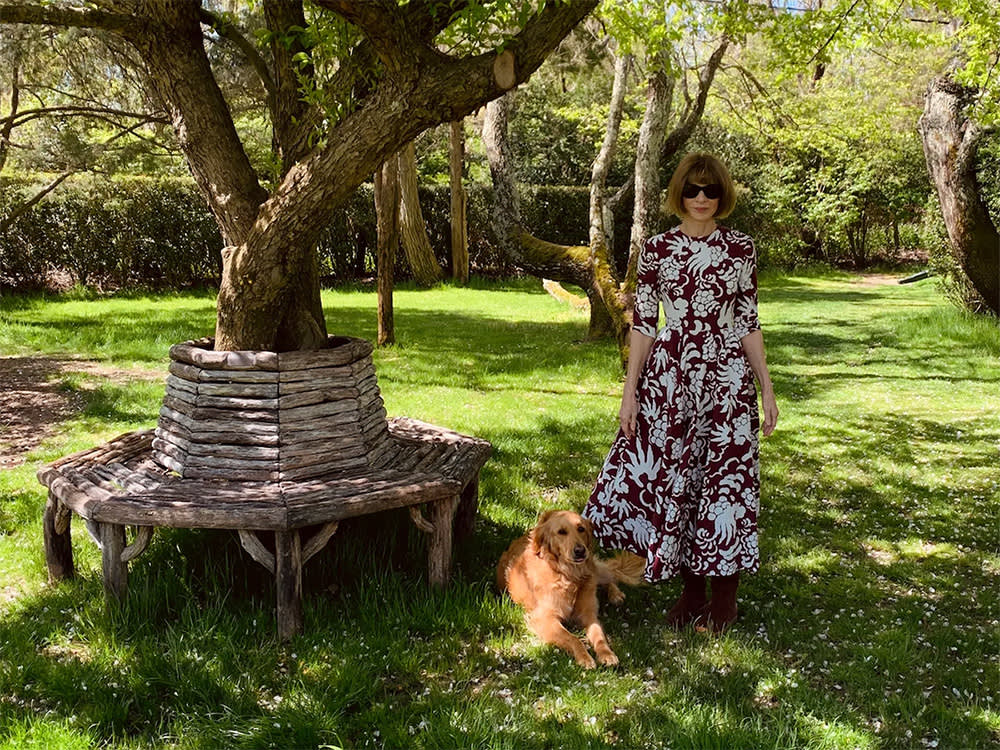
Anna Wintour has built a half-century career on control. She has run Vogue since 1988 and served as Condé Nast’s global chief content officer since 2020, and she is, by most measures, the single most powerful woman in American fashion, an industry that bends to her preferences. The public image is all precision: the bob, the sunglasses, the famously glacial composure that Meryl Streep mined for an Oscar-nominated performance in The Devil Wears Prada. So the most revealing detail in Amy Odell’s Anna: The Biography, an exhaustively reported deep dive into the tastemaker, is not about fashion at all. It is that the one corner of her life she does not appear to control, or want to, is her dogs.
That contradiction is the portrait. A woman who orchestrates everything chose the least orchestratable breed imaginable, and surrenders to it gladly.
The most controlled woman, the least controllable breed
Wintour’s dogs are all Goldendoodles, and Odell found that genuinely surprising, because the breed is the opposite of the woman. “Anna Wintour is someone who’s known for being cold in probably the majority of her human-human interactions at work,” Odell told us. “And a Goldendoodle, to me, is like a big, boisterous, blonde, vivacious, upbeat sort of breed. So I thought it was fascinating that this woman who is so reserved, so controlled, has this big, boisterous, happy breed of dog.” It is a deliberate-seeming mismatch, the buttoned-up icon picking the floppy, exuberant, impossible-to-keep-composed dog. The most plausible reading is the simplest: the dogs supply the joy and looseness the public Wintour never shows. As Odell put it, “Something joyful in her life. Absolutely.”
The literary streak adds another layer. All of Wintour’s dogs, Odell learned, are named for characters in To Kill a Mockingbird, a detail that fits a woman who, by every account, reads voraciously and fast, especially on vacation. The dogs are not accessories; they are named with the care of someone for whom they clearly mean something.
The 2 a.m. tell
If you want the single fact that detonates the ice-queen myth, it is this. According to Anne McNally, one of Wintour’s close friends, Anna got a third puppy not long ago, and when the puppy cries in the night, “Anna picks them up at two o’clock in the morning and takes care of them.” Whatever you imagine the most powerful woman in fashion doing at 2 a.m., it probably is not soothing a crying puppy by hand. But that is the woman the people closest to her describe.
Yes, she has help, an entire apparatus of assistants, with one whose responsibilities specifically include the dogs. Odell devotes a chapter to those assistants and is careful to note they are personal assistants, helping Wintour function as the executive she is, rather than aspiring editors gaining Vogue experience. (There is a telling anecdote about a dog going missing on her sprawling Old Mastic, New York estate; lost-dog flyers were printed, but the dogs turned up before anyone had to hand them out.) The point is not that Wintour scoops every bag herself. It is that, by the accounts of people who know her, she does the 2 a.m. part, the part no assistant can do for you, the part that is about love rather than logistics.
Why the dogs, specifically
Odell offers a theory for why this particular relationship works for a person like Wintour, and it is quietly poignant. A lot of people find Wintour intimidating, “when she walks the halls of Condé Nast, people press themselves against the walls,” but several sources told Odell she responds best to people who do not treat her like an icon, who “just walk into her office and ask her a question like she’s any other person.” Dogs do that by default. They have no idea who she is or what she does. They only know she loves them, and they love her back without the deference, fear, or angling that follows her everywhere else.
It tracks with how she arranges her life. She got her first dog when she moved into a West Village townhouse in the 1990s, partly for her children. The house is unusual for Manhattan: a private garden out back opening onto a courtyard, rare outdoor space for a city dog. She has said she likes her home environment serene because her work is so relentlessly visual. The dogs fit a life deliberately kept calm and unimpressed by her, a refuge from a world that is neither.
The quiet values shift the dogs sit alongside
The biography catches one more reversal that rhymes with the dog story: Wintour has stopped wearing real fur. She was once synonymous with it, a frequent target of PETA, and for years she dug in. But over the past several years, as the major fashion houses swore off fur and switched to faux, she quietly followed, no press release, no public stance. Odell notes that Wintour’s fur collection was being sold off with some proceeds donated, and that the shift in fashion has been dramatic: “It used to be that you could count on one hand the designers that didn’t use fur and now you can count on one hand the designers who are.”
It is worth not overstating this. Giving up fur is not the same as devotion to a pet, and Odell frames it as much as an industry shift as a personal conversion. But placed next to the dogs, it sketches a more complicated animal politics than the icon’s reputation allows, a woman who, late and without fanfare, moved away from the most conspicuous use of animals in her field, and who gets up in the dark for a puppy when no one is watching.
That is the real find in Anna: The Biography. Not that Wintour has a soft spot, everyone has one. It is that her soft spot is the precise inverse of her public self: chaos where she usually demands order, surrender where she usually demands control, and a pair of bounding, indifferent Goldendoodles who could not care less that she runs fashion. Anna: The Biography is available now on Amazon and wherever books are sold.
Nina Vasquez writes about life at home with pets and the relationships at the heart of it. Her work covers day-to-day living, people-and-pet stories, and the products that fit into a real household, with a warm, grounded take on everyday pet ownership.
Meet our experts ↗Keep reading
 LivingThe Kelces Lost Two Wolfhounds in Two Years. That's the Deal With Giant Dogs.Sasha Ford · 6 min
 LivingThe Dog You Didn't Choose: How Titan Adopted Arabelle SicardiLeila Torres · 8 min
 TrainingYour Dog Isn't Reading Your Face. They're Reading Your Hand on the Leash.Dr. Lena Park · 8 min
 LivingThe Co-Working Shakeout Had a Survival Trait: Letting the Dog InJames Okafor · 6 min
 LivingA Dog Was Surrendered for Being 'Gay.' The Couple Who Adopted Him Had Heard That One Before.James Okafor · 4 min
 LivingWhy Kids Read Better to a Dog Than to YouClaire Sutton · 5 min