


The Kelces Lost Two Wolfhounds in Two Years. That's the Deal With Giant Dogs.
Baloo was seven. Winnie died a year earlier. Nobody did anything wrong, and that's the hard part: an Irish Wolfhound's whole life is about as long as a Labrador's adolescence, and the people who love them sign up knowing it.

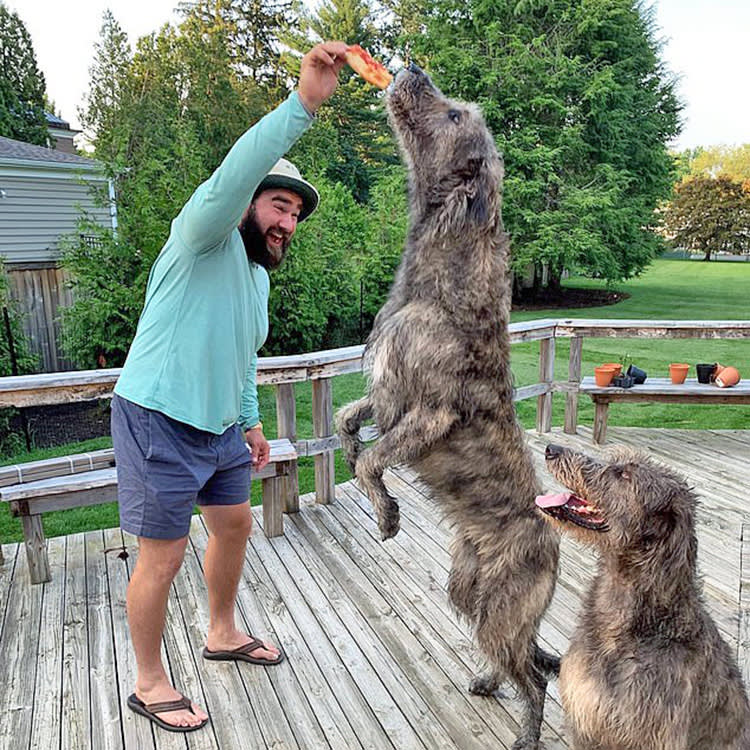
On Saturday, March 22, 2025, Kylie Kelce posted that the family’s Irish Wolfhound, Baloo, had died. He was seven years old.
“We were lucky enough to have 7 years with the goofiest, sweetest, most lovable, and tolerant dog I’ve ever met,” she wrote on Instagram. “He wanted nothing more than carbs and pets. He was a simple guy, held together by bubble gum and paper clips.”
It was the second time in almost exactly a year. Winnie, the family’s other Irish Wolfhound, adopted in 2017, had died in March 2024. Baloo joined the family in April 2018.
Two enormous dogs, two funerals, twelve months apart. And here is the thing that gets lost in a celebrity pet-death story: nothing went wrong. That is roughly how this goes.
Seven is not a tragedy for a Wolfhound. It’s a life.
If your reference point for a dog is a Labrador or a terrier, seven years old sounds like the middle. A seven-year-old Lab is a dog with a lot of road left.
For an Irish Wolfhound, seven is not the middle. It is around the whole thing. Giant breeds live dramatically shorter lives than small ones, and the Wolfhound sits at the far end of even that distribution. Owners of the breed talk about it openly and constantly, because you cannot love one without doing the arithmetic.
The inverse relationship between size and lifespan is one of the strangest facts in dog biology. Across species, bigger animals generally live longer: an elephant outlives a mouse by decades. Within dogs, the rule flips hard. A Chihuahua can reach sixteen. A Great Dane is doing well to see eight.
The leading explanation is that large dogs are on an accelerated schedule of growth, and growth has a cost. Giant-breed puppies put on mass at a rate that would be pathological in a smaller animal, and that speed appears to come bundled with faster cellular aging and a markedly higher cancer risk. They age faster because they were built faster.
Which means the Kelces did not get unlucky twice. They got a Wolfhound’s life, twice.
Why people do it anyway
The obvious question is why anyone signs up for a dog whose life is that short. Two decades of Wolfhound owners have a consistent answer, and it is not resignation.
Kylie has loved the breed since she was young. In high school, she kept a folder on her desktop labeled “Gods gift to earth” filled with photos of them. That is not a person who stumbled into a giant dog. That is somebody who chose one with both eyes open.
And the choice makes a kind of sense once you have been around them. Wolfhounds are famously gentle, famously tolerant, and famously absurd, an animal the size of a small pony with the emotional register of a golden retriever. Fans of the Kelces’ podcast might remember Baloo galloping across the screen mid-conversation, prompting Travis Kelce to exclaim, “Goddamn, what the f— is that?” before recognizing him and telling Jason to give him a pat.
That is the correct reaction to a Wolfhound entering a room. They are ridiculous, and they know it, and they lean on you like furniture.
Seven years of that, the argument goes, beats fourteen years of almost anything else.
The part that actually helps the kids
The most quietly useful thing in Kylie’s post was not about Baloo at all.
She shared what happened when she told her daughter Ellie that Baloo was going to die. “Ellie asked where he was going,” she wrote. “I told her that he was going to heaven and without skipping a beat she replied, ‘Oh! He’ll get to be with Winnie again! They’ll be so happy to see each other!’”
There is a lesson buried there that grief counselors have been making for years, and it is not the one about heaven. It is that the child was told, in advance, in plain words, and given room to respond. She did not come home to a missing dog and a vague story. She was handed the truth at a size she could hold, and she did what children reliably do when you trust them with it: she found her own way through.
The Kelces also did something else worth noticing, which is that they grieved in public, loudly, without apologizing for the scale of it. Pet grief is routinely dismissed as disproportionate, and people carry it privately as a result. Two adults with millions of followers saying plainly that this hurts, and that it hurts a lot, is not a small thing for everyone reading it who has been told to get over a dog.
The families who do best are almost never the ones who protected everybody from the news. They’re the ones who said the true thing out loud, early, and then let each person, including the seven-year-old, have whatever reaction they were going to have.
If you love a giant breed
The short life is not entirely fixed. Some of it is, and some of it is on you.
Grow them slowly. This is the single biggest lever, and it runs against instinct. Giant-breed puppies should be raised on a large-breed puppy food formulated for controlled growth, and they should not be overfed. Pushing a Wolfhound or a Dane puppy to grow fast is directly implicated in developmental orthopedic disease, and it is one of the few things owners control.
Keep them lean, forever. Extra weight on a frame that big is a mechanical problem as well as a metabolic one.
Screen the heart. Dilated cardiomyopathy is a major killer in Wolfhounds specifically, and it is one of the conditions where finding it early genuinely changes the story. Breed-specific cardiac screening is not paranoia.
Know about bloat before it happens. Gastric dilatation-volvulus is a deep-chested-dog emergency measured in hours, and preventive gastropexy is a conversation worth having with your vet at the time of spay or neuter. Learn the signs now, not at midnight.
Take the lumps seriously. Osteosarcoma and other cancers are far more common in giant breeds, and early is the only advantage you get.
None of that buys you a sixteen-year Wolfhound. There is no such thing. It buys you a better seven or eight, and it means that when it ends, it ends because of what he was and not because of something you missed.
What we know now
The size-lifespan relationship has firmed up considerably in the last decade of research. Large-breed dogs die younger, they die disproportionately of cancer, and the effect tracks with growth rate rather than adult size alone, which is why the “grow them slowly” advice has moved from folklore to something closer to consensus.
Work on canine aging has also started asking whether any of this is modifiable, with large longitudinal projects now tracking tens of thousands of dogs to understand what actually predicts a long, healthy life. Body condition keeps coming out near the top. Lean dogs live longer, and that finding is remarkably robust across breeds and sizes.
But there is no intervention on the horizon that turns a Wolfhound into a Jack Russell, and the people who love them are not waiting for one.
Baloo was seven. He wanted carbs and pets, and by the sound of it he got both. Held together by bubble gum and paper clips, which is about the most affectionate thing anyone has ever said about a dog.
References
- Kelce, K. Instagram tribute post, March 22, 2025.
- Kraus, C., Pavard, S., Promislow, D.E.L. “The size–life span trade-off decomposed: why large dogs die young.” The American Naturalist, vol. 181, no. 4, 2013, pp. 492–505.
- Fleming, J.M., Creevy, K.E., Promislow, D.E.L. “Mortality in North American Dogs from 1984 to 2004: An Investigation into Age-, Size-, and Breed-Related Causes of Death.” Journal of Veterinary Internal Medicine, vol. 25, no. 2, 2011, pp. 187–198.
- Vollset, I., et al. “Dilated cardiomyopathy in Irish Wolfhounds: screening and heritability.” Journal of Veterinary Cardiology.
- Salt, C., Morris, P.J., Wilson, D., Lund, E.M., German, A.J. “Association between life span and body condition in neutered client-owned dogs.” Journal of Veterinary Internal Medicine, vol. 33, no. 1, 2019, pp. 89–99.
- American College of Veterinary Surgeons. “Gastric Dilatation-Volvulus.” ACVS Animal Owners resources.
Sasha Ford is a certified cat behaviour consultant who has worked with shelters, catteries, and private clients across the country. They review all feline behaviour content at The Pet Times, with expertise in multi-cat households, indoor enrichment, and stress-related disorders.
Meet our experts ↗Keep reading
 Health & WellnessThe 'Beards Are Dirtier Than Dogs' Study Says No Such ThingDr. Priya Nair · 6 min
 LivingTraining Service Dogs Slowed These Veterans' Aging. At the Cellular Level.Dr. Nina Kohl · 4 min
 LivingPetting a Dog Lights Up Your Social Brain, and the Glow Doesn't Fade When They LeaveDr. Lena Park · 5 min
 LivingA 'Luxury' Dog Boarding Chain Just Paid $150K to Settle Neglect ClaimsNina Vasquez · 4 min
 Health & WellnessMoney Doesn't Keep Your Dog Healthy. Company Does.Dr. Mara Chen · 6 min
 LivingShe Came Home to a Box of Ashes. Her Sitter Had 118 Five-Star Reviews.Nina Vasquez · 6 min