


Training Service Dogs Slowed These Veterans' Aging. At the Cellular Level.
A study of female veterans with PTSD found that training a service dog lengthened their telomeres, a biological marker of aging. The twist: it wasn't owning a dog that helped, it was the work of training one.
You have probably heard that a dog is good for your head. Here is a stranger claim, and there is now data behind it: a dog may be good for your chromosomes.
A team led by researchers at Florida Atlantic University, working with the University of Maryland School of Nursing, the Medical College of Georgia, and the nonprofit Warrior Canine Connection, followed a group of female veterans living with post-traumatic stress disorder. They were not measuring mood or sleep, or at least not only those things. They were measuring telomeres, and what they found is worth slowing down for.
What a telomere actually is
Picture the plastic tip on the end of a shoelace. Telomeres are the biological version of that tip, a stretch of repeated DNA capping the ends of your chromosomes and keeping the genetic material inside from fraying. Every time a cell divides, the cap gets a little shorter. Chronic stress speeds that shortening up. Because of that, telomere length has become one of the clearest readable markers scientists have for biological aging, the wear-and-tear kind that shows up eventually as thinning skin, lower resilience, and disease risk, rather than the number on a birthday card.
So when a study reports that something lengthened participants’ telomeres, it is reporting something close to the opposite of what stress normally does to a body.
The finding, and the part everyone skips
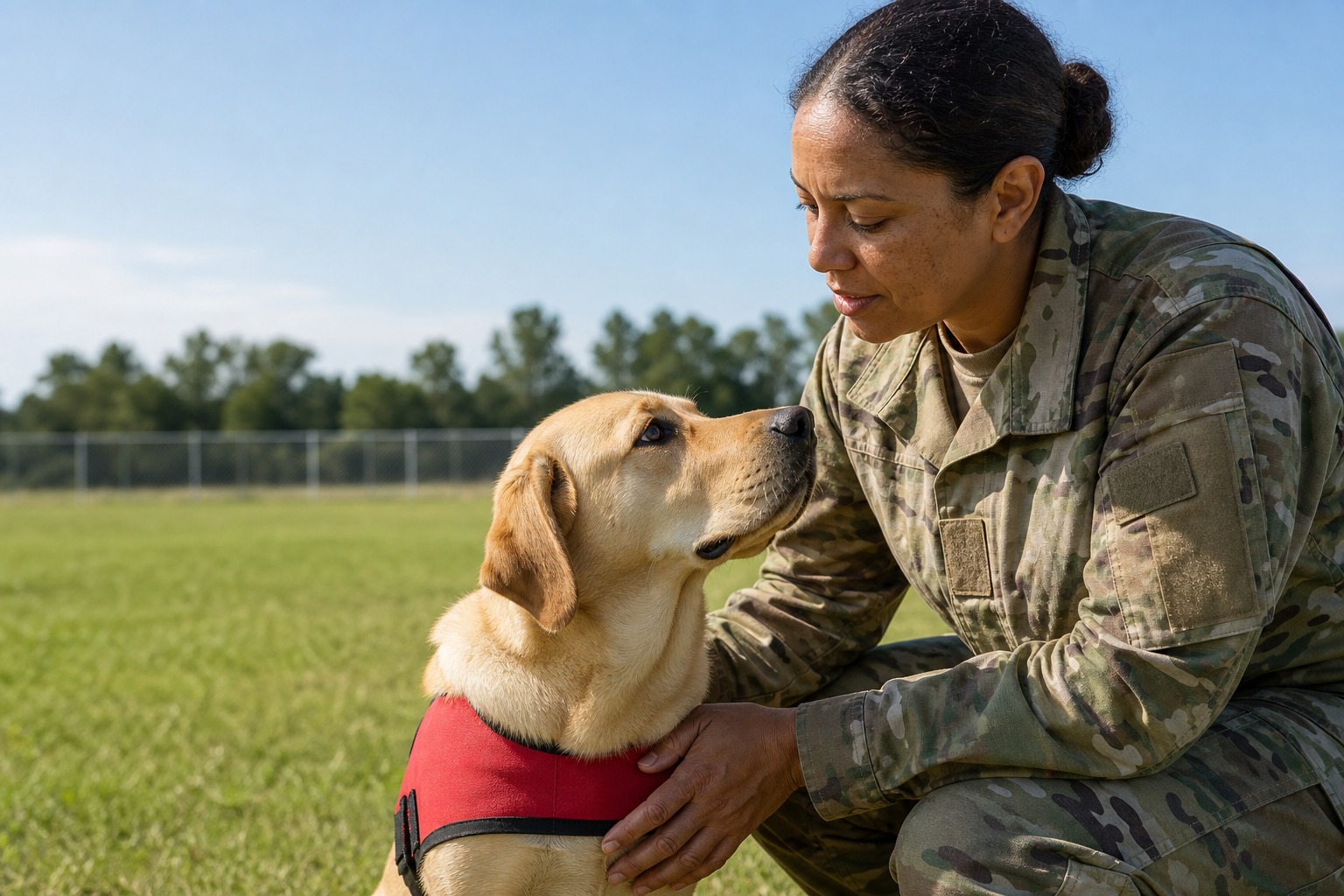
Twenty-eight female veterans took part, ranging in age from their early thirties to their early seventies, all carrying a PTSD diagnosis. Thirteen of them spent an hour a week for eight weeks actively training service dogs through Warrior Canine Connection’s program in Maryland. The other fifteen served as a comparison group and watched training videos instead of handling any animals.
By the end, the veterans who had been hands-on with the dogs showed longer telomeres. The comparison group’s telomeres had gone the other way, shortening over the same window. The strongest gains of all turned up in the veterans who had combat exposure, the people you might expect to be the hardest to move.
Here is the detail that the “dogs make you look younger” framing tends to bury. Both groups felt better psychologically. Perceived stress, anxiety, and PTSD symptom severity eased for the video group and the training group alike, which the researchers chalk up to the structure and attention that any well-run program provides. The biological change, the telomere lengthening, showed up only in the veterans who did the training. In other words, feeling supported helped everyone. Rebuilding the body’s stress biology took the doing.
That is the real headline. It was not proximity to a dog, and it was not ownership. It was the purposeful, repetitive, other-focused work of teaching one.
Why it landed hardest for women
The study deliberately centered female veterans, and that choice fills a real gap. Women have served in the military for generations, yet most PTSD research has been built around men. Female veterans report PTSD at high rates and remain comparatively understudied, so a trial designed around their physiology and their stress responses is not a footnote. It is overdue.
What this means if you are not a veteran
The most useful takeaway is also the most portable one. If the active ingredient is purposeful work with an animal rather than owning the animal, then the benefit is available to people who cannot take a dog home. Not everyone has the space, the schedule, or the stability to be a service-dog handler or a full-time pet parent. Volunteering at a shelter, fostering on a set timeline, or joining a training or socialization program may tap the same mechanism, the mix of routine, gentle physical activity, and being needed by another creature, without the weight of sole ownership.
What moved these women’s biology wasn’t being near a dog, it was having a job to do with one, week after week. That reframes the whole thing. You don’t have to adopt to get the payoff. You have to show up for something that depends on you.
What newer research adds
Two honest caveats keep this in proportion. First, the trial was small, twenty-eight people, which the authors are the first to flag. It points a direction; it does not settle the science, and larger studies are needed before anyone promises telomeres on demand. Second, the training here was not casual play. It ran through Warrior Canine Connection, whose whole model is built on the idea that veterans training service dogs for other veterans creates a mission, and it is that mission, the structure and the sense of purpose, that appears to be doing the heavy lifting. The dog is the vehicle. The work is the medicine.
References
- Florida Atlantic University Newsdesk, “Study: ‘Man’s Best Friend’ Slows Cellular Aging in Female Veterans”
- Warrior Canine Connection et al., “Veterans Training Service Dogs for Other Veterans: An Animal-Assisted Intervention for Post-Traumatic Stress Disorder” (PMC)
- Warrior Canine Connection, program overview
Dr. Kohl is a board-certified veterinary dentist with a particular interest in preventive oral care. She reviews all dental health content at The Pet Times and contributes practical guides on home dental routines, professional cleaning, and oral disease prevention.
Meet our experts ↗Keep reading
 Health & WellnessMoney Doesn't Keep Your Dog Healthy. Company Does.Dr. Mara Chen · 6 min
 LivingPetting a Dog Lights Up Your Social Brain, and the Glow Doesn't Fade When They LeaveDr. Lena Park · 5 min
 LivingA Disabled Girl's Service Dog Got Her Family Kicked Off a Flight. The Culprit Was One Checkbox.James Okafor · 4 min
 LivingA Dog Costs More Than a Used Car. Where You Live Swings It by $10,000.Marcus Webb · 7 min
 Health & WellnessThe 'Beards Are Dirtier Than Dogs' Study Says No Such ThingDr. Priya Nair · 6 min
 LivingService Dog or Emotional Support Animal for Anxiety? The Decision That Changes EverythingLeila Torres · 10 min