


You Love Your Dog Like a Primate. That's the Whole Problem
Almost everything dogs quietly dislike about us comes down to one thing: we show affection like the apes we are, and dogs aren't apes. Here's how to translate love into a language your dog actually speaks.
You and your dog understand each other on a hundred things. They know your stern look means “no chance,” you know those pleading eyes mean they want your dinner. And yet a surprising number of the affectionate things you do every day land badly with your dog, and there is one reason underneath nearly all of them.
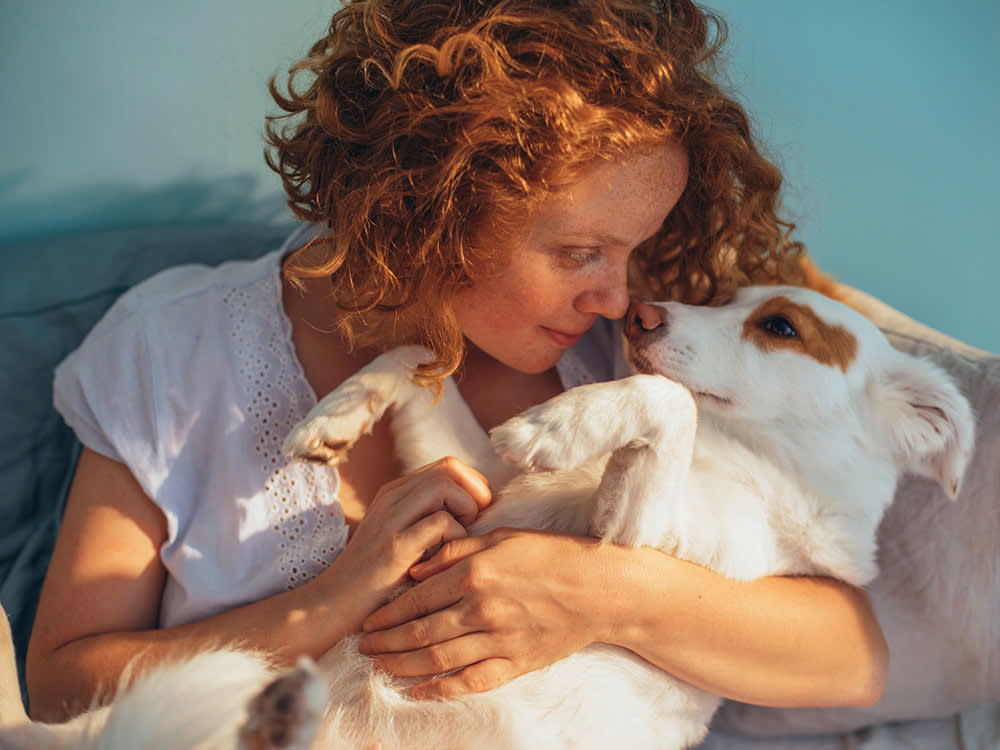
You are a primate, and you express love like one. Primates hug. We bring our faces close, we kiss, we wrap our arms around the people we adore, we reach out and touch. Dogs are not primates. They descend from animals that greet nose-to-rear, that find face-to-face closeness pushy rather than warm, and that read a hug as a restraint rather than an embrace. So when we pour primate affection onto a non-primate, a lot of it gets lost in translation, and some of it actively stresses the dog out.
The good news is that once you see the pattern, the fixes are easy, and they make your dog like being around you more, not less. Here is the primate problem, sorted into the three places it shows up.
The greeting mismatch
This is the biggest category, and it is all about faces and closeness.
Hugging. Every time a trainer points out that dogs do not necessarily enjoy hugs, the pushback is fierce, everyone is certain their dog is the exception. Most are not. Wrapping your arms around a dog’s neck and shoulders feels like love to you, but to a dog it often reads as being trapped. Watch a hugged dog closely and you will frequently see stress signals: tongue flicks, a tightly closed mouth, pulled-back ears, a furrowed brow, a stiff body. The dog is tolerating it, not savoring it.
Kissing. Humans pour love into kisses; to a dog, a kiss means essentially nothing, and bringing your face right up to theirs can read as a threat. Dogs lick each other and us, and we like to call it a “doggy kiss,” but it is a different behavior entirely. A dog being kissed will often try to slip away, lean back, yawn, flick their tongue, or wrinkle their nose, then scoot off the moment they are released. None of that means they do not love you. It means face-pressing is not how they say it.
Patting the head. Head pats are meant to say “I love you,” and most dogs do not love receiving them; many lean or step away to dodge the descending hand. What they generally do enjoy is being stroked smoothly along the head, ears, and the sides of the face. Same affection, dog-friendly delivery, and you will often get a lean-in for more instead of a dodge.
The restraint mismatch
The second category is about a dog’s deep dislike of being held in place.
Holding a paw, especially a back one, while they stand. Dogs who have been rewarded for shaking or high-fiving may be fine with brief paw contact while sitting. But grabbing a paw and hanging onto it is a different story. It can leave a dog feeling physically unstable, and it tends to call up associations with nail trims and muddy-paw wipe-downs, neither a favorite. Holding a back paw goes over especially poorly, because it threatens their balance most.
Hoarding the ball during fetch. This one looks like affection (you are playing together!) but functions like a tease. You pick up the ball and hold it while praising your dog; in your mind you are bonding, in your dog’s mind you are hoarding the one thing they want, and they want it back now. Plenty of dogs lose interest in fetch, or never learn how fun it can be, precisely because of this human habit. What they want is for you to throw it the instant they drop it near you. Simple in theory, weirdly hard in practice.
The sensory mismatch
The last category is about imposing our preferences on a very different nose and body.
Citrus-scented everything. Most dogs cannot stand the smell of citrus, lemon, grapefruit, tangerine, which is exactly why those scents show up in anti-chew deterrents. Since the smell genuinely repels them, it is kind to skip citrus-heavy lotions, shampoos, candles, and air fresheners around a dog. (A small minority do not mind it. To find out where yours stands, peel an orange until your hands are sticky and offer them; a turn of the head is your answer.)
Dressing them up. The delight people take in costuming their dogs is often in direct conflict with how the dogs feel about it. Yes, they look adorable. No, very few enjoy being stuffed into clothes, and many tense up, with body language that makes the discomfort plain. Bulky, constricting costumes are genuinely miserable for a lot of dogs. With patient conditioning some learn to tolerate clothing, and if you must dress them, reach for the lightest, least restrictive option, but given a vote, most dogs would skip it. Apologies to your Halloween plans.
The fix: learn the consent test
Here is the tool that ties all of this together, and the thing the standard “stuff dogs hate” list never gives you. Almost every problem above disappears if you let the dog opt in, using a simple consent test that dogs respond to clearly:
- Pet for about three seconds, in a dog-friendly spot (chest, shoulder, base of the neck, not the top of the head), then stop and take your hands away.
- Watch what the dog does. A dog who wants more will move back into you, nudge your hand, lean in, or paw for it. That is a yes, carry on.
- A dog who’s had enough will turn away, move off, go still, lick their lips, or simply not re-engage. That is a no, and the respectful move is to stop.
Run that test instead of assuming, and you let your dog steer the affection. The payoff is real: dogs who get a say in being touched seek out their people more, not less, because closeness stops being something that happens to them.
“The single biggest upgrade most owners can make is to ask the dog rather than tell them,” says Dr. Mara Chen, a veterinary behaviorist. “Pet, pause, and read the answer. When a dog learns that you’ll always stop when they ask, they relax into contact in a way they never do when affection is something they have to endure.”
None of this means loving your dog less. It means loving them in their language instead of yours, which is the whole point of sharing your life with a creature this different, and this wonderful.
References
- Kuhne, F. et al., “Behavioral and cardiac responses by dogs to physical human-dog contact,” Journal of Veterinary Behavior (2014)
- Fear Free Pets, guidance on canine consent and handling
Jordan Ellis is a certified professional dog trainer with a decade of experience working with rescue organisations and private clients. They specialise in anxiety, reactivity, and positive reinforcement methods, and review all training and behaviour content at The Pet Times.
Meet our experts ↗Keep reading
 LivingShelter Temperament Tests Are Barely Better Than a Coin Flip. Good Dogs Die for It.Dr. Ravi Mehta · 7 min
 TrainingStop Telling Yourself Your Dog Was AbusedDr. Nina Kohl · 8 min
 Health & WellnessA Quiet Dog Is Fine. A Newly Quiet Dog Is a Symptom.Dr. Ravi Mehta · 7 min
 TrainingYour Grumpy Dog Might Be the Sharpest One at the ParkSasha Ford · 5 min
 TrainingThat Friendly On-Leash Hello Is Teaching Your Dog to Melt DownDr. Amara Solis · 6 min
 LivingTwo Years, Two Best in Show Winners, Two Sets of Cut-Off Ears. That's Not a Coincidence.Dr. Ravi Mehta · 11 min