


First Grass, Then a Record $35 Million: What Became of the 4,000 Envigo Beagles
Thousands of beagles pulled from the Envigo breeding site had never touched grass. The rescue ended in the largest Animal Welfare Act fine in U.S. history. Here's the full arc, and how to help.

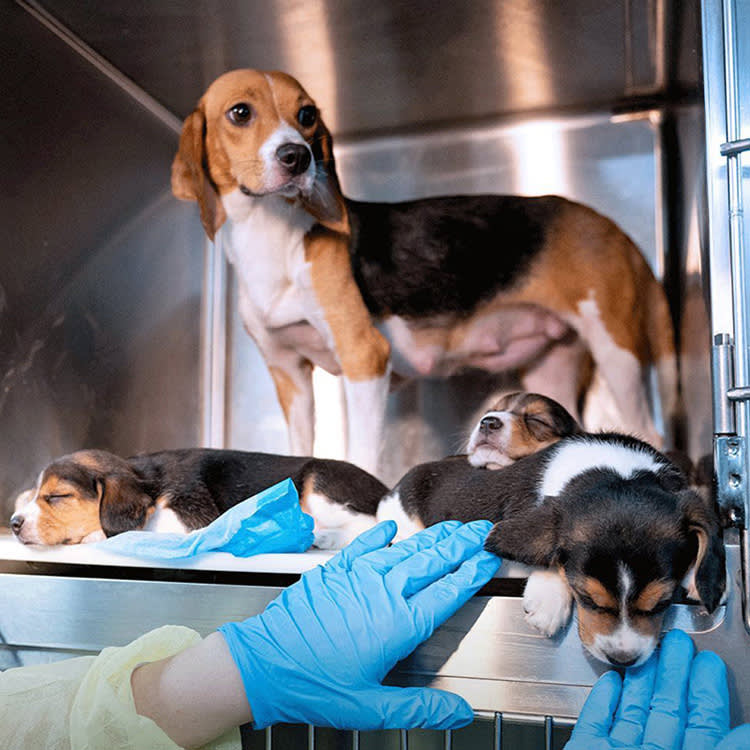
Two beagles, Caleb and Armando, stand on a concrete slab at the edge of a garage, staring at a lawn. The grass is right there, green and warm in the sun, and it smells like nothing they have ever encountered. They look at the yard, then at each other, then back at the yard. Finally one of them lifts a paw and sets it down on the grass. It is the first time either dog has touched it.
That single hesitant step is the emotional center of the Envigo story, and for a long time it was where the story stopped: thousands of dogs learning, in their first weeks of freedom, what grass and bowls and birdsong even are. But the story did not stop there. It ended in a federal courtroom, with the largest fine in the history of American animal-welfare law. To understand why those beagles’ firsts mattered so much, you have to follow the whole arc, from a Virginia kennel to a record-setting reckoning.
What the beagles were rescued from
Caleb and Armando were among roughly 4,000 beagles removed in 2022 from the Envigo breeding site in Cumberland, Virginia, by the Humane Society of the United States (HSUS), following an investigation by the U.S. Department of Agriculture. The dogs were bred to be sold to research and testing facilities, and the conditions they were bred in were, by the government’s own account, brutal.
“The Department of Agriculture has alleged some pretty significant Animal Welfare Act violations,” Lindsay Hamrick, director of shelter outreach and engagement at HSUS, told The Pet Times. “They noted things like 25 puppies who died of cold exposure at the facility in the past, maggots that were in dog food, and animals with medical conditions that should have received treatment but did not.”
The dogs lived in large kennels with concrete floors they relieved themselves on, and ate from communal troughs. No quiet, no beds, no personal space, no toys. Each dog wore a tattooed ID number in its ear; for most, that number was the only name they had ever had.
The bitter irony, Hamrick notes, is that the same trait that made these dogs targets is the trait that makes them wonderful pets. “The same reason that so many people are interested in helping to give these beagles a home is the reason that companies like Envigo use them,” she said. “They’re generally very social and unlikely to bite the people performing these horrible tests on them.”
The first weeks of being a dog
After a federal judge approved a removal plan, HSUS coordinated a 60-day operation, routing the dogs through a national network of rescue organizations where they were spayed, neutered, and screened for health problems before adoption. By mid-August of 2022, roughly half the dogs were out.
Caleb and Armando landed with the Virginia Coalition for Beagle Protection and, from there, in the Norfolk backyard of foster mom and PETA employee Cindy Kent, where the firsts came fast.
“Everything is brand new. Eating from a bowl was brand new,” Kent said. “While the average puppy born into the world is used to sounds like a lawn mower or car, or coming home and turning on the television, it’s brand new for these pups.” She remembers the two dogs ducking in the yard the first time birds flew overhead, unable to judge how far away they were. She remembers their first time on leashes, before they were anywhere near ready for walks.
Caleb was adopted within weeks, so Kent took in another foster, Roxy. Armando, still with her, had a harder adjustment, barking through the night, unsure of every unfamiliar sound.
Three thousand miles away, in Chino Hills, California, foster Tricia Rossman deliberately requested one of the oldest dogs in the group. “I strategically wanted the oldest one because I figured she’s been in that facility for the longest,” she said of Goldie, a six-year-old beagle. “She was just kind of sitting there politely wagging her tail and definitely uncertain what’s going on, but you could tell that she wanted to be loved.” Simple acts, setting Goldie on the grass, easing her onto a couch, frightened the dog at first. A covered crate for a safe spot and gentle exposure to household noise helped.
“One of the things that she did, which I thought was just the sweetest thing, is she would eat her kibble laying down,” Rossman said. “I bet she’d never had that privilege in the past.”
The reckoning: a record $35 million
This is the part that came after the original headlines, and it changes the ending.
In June 2024, the U.S. Department of Justice announced that Inotiv, Envigo’s parent company, would pay more than $35 million, the largest fine in the history of the federal Animal Welfare Act. Envigo RMS pleaded guilty to conspiracy to violate the Animal Welfare Act and to violating the Clean Water Act. The settlement included an $11 million criminal penalty tied directly to the Animal Welfare Act violations, plus funds toward remediation and animal-welfare improvements. As part of the resolution, the company is barred from breeding dogs and serves a multi-year probationary period.
That outcome corrects an early, grimmer version of this story. When the facility first closed in 2022, the company settled without paying fines, and advocates feared that would be the end of the accountability. It was not. The criminal case took two more years, and it ended with the heaviest penalty the law allows.
The legal groundwork had been building for years. Virginia state senator Bill Stanley said efforts to close Envigo began long before the 2022 rescue: “I tried to shut them down in 2019 but was not successful. But over the years, we never stopped fighting.” And in April 2022, Governor Glenn Youngkin signed a package of five “beagle bills” strengthening protections for dogs bred and held at commercial and research facilities in the state.
Where they are now
The dogs found homes, and fast. After the rescue made national news, HSUS and its partners were flooded with thousands of foster and adoption applications, and the 4,000 beagles were placed across the country. Some landed in famously high-profile homes, but most simply became somebody’s couch dog, which was always the point.
“It’s always so surprising when animals are pulled from a situation that is really horrifying and are still capable of being social with people,” Hamrick said. “Many of these dogs are timid because they’ve been living in a kennel their entire lives. They have no sense or socialization of the world around them.” That so many opened up anyway is the quiet miracle running underneath this whole story.
How to help now
The 4,000 Envigo beagles have homes. But the conditions that produced them have not vanished, and shelters everywhere still hold dogs waiting for their first patch of grass. If this story moved you, the most durable way to honor it is to support the rescue network that absorbed those 4,000 dogs, through HSUS’s partner shelters or your own local rescue, and to back legislation, like Virginia’s beagle bills, that targets the breeding pipeline rather than just cleaning up after it.
References
- U.S. Department of Justice, “Justice Department Secures Surrender of Over 4,000 Beagles From Virginia Breeder of Dogs for Research”
- Humane World for Animals (HSUS), “Inotiv to pay historic $35 million in case involving thousands of beagles”
- NPR, “A beleaguered breeder faces a record $35 million fine for mistreating its beagles”
- The New York Times, “4,000 Beagles Need Homes After Rescue From a Virginia Facility”
Leila Torres leads our Living coverage, from home life and travel to the products and rescue stories that come with sharing a life with animals. She edits and writes across the section, with a soft spot for pieces about the bond between people and their pets.
Meet our experts ↗Keep reading
 LivingHe Ran the Pentagon's Networks and a Dogfighting Ring. He Got 18 Months.Marcus Webb · 7 min
 LivingThe "World's Ugliest Dog" Winners Aren't Ugly. They're Evidence.Jordan Ellis · 7 min
 LivingThe Puppy Bowl XX Lineup, Sorted Into Taylor Swift ErasTom Hadley · 6 min
 Product PicksSenior Dogs Don't Have a Pity Problem. They Have a Visibility Problem.Nina Vasquez · 7 min
 LivingThe Rescue-Chihuahua Coincidence That Built a Cult Leash BrandMarcus Webb · 5 min
 Health & WellnessYou Can't Know a Rescue Dog's Age. Here's How Close You Can Get.Dr. Nina Kohl · 8 min