


Your Dog Isn't Staring at Nothing. You're Just Missing Their World
The concept of 'umwelt' says every animal lives in its own sensory reality. Understanding your dog's, ruled by the nose, dissolves half of what looks like misbehavior.

Affiliate disclosure. This article contains affiliate links. We may earn a small commission if you buy through a link, at no extra cost to you. How we handle recommendations.
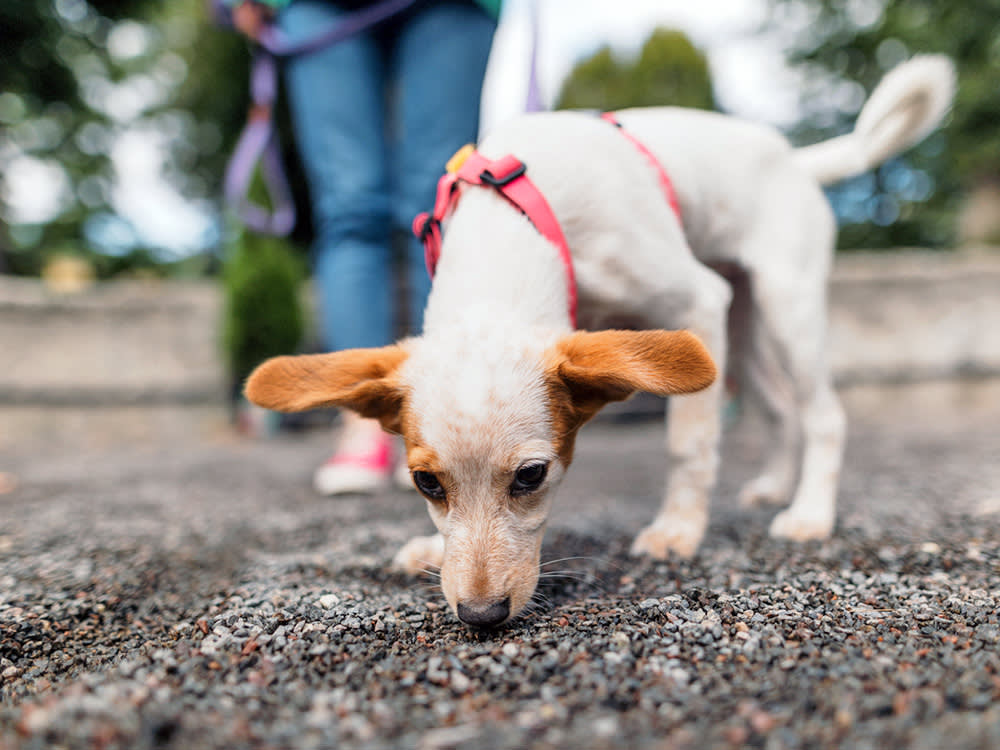
Your dog freezes on a walk to inhale a single unremarkable patch of grass for a full minute. They bark at a doorway where you see absolutely nothing. They stare, intently, at a stretch of empty air. It is tempting to file all of this under “dogs are weird.” The more accurate explanation is that your dog is living in a different world than you are, and mostly doing a good job of it.
There is a word for this: umwelt (say it “oom-velt”). Coined more than a century ago by biologist Jakob von Uexküll, it names the idea that every animal inhabits its own perceptual bubble, built entirely from the signals its particular senses can pick up. Set a person, a honeybee, and a dog down in the same meadow and none of them are really standing in the same meadow. Each one navigates a private version of it, assembled from wildly different information. Once you understand your dog’s version, a lot of their behavior stops looking strange and starts looking sensible.
A world built by the nose
For us, the world arrives mostly through our eyes. Open them and everything is just there, laid out at once. A dog’s world arrives mostly through the nose, and smell does not work like sight. Odors are not passively received; they have to be actively sampled, which is exactly why your dog sniffs, and moves, and sniffs again, physically working their way toward a scent to build a picture of it. That patch of grass is not boring. It is a dense, layered record of who passed by, when, and in what state, and your dog is reading it the way you would read a bulletin board.
Smell gives dogs information we simply cannot access, both in the present and stretching backward in time. It is how they identify individuals, make decisions, learn, detect drugs and disease, and even register shifts in our own mood. When your dog seems obsessed with an invisible nothing, they are almost never staring at nothing. They are perceiving something you were never equipped to notice.
Seeing differently, not seeing worse
Vision still matters to dogs; it just works on different settings. Dogs see the world in two-color (dichromatic) vision rather than our three, so their palette is more limited, weighted toward blues and yellows. They are also more nearsighted than we are. But it is not all deficits. Dogs refresh what they see faster than we do, a higher flicker-fusion rate, which sharpens their read on quick motion and lets them clock a change a beat before our own eyes catch up. That is part of why your dog sometimes reacts to a person or a passing car before you register it at all. They are not psychic. Their eyes are just running at a higher frame rate.
The rest of the picture
Where we lean on spoken language, dogs lean heavily on body language, both reading it and broadcasting it. Ear position, the set of the eyes, the angle of a spine and tail, weight shifts, all of it carries meaning. To a dog, your posture and movement often say more than your words, which is why a dog will sometimes trust what your body is doing over what your mouth is saying. And none of these senses operates in isolation; smell, sight, hearing, and social experience all braid together, shaped further by how a dog was raised and what their individual mind is like. The umwelt is the whole weave, not any single thread.
Why this changes how you live with your dog
Here is the practical payoff. Most of the friction between dogs and their humans comes from expecting a dog to share our world, when they are living in theirs. To us, the couch is for sitting and a shoe is for wearing; the objects come pre-labeled with their purpose. To a dog, those labels do not exist. One spot smells like you, so it is worth investigating; another is soft and warm, so it is worth lying on. Behavior we read as “bad” is often just a dog acting reasonably inside their own reality.
Meet them there, and everyday life gets easier. A few ways to do it:
- Let the walk be a sniff walk. Instead of marching your dog around the block, build in time to amble and let them read the ground at their own pace. Sniffing is not a delay to the walk; for a dog, it often is the walk, and it is genuinely enriching.
- Give the nose a job. Scent games and nose work let a dog flex their strongest sense while burning real mental and physical energy. For a keen-nosed dog, formal nose-work classes and competitions exist, but a hidden-treat hunt in your living room counts too.
- Learn to read the body. Watch your dog across different situations until you can spot the subtle signals of stress, ease, and uncertainty. Remember it runs both ways: if your body language contradicts your words, you may be confusing or stressing your dog without meaning to.
- Take socialization seriously, early. A young dog’s brain is deciding what counts as normal versus threatening, and that early window shapes how they perceive the world for life. Thoughtful, positive exposure during puppyhood builds a dog who finds more of the world safe.
Half the ‘problem’ behaviors people describe to me aren’t problems at all. They’re a dog behaving logically inside a sensory world we can barely imagine. The moment you stop asking your dog to live in your world and start respecting theirs, you both relax.
If you want to go deeper on how dogs experience the world, the definitive popular starting point is cognitive scientist Alexandra Horowitz’s Inside of a Dog: What Dogs See, Smell, and Know, which is effectively a book-length tour of the canine umwelt.
What newer research adds
The science keeps making the case that a dog’s world is stranger and richer than we assumed. A 2022 neuroimaging study mapped surprisingly extensive connections between the smell-processing regions of a dog’s brain and the areas that handle vision, suggesting that for dogs, smelling and “seeing” are far more intertwined than they are for us, that a dog may, in a loose sense, partly see with their nose. And if you want the big-picture version, science writer Ed Yong’s 2022 book An Immense World takes the umwelt idea and runs it across the entire animal kingdom, from dogs to beetles to birds, and it will permanently change how you watch your pet move through a room.
References
- von Uexküll, J. (1934). A Foray into the Worlds of Animals and Humans. (Origin of the “umwelt” concept.)
- Horowitz, A. (2009). Inside of a Dog: What Dogs See, Smell, and Know. Scribner.
- Kokocińska-Kusiak, A., et al. (2021). “Canine Olfaction: Physiology, Behavior, and Possibilities for Practical Applications.” Animals, 11(8), 2463. https://doi.org/10.3390/ani11082463
- Andrews, E. F., et al. (2022). “Extensive connections of the canine olfactory pathway revealed by tractography and dissection.” Journal of Neuroscience, 42(33), 6392–6407. https://doi.org/10.1523/JNEUROSCI.2355-21.2022
- Yong, E. (2022). An Immense World: How Animal Senses Reveal the Hidden Realms Around Us. Random House.
Dr. Mehta is a board-certified veterinary nutritionist who evaluates pet food formulations, ingredient quality, and the science behind dietary trends. He writes and reviews all nutrition content at The Pet Times, including our food rankings and feeding guides.
Meet our experts ↗Keep reading
 TrainingThe One Thing Your Dog's Breed Is Quietly Begging You ForJordan Ellis · 7 min
 LivingYour Dog Isn't Pulling. You're on the Wrong Outing.Dr. Mara Chen · 7 min
 TrainingSkip the Doomscroll: 8 Dog Trainers Worth Following on InstagramDr. Mara Chen · 7 min
 TrainingA Therapy Dog Isn't a Service Dog. Here's Where They Do Their Best Work.Sasha Ford · 7 min
 TrainingFeeling Great? Then Your Dog Looks Miserable. That's You, Not Him.Dr. Amara Solis · 6 min
 TrainingYour Dog Picked the Foot of the Bed on Purpose. It's a Compromise.Dr. Ravi Mehta · 6 min