


Your Cat Can't Pick Your Face Out of a Lineup. It Doesn't Need To.
A classic study found dogs recognize their owner's face almost every time, and cats basically flip a coin. Before you take it personally, here's what your cat is using to know you instead, and it may be sharper than sight.

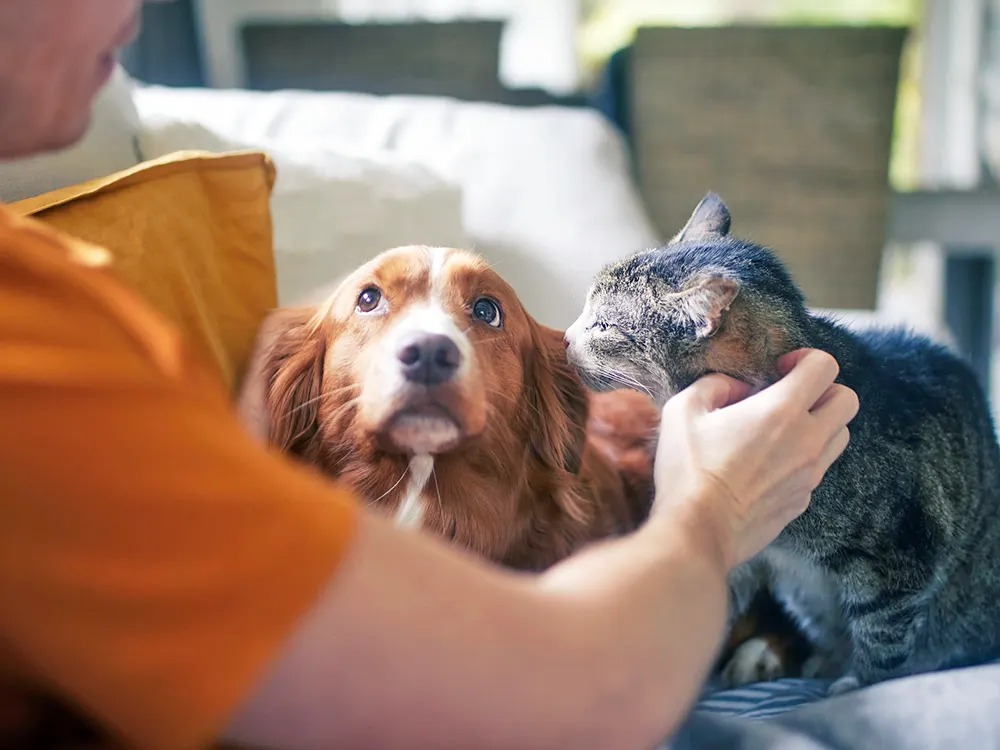
You have almost certainly memorized your pet’s face, every whisker and freckle, and you could spot them in a crowded room instantly. Whether they can return the favor is a different story, and the answer splits sharply down the middle depending on whether you own a dog or a cat. A well-known experiment found that dogs identify a familiar human face nearly every time. Cats, faced with the same test, performed at barely better than a coin flip. It is tempting to read that as your cat being aloof or dim. That reading is wrong, and the truth is far more interesting: your cat knows exactly who you are. It just does not bother using your face to do it.
The experiment that started it
The study, published in the Journal of Vision, was patient work. Researchers took twelve dogs and twelve cats and paired each with a human handler who spent two hours a day with the animal for six months, mostly teaching it to operate a simple two-choice testing rig. Once the animals knew the machine, each was shown four kinds of image pairs and asked to pick one: their own handler’s face against a stranger’s, a housemate animal against an unfamiliar animal, a familiar scene against a new one, and a pair of two unfamiliar scenes as a control. Every animal ran each matchup fifty times, and they got a treat no matter which they chose, so there was no incentive to game the task.
On three of the four tests, cats and dogs scored about the same. The split opened up on exactly one: the human face. Dogs chose their own person roughly 88 percent of the time. Cats managed about 55 percent, which is statistically close to guessing. Tellingly, cats had no trouble recognizing familiar faces of their own species. It was specifically the human face that stumped them.
Why the gap exists
The likely answer is written into how long and how closely each species has lived with us. Dogs have been our companions for a very long stretch, possibly tens of thousands of years, and they arrived as social animals wired to live in cooperative groups. For a dog, being able to tell a friendly human from a threatening one, and one individual from another, had direct survival stakes. Over that long partnership dogs did not just learn faces, they picked up the ability to read expressions and infer moods from them.
Cats were never under that pressure, so they never built the hardware for it. People frame it as a deficit, but it is really just a different toolkit. A cat solved the who-is-this problem with the senses it already trusted most, and vision was never top of that list.
Cats came into the human orbit more recently, on the order of ten thousand years, and they did it on their own terms rather than as pack members. The evolutionary reason to memorize a specific human face was simply never there, so the genetic machinery for it did not develop. That is not a knock on the cat. It is a species that solved the same problem a different way.
What your cat uses instead
Strip out face recognition and your cat is left with a genuinely impressive set of alternatives. Scent leads the way. A cat’s sense of smell is one of its sharpest tools, and even in a household where everyone shares the same soap and the same couch, your individual odor is distinct enough for your cat to single out. Voice is another. Cats learn the particular pitch, rhythm, and volume of the people they live with and can pick a familiar voice out from strangers. Add in your size and silhouette and the specific way you move through a room, and a cat assembles a reliable identity for you out of several channels at once, none of which happens to be the flat visual snapshot of a face.
It is also worth remembering that cat eyes are built for a different job than ours. Feline vision is tuned for low light and for catching movement, which makes it superb for hunting at dawn and dusk. The trade-off is weaker detail at distance and much less color, so fine facial features, the stuff human recognition leans on, are not where a cat’s eyes shine in the first place.
What newer research adds
The picture has only gotten clearer since that original face study, and it keeps landing in the cat’s favor on the senses that matter to it. Work on cats and human voices, first shown over a decade ago and reinforced by a 2025 study, confirms that cats really do distinguish their own person’s voice from a stranger’s, tracking those subtle acoustic fingerprints. On the dog side, newer brain-imaging research has started to map how face recognition physically works, pointing to regions of the temporal cortex, the same broad area other mammals use for faces, and showing that dogs lean especially hard on the eye region when they study a human face. Put together, the recent science reframes the old headline. The story is not that cats fail a test dogs pass. It is that each species reads you through the sense it trusts, and your cat’s version of knowing you runs mostly through its nose and ears.
So the next time your cat stares straight through you as though meeting you for the first time, take it in stride. Somewhere behind that blank look, it has already clocked your scent, your footsteps, and the sound of your voice, and it knows precisely who just walked in.
References
- Kaminski, J., et al. “Dogs, but not cats, can readily recognize the face of their handler.” Journal of Vision, 2005. https://jov.arvojournals.org/article.aspx?articleid=2132249
- Saito, A., et al. “Vocal recognition of owners by domestic cats.” Animal Cognition, 2013. https://pubmed.ncbi.nlm.nih.gov/23525707/
- “Cats distinguish their owner’s voice.” PLOS One, 2025. https://journals.plos.org/plosone/article?id=10.1371/journal.pone.0324016
Common questions
Does my cat actually recognize me?
Yes, reliably, just not primarily by your face. Cats identify their people through scent, voice, body size and shape, and movement style. Facial recognition is the one channel where they score poorly, but they have several stronger ones.
Why can dogs recognize faces when cats can't?
It appears to come down to evolutionary history. Dogs have lived closely alongside humans far longer and as social animals, so telling one human face from another had real survival value. Cats domesticated more recently and more independently, so that pressure was never there.
Should I be worried my cat doesn't know my face?
No. Your cat knows you well through other senses. If anything, leaning on scent and voice, like letting your cat smell your hand and speaking to them in a consistent tone, plays to their real strengths.
Dr. Chen is a small-animal veterinarian who leads health and safety coverage at The Pet Times. She writes and reviews the bulk of our illness, condition, and safety content, translating clinical guidance into clear, practical advice owners can act on at home.
Meet our experts ↗Keep reading
 LivingYour Pet Has a Carbon Pawprint. Don't Let It Wreck Your Peace.Leila Torres · 6 min
 Health & WellnessThe Hardest Part of Your Vet's Job Isn't the Medicine. It's Everything Else.Dr. Amara Solis · 5 min
 LivingYour Pet Probably Won't Go Viral. Chase This Instead.Sasha Ford · 6 min
 LivingThe Shelter Crisis Is Really a Cost-of-Living CrisisJames Okafor · 5 min
 LivingHe Lured a Feral Kitten Out With a Fast-Food Sandwich. Now 3 Million People Watch His Animals.Jordan Ellis · 8 min
 LivingThe Cat-or-Dog Sleep Gap Is About Physics, Not LoveSara Lim · 7 min