


Stare Into Your Dog's Eyes and Your Brains Literally Sync. There's a Catch.
A study wired up humans and dogs and watched their brain waves fall into step during mutual gaze. The surprising part isn't that it happens. It's who starts it, and what a mutant gene did to the whole effect.

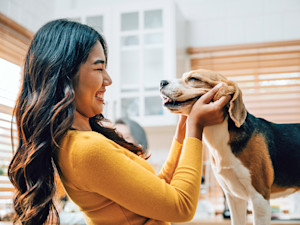
You already know what happens inside your own head when you lock eyes with your dog. It is warm, a little dopey, hard to describe, and it feels like connection. What you probably assumed is that the feeling was yours alone, a nice story you told about an animal who was mostly just waiting for a treat. A study that put humans and dogs in matching brain-monitoring gear says otherwise, and the details are more surprising than the headline.
The finding is not simply “gazing feels good.” It is that during a shared gaze, two nervous systems, one human and one canine, start to move in step. And when researchers looked closer, they found out which side leads the dance, that it strengthens as the pair gets to know each other, and, most strikingly, that a single genetic change can switch the whole effect off.
The study, briefly
Researchers paired ten Beagles with ten people the dogs had never met. Both the humans and the dogs wore EEG caps, which read electrical activity from the brain, while the pairs did ordinary bonding things: gentle petting and mutual eye contact. The scientists then looked for “interbrain” coupling, moments when the two brains’ activity rose and fell together rather than independently.
During mutual gaze, coupling in the frontal and parietal regions of the brain climbed sharply. When people both petted and gazed at the dog, the syncing was stronger still. This is not mysticism. It sits alongside earlier work showing human brains fall into step with each other during shared attention, and even with a musician’s brain when we are swept up in a concert. The new piece extends that phenomenon across the species line.
The parts that make it interesting
Three details lift this above a feel-good result.
First, the connection deepened with familiarity. The pairs met over five days, and the synchronization got stronger as they grew more comfortable together. Bonding, in other words, was measurable as it formed.
Second, the human appears to lead. The analysis suggested it was the person’s brain initiating the coupled activity, with the dog’s falling into step. That reframes the moment: when you settle in and give your dog your calm, focused attention, you may be setting the tempo their brain then matches.
Third, and this is the part most coverage skips, the study was really built around a genetic question. Some of the dogs carried a mutation in a gene called Shank3, which is used as an animal model for autism-associated differences in social connection. Those dogs showed a loss of interbrain coupling and reduced attention during interaction. The syncing effect was not a given; it depended on the neural machinery of social connection being intact.
What moves me about this work is that the bond stops being poetic and starts being physiological. Two brains keeping time with each other, the effect growing as trust grows, and the whole thing hinging on the wiring for social connection. That is a real, biological relationship, not a projection we put on our dogs.
What newer research adds
This study sits inside a fast-growing body of work on the neuroscience of the human-animal bond, and the direction of travel is consistent: the effects long dismissed as sentimental keep turning out to be measurable. Earlier research had already shown that petting a dog boosts activity in the human prefrontal cortex, a region tied to social skills, emotional regulation, and attention. What was missing was evidence that anything comparable was happening on the dog’s side. Now there is.
The genetic angle is where the science is likely to go next. Because the Shank3 mutation disrupted the coupling, dogs are emerging as a way to study how social-connection circuitry works, and fails, in ways that may inform human conditions too. For the average dog owner, the practical message is smaller and lovelier: the connection you feel is not one-sided, it grows with time and trust, and slowing down to genuinely look at your dog is doing something real in both of your brains.
So the next time your dog holds your gaze and you feel that quiet click of connection, believe it. Give them the chin scratch. You were going to anyway, and now you know it counts for both of you.
References
- Ren, Wei, et al. “Disrupted Human–Dog Interbrain Neural Coupling in Autism-Associated Shank3 Mutant Dogs.” Advanced Science, 2024. https://doi.org/10.1002/advs.202402493
Dr. Nair is a veterinarian focused on diet and feeding. She covers everyday nutrition, treats, and the many "can they eat this?" questions owners ask, grounding each answer in what is actually safe and sensible for dogs and cats.
Meet our experts ↗Keep reading
 Health & WellnessHomemade Dog Ear Cleaner: The Ingredients to Skip Matter More Than the RecipeDr. Amara Solis · 9 min
 Health & WellnessStem Cells Won't Regrow Your Dog's Cartilage. Here's What the $3,000 Actually Buys.Dr. Mara Chen · 8 min
 Health & Wellness'Natural' Won't Cure Your Dog's Seizures. But These Add-Ons Actually Help.Dr. Lena Park · 9 min
 Health & WellnessSound Baths for Dogs Sound Like Woo. The Research Isn't.Dr. Lena Park · 6 min
 Health & WellnessCoconut Oil for Dogs: A Mild Moisturizer, Not a MedicineDr. Lena Park · 8 min
 Health & WellnessNeem Oil Won't Shield Your Dog From Fleas. Here's What It Can Actually Do.Dr. Amara Solis · 7 min