


The Dog That Guides the Dead Outlived Its Own Bloodline
For 3,000 years the Xoloitzcuintli's job was to walk souls across the river into the underworld. The strange part, which DNA only revealed recently, is that the job survived the conquest better than the dogs did.

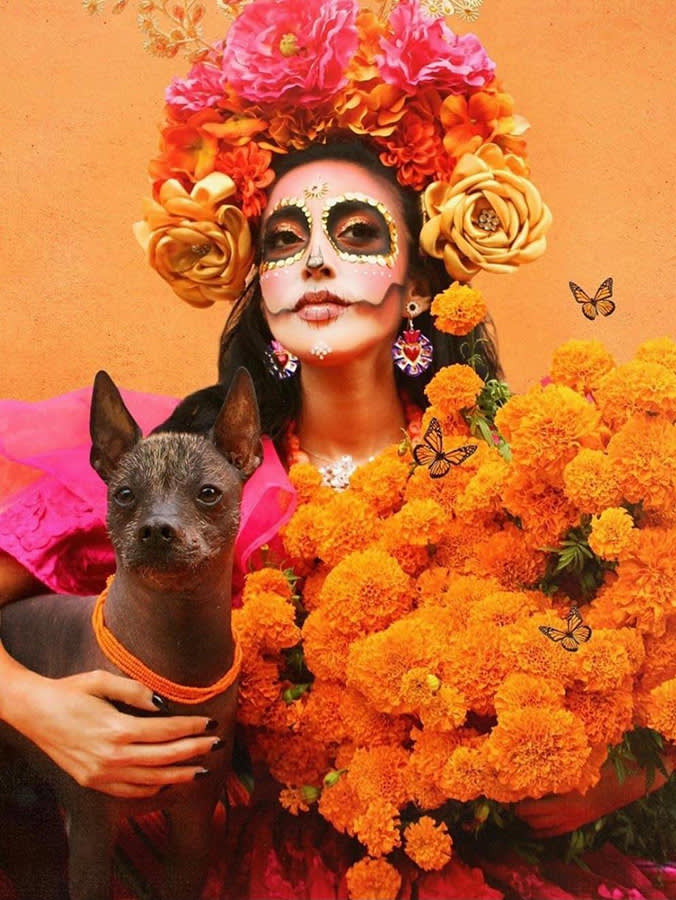
Every November 1 and 2, Mexico and its diaspora set out altars for the dead: photographs, candles, food, marigolds. It is not a somber holiday. It is a welcome, extended to people who are making a long trip.
In the Aztec conception, the dead do not simply arrive. They travel, for four years, down through nine levels of Mictlán, and the journey is hard. There is a river to cross. And crossing it, in the oldest versions of the story, requires a dog.
That dog is the Xoloitzcuintli.
What almost nobody talks about, and what makes this the most interesting fact about the breed, is that the Xolo’s job has proven more durable than the Xolo’s own lineage. The role survived the conquest. The bloodline, according to modern genetics, largely did not.
The dog at the river
Xolos, as they’re mercifully known (it’s pronounced show-low-eats-QUEENT-lee), were believed to guard their people in life and in whatever comes after it. That’s why, in ancient times, they were so often buried alongside their humans.
The origin story is specific. The Aztec god Xolotl, deity of lightning and death, made the breed from the same bone of life as humanity itself, expressly so the dogs could guide human souls through Mictlán. The Xolo’s central task was helping their person across the Apanohuacalhuia, the perilous river blocking the way. Some legends carry a warning attached: people who had treated dogs badly in life found no dog waiting at the water, and were left stranded on the bank.
The archaeology is grimmer and more human than the myth. Some dogs were sacrificed to be buried with their people. Archaeologists have found their bones in Mayan tombs. But in other graves they’ve found something more tender: ceramic Xolos, buried symbolically in place of a living animal, to do the same work of escorting a soul.
The impulse never stopped. It is entirely ordinary now, during Día de los Muertos, to see a family build an ofrenda for a pet who died, with photographs and toys and treats laid out. The same holiday, the same instinct, five hundred years later.
The name is a warning label
Break the name in half and you get the whole worldview. Xolotl is the god. Itzcuintli means dog. Put them together and you have named the animal after death and lightning, which is not a soft branding decision. In Nahuatl, “Xolo” is also said to carry a sense of monster, presumably in tribute to how the dogs looked to people who had every reason to find them uncanny.
They have paid for that appearance repeatedly. Xolos have been mistaken for chupacabras. Reader’s Digest once crowned them the world’s ugliest dog, a verdict a great many people would fight you over.
The hairlessness had a practical upside, though, and it produced one of the more charming beliefs in the historical record. Xolos radiate noticeable warmth through bare skin, and the Aztecs took that heat for a healing power. People kept them close as remedies for asthma, insomnia, toothaches, and rheumatism. Which is to say they used them as living, breathing hot-water bottles, and honestly, if you have ever slept next to a dog with a bad back, you understand the theory perfectly.
The near-extinction nobody mentions
Then the Spanish arrived, and the Xolo went from sacred escort to food source. The conquistadors ate them. The population collapsed.
By the twentieth century the breed was so scarce that in 1954, enthusiasts mounted an expedition across Mexico to find survivors. They located ten dogs. Ten. Everything that exists today was rebuilt from that margin.
The American Kennel Club’s record tells the same story of near-loss from an administrative angle: the Xolo was recognized, then dropped from the registry entirely in 1959 for lack of dogs, and only re-recognized in 2011, as the AKC’s 170th breed. They now appear at Westminster. They remain among the least-registered breeds the AKC has.
What newer research adds
Here is where the romance meets the lab, and it’s worth handling carefully, because the finding is startling.
The Xolo is routinely described as a living relic, a dog that has walked beside Mesoamerican people for 3,000 years, with one archaeological site suggesting a presence as far back as 5,500 years. That deep history is real. What genetics has complicated is the assumption of an unbroken bloodline.
A major 2018 study in Science, sequencing dozens of ancient North American and Siberian dog genomes spanning around 9,000 years, found that the dogs who came into the Americas with people formed a distinct lineage of their own, and that after European contact this pre-contact lineage almost entirely vanished, leaving very little genetic trace in modern dogs. Even the Xolo, the poster animal for ancient American dog ancestry, turned out to carry a genome quite different from those pre-contact dogs. (The single closest living relative of that lost lineage, in one of biology’s more macabre footnotes, is a transmissible cancer.)
Researchers still debate how total the replacement was, and other work using mitochondrial DNA argues for more continuity than the Science paper allows. But the broad picture holds: the dogs of the Americas were nearly erased alongside the people who kept them.
Which reframes what the Xolo actually is. Not a genetic fossil, preserved intact. Something more moving than that: a cultural survival. The conquest took the dogs and it did not take the story. People kept rebuilding the dog around the job. The escort at the river was too important to let go.
The modern Xolo
They are slender dogs, 10 to 23 inches tall depending on the variety, with a life expectancy of 13 to 18 years, which is exceptional. Most are hairless apart from a tuft on the head, though a coated variety exists too.
They have been claimed, enthusiastically, by artists. Frida Kahlo kept Xolos and painted them, her favorite among them Señor Xolotl, and she posed with them in Diego Rivera’s work. Rivera himself opened the first Xolo breeding kennel in 1925. Pixar’s Coco, in 2017, gave the breed its biggest global moment in the form of Dante, a Xolo who refuses to leave his boy’s side through the land of the dead, which is not a screenwriter’s invention so much as a 3,000-year-old job description.
Tijuana named a soccer club after them. Mexico named the Xolo its national dog, and in 2020 Mexico City adopted it as a symbol of the city. Prestige followed money: by 2017, purebred Xolos were going for as much as $5,000 in Mexico City. Population estimates vary widely and none are precise, from a few thousand worldwide to under 30,000, but every count agrees the breed is rare.
They are also, by every account, not a beginner’s dog. Kay Lawson, a breeder and former president of the Xoloitzcuintli Club of America, told National Geographic that they demand constant thought, that they open doors and open crates, and that this is a primitive, extremely intelligent animal.
Which sounds about right for a dog whose original assignment was to know the way through the underworld, and to get you across the water when you couldn’t manage it alone.
References
- The evolutionary history of dogs in the Americas — Ní Leathlobhair et al., Science, 2018
- America’s first dogs lived with people for thousands of years. Then they vanished — Science News
- Xoloitzcuintli breed history — American Kennel Club
- About Xolos — Xoloitzcuintli Club of America
- Pre-Columbian origins of Native American dog breeds, confirmed by mtDNA analysis — van Asch et al., Proceedings of the Royal Society B
Leila Torres leads our Living coverage, from home life and travel to the products and rescue stories that come with sharing a life with animals. She edits and writes across the section, with a soft spot for pieces about the bond between people and their pets.
Meet our experts ↗Keep reading
 LivingPride Gear for You and Your Dog: 20 Picks That Give BackJordan Ellis · 10 min
 LivingBeacon, the Golden Who Became Team USA Gymnastics' Secret WeaponNina Vasquez · 5 min
 LivingStare Into Your Dog's Eyes and Your Brains Literally Sync. There's a Catch.Dr. Priya Nair · 5 min
 LivingA Runaway Wolfdog Crashed the Olympics and Beat the Skiers to the LineJordan Ellis · 4 min
 LivingSofía Valdés's Corgi Pees on Her Pillow Out of Spite. She Wrote a Love Song About Her Anyway.Sara Lim · 6 min
 Training'Imprinting' Is the Wrong Word for What Your Dog FeelsDr. Ravi Mehta · 8 min