


Beacon, the Golden Who Became Team USA Gymnastics' Secret Weapon
A four-year-old Golden Retriever isn't just a feel-good sideline story. Beacon is a credentialed part of USA Gymnastics' mental-health program, and the science behind why he works is real.

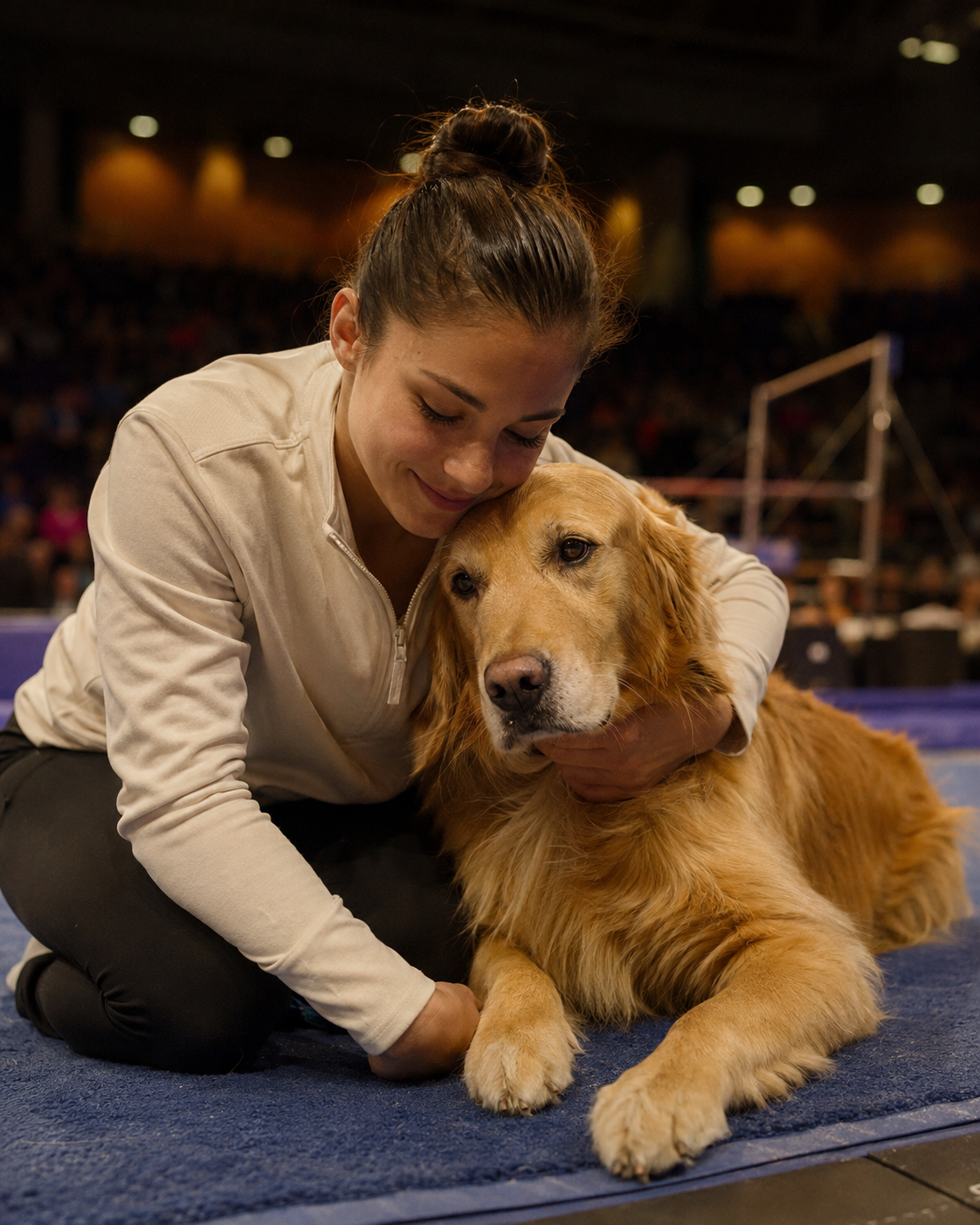
By the time elite gymnasts reach the Olympic trials, they have spent years training for a window that lasts seconds, and the emotional pressure is almost unimaginable. So when a wagging tail appeared among the chalk and the vaulting at Minneapolis’ Target Center last week, it was not a publicity stunt. It was strategy. The tail belonged to Beacon, a four-year-old Golden Retriever who holds an unusual title: the first official therapy dog of USA Gymnastics, and a credentialed part of the organization’s mental-health program.
What makes Beacon’s story worth telling is not just that he is adorable, though he is. It is that he sits at the intersection of two things the sport has been forced to take seriously, athlete mental health and the hard science of stress, and he represents a deliberate institutional bet that a dog can do work no sports psychologist or motivational speaker can.
Why a sport this serious added a dog
To understand the bet, rewind to 2021, when athlete mental health stopped being a whispered topic and became a national conversation. That year, Simone Biles withdrew from the Tokyo Olympics to protect her well-being, describing the “twisties,” a terrifying mental block in which a gymnast loses track of their body in midair. “I felt like it would be a little better to take a back seat, and work on my mindfulness,” she said at the time. The moment forced gymnastics, and elite sport broadly, to reckon with the toll of the pressure it produces.
USA Gymnastics responded by building out a fuller mental-health support system, sessions with sports psychologists, talks from motivational speakers, and, eventually, Beacon. The idea came from leadership who had seen firsthand what a dog does to a room: chief executive Li Li Leung had brought her own dog into the office during the pandemic and watched it lift her staff. Together with Beacon’s handler, Tracey Callahan Molnar, she decided an official therapy dog might be exactly what gymnasts needed during the sport’s most punishing stretches.
The science behind the wagging tail
This is where Beacon stops being a cute aside and becomes something closer to a tool. The calming effect of a dog is not folklore; it is measurable. Time spent with a friendly dog, even watching someone else pet one, is associated with lower blood pressure, reduced levels of the stress hormone cortisol, and a rise in feel-good neurochemicals like oxytocin, serotonin, and dopamine. Bonding with a dog also blunts loneliness, which matters enormously for athletes living out of hotel rooms during the most stressful weeks of their lives.
“It’s a signal of support and comfort and something that’s really valuable in these environments when you are away from home,” Dr. Maggie O’Haire, an associate dean for research at the University of Arizona College of Veterinary Medicine and a leading researcher on human-animal interaction, told The New York Times. That phrase, a signal of support, captures why a dog reaches athletes that words sometimes cannot. There is nothing to perform for a dog, no expectation to meet, just a warm presence that asks nothing back.
Beacon’s road to the floor
Beacon came to the work through loss. Callahan Molnar first grasped the power of therapy dogs when her husband, undergoing chemotherapy, found comfort in a hospital dog and suggested their own dog, Tulsa, might do the same kind of work. Tulsa did. After Tulsa passed, Callahan Molnar brought home Beacon as a puppy and enrolled him in training, and he turned out to have a rare gift for it.
He is not alone on the circuit, either. When Callahan Molnar learned that one Indianapolis qualifier would host roughly 300 athletes, she recruited three local therapy-dog organizations, and eleven additional dogs joined; at nationals, the roster swelled to 19 dogs and their handlers, a small fleet that has come to include other goldens and even a Cavalier King Charles Spaniel. But Beacon is the constant, the only official one, known by name and treated like a minor celebrity.
His work during trials is quietly demanding. Across long, grueling days, he seeks out the athletes who need him, and many call him over the instant they spot him. Sometimes, Callahan Molnar told ESPN, he simply senses it on his own. He is brought to gymnasts in their worst moments, after an injury, after learning they did not make the team. “Not every dog is cut out for this, but it turns out that he’s good at it and he really loves it, which was a very important part of it for me,” she told The Times. “Even if he’s tired, even if he has been working for 12 hours, the second he hears his name, he’s like, ‘I’m up and ready and I want to say hi. Who wants to be close to me?’”
What the athletes say
The gymnasts do not talk about Beacon the way you talk about a mascot. They talk about him the way you talk about something that genuinely helps. “I feel like he kind of blocks out reality and sometimes that’s good for us so we don’t overthink things,” said Shilese Jones, who has weathered a string of injuries including one during the trials. “He distracts me from the reality of the pain.”
And then there is Suni Lee. Lee was in tears as she stepped up for her first vault on day one of the trials, rattled after her friend Kayla DiCello withdrew with an Achilles injury. She spent extra time with Beacon afterward, and on day two she made it through and earned her spot at the 2024 Paris Olympics. On Instagram, she posted a photo with the dog and a caption that needed no elaboration: “thank god for beacon.” For a sport learning, the hard way, that taking care of the athlete is part of the performance, that may be the most concise endorsement a therapy dog has ever received.
References
- Macur, J. “At the Olympic Gymnastics Trials, a Therapy Dog Named Beacon.” The New York Times, June 2024. https://www.nytimes.com/2024/06/28/us/olympics-gymnastics-therapy-dogs-mental-health.html
- “A Day in the Life of Beacon, the Therapy Dog at U.S. Olympic Gymnastics Trials.” ESPN, 2024. https://www.espn.com/olympics/gymnastics/story/_/id/40459211/2024-gymnastics-olympic-trials-beacon-therapy-dog-usa
- Alliance of Therapy Dogs. “Therapy Dog Support for Athletes.” https://www.therapydogs.com/therapy-dog-support-for-athletes/
Nina Vasquez writes about life at home with pets and the relationships at the heart of it. Her work covers day-to-day living, people-and-pet stories, and the products that fit into a real household, with a warm, grounded take on everyday pet ownership.
Meet our experts ↗Keep reading
 LivingCelebrate the Holidays With Your Dog Without Landing in the ERNina Vasquez · 5 min
 LivingThis Viral Dog-City Ranking Measures Hype, Not Livability. Check This InsteadLeila Torres · 6 min
 Product Picks22 Father's Day Gifts for the Dog Dad Who Already Has Everything (Except These)Sasha Ford · 9 min
 TrainingYour Husky Isn't Arguing With You. It's Doing the Job It Was Bred For.Dr. Ravi Mehta · 6 min
 LivingShe Paints the Rescue Dogs Nobody Wanted. They're Unforgettable.Leila Torres · 4 min
 Living14 Years, 10 Houses, One Dog: How Alison Wu's Cavalier Anchors Her AnxietyLeila Torres · 5 min