


14 Years, 10 Houses, One Dog: How Alison Wu's Cavalier Anchors Her Anxiety
Creative director Alison Wu has moved across borders, weathered divorce and a layoff, and stayed anxious through most of it. Her Spaniel Tilly is the constant that holds it together, and there's real science in why that works.

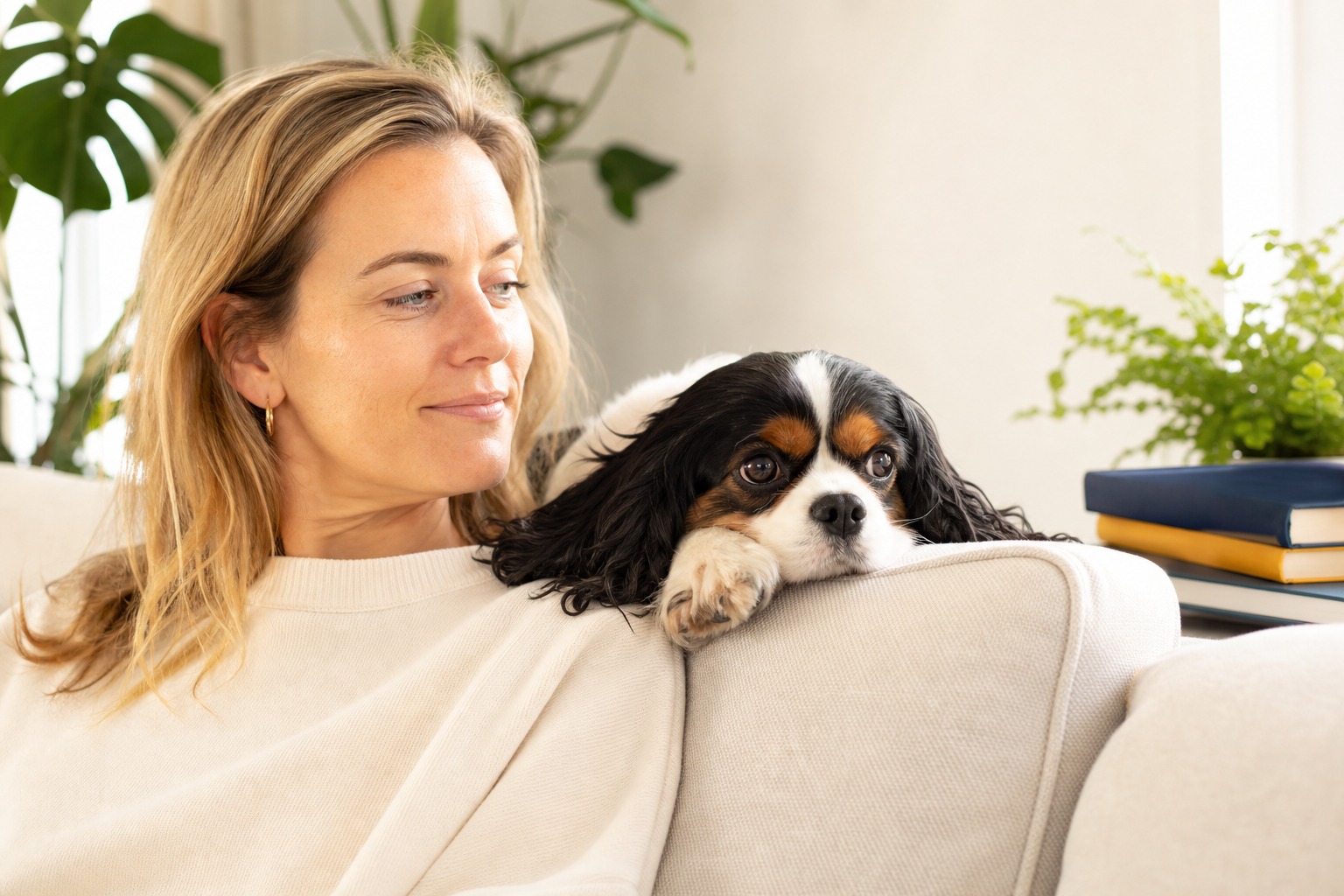
People who lean on a pet for their mental health usually describe it in soft, fuzzy terms: comfort, companionship, unconditional love. All true. But Alison Wu’s story, told in her own words, is more specific and more useful than that, because she can name exactly how her dog steadies her. Across more than 14 years, ten different homes, and an international move, her Cavalier King Charles Spaniel, Tilly, has been the one fixed point. And the mechanisms she describes, routine, co-regulation, and connection, are the same ones researchers point to when they explain why the human-animal bond measurably helps. Here is her account, with the science running underneath it.
A constant through every upheaval
Wu, a lifestyle creative director, got Tilly at 11 weeks old, when Wu herself was 21. “We’ve been together ever since, for the last 14 and a half years,” she says. “We’ve lived in more than 10 different houses together. Tilly has been with me through breakups, a layoff, heartbreak, divorce, and an international move. She has been my constant companion, my rock. She is like my baby, my partner, and my best friend all rolled into one.”
When life gets inevitably turbulent, Tilly offers me much-needed stability, support, and calm. Plus, she’s a beacon of joy and happiness in my life.
Routine: the anchor you can’t skip
The first mechanism Wu names is consistency. “Tilly provides a level of consistency to my life that helps me stay grounded,” she says. “We have our daily routine, and I know that no matter what comes up or where we are together, I will always stay committed to it. In a lot of ways, she gives me purpose and helps me maintain a daily cadence.”
This is not a soft observation, it is a structural one. A dog imposes a non-negotiable schedule, morning walk, meals, evening wind-down, and for an anxious mind, that external scaffolding is genuinely stabilizing. It is also why the effect held up during her hardest transition. In 2020, after 12 years in Portland, Wu moved to Mexico City, “a country where I barely knew the language or anyone there.” It was, she says, “extremely scary at times.” Tilly carried the familiarity across the border. “Tilly offered me familiarity and groundedness at times when everything else felt like it was spinning around me. Tilly feels like home. Tilly is home to me.”
Co-regulation: borrowing a calmer nervous system
The second mechanism is what psychologists call co-regulation, soothing your own state by syncing to a calmer one. Tilly has always supplied it. “Even as a puppy people would ask, ‘How is she so chill?’” Wu says. “I can get pretty wound up given certain circumstances, and have struggled with anxiety most of my life. I’ve leaned on Tilly’s energy as a calming force in my daily life, and also when I’ve struggled through periods of intense anxiety or big life changes.”
The physical closeness is the point. “She loves to snuggle and lay in my lap. She’s even been known to come curl up while I’m meditating. She’s never been a super active dog. She always, always wants to be near me. So long as she can keep her eye on me, she’s content.” That quiet, present, low-arousal companionship is exactly the kind of contact associated with the calming, connection-linked effects of being with a trusted animal.
Connection: the antidote to a lonely workday
The third mechanism is social. Wu has worked from home since going freelance and launching her own brand in late 2015, and she is candid about the isolation that comes with it. “If you’ve ever worked from home, you know it can be quite isolating unless you make a concentrated effort to leave the house,” she says. Tilly counters it on two fronts: companionship inside, and a reason to go outside. “We love to wander around the neighborhood, stopping at our favorite coffee shop, where everyone knows Tilly. Taking her for walks forces me to get out and have a change of scenery.” She is clear-eyed that it is not a substitute for people, “Tilly isn’t a replacement for human interaction,” but it loosens the grip of a solitary day and nudges her into the world.
And, simply, joy
The last thread is the least technical and maybe the most important. “Animals are pure joy,” Wu says. “Their innocence, playfulness, and exuberance are all healthy reminders for us as human adults to find our joy and not take everything so seriously. Even just looking at Tilly makes me smile. I love having her around during the day to remind me to smile, to be joyful, to play!”
“What Alison describes isn’t vague comfort, it’s three concrete things: a structured routine, a calm presence to settle against, and a pull back into social life,” says Dr. Priya Nair. “Those are exactly the levers the human-animal bond research keeps surfacing. A dog won’t replace therapy or medication for clinical anxiety, but as a daily stabilizing force, the effect is real.”
One honest caveat worth adding to a story this lovely: a pet can be a powerful support, but it is a complement to mental-health care, not a replacement for it. If anxiety is interfering with your life, a dog is a wonderful thing to have beside you while you also talk to a professional, not instead of it. Wu’s 14 years with Tilly is not a prescription. It is a clear-eyed example of what a steady animal can hold for a person, and of how worth it the holding is.
References
Leila Torres leads our Living coverage, from home life and travel to the products and rescue stories that come with sharing a life with animals. She edits and writes across the section, with a soft spot for pieces about the bond between people and their pets.
Meet our experts ↗Keep reading
 LivingAn 8-Pound Rescue Chihuahua Yanked Her Down a Side Street. She Found a Fashion Brand.Nina Vasquez · 6 min
 Living40 Sled Dogs, No Phones: What a Norwegian School Uses to Grow Up Its TeensJordan Ellis · 7 min
 LivingYour Dog Isn't Why You're Not Dating. It's Just Your Best Excuse.Claire Sutton · 6 min
 LivingNew York's Hottest Club Is a $795 Dog RunNina Vasquez · 8 min
 TrainingYour Dog Already Knows Your Name. This Game Makes Them Prove It.Dr. Mara Chen · 6 min
 TrainingA Therapy Dog Isn't a Service Dog. Here's Where They Do Their Best Work.Sasha Ford · 7 min