


Sofía Valdés's Corgi Pees on Her Pillow Out of Spite. She Wrote a Love Song About Her Anyway.
The Panamanian singer got Padmé while grieving another dog and going through a breakup. What followed was a year of potty training, a chewed guitar, and one unreleased song that sounds like it's about a person.

Every musician who gets a puppy tells the same story about how it made them more present, more grounded, more open. Sofía Valdés tells a story about a dog who waits for you to open a suitcase and then urinates in it.
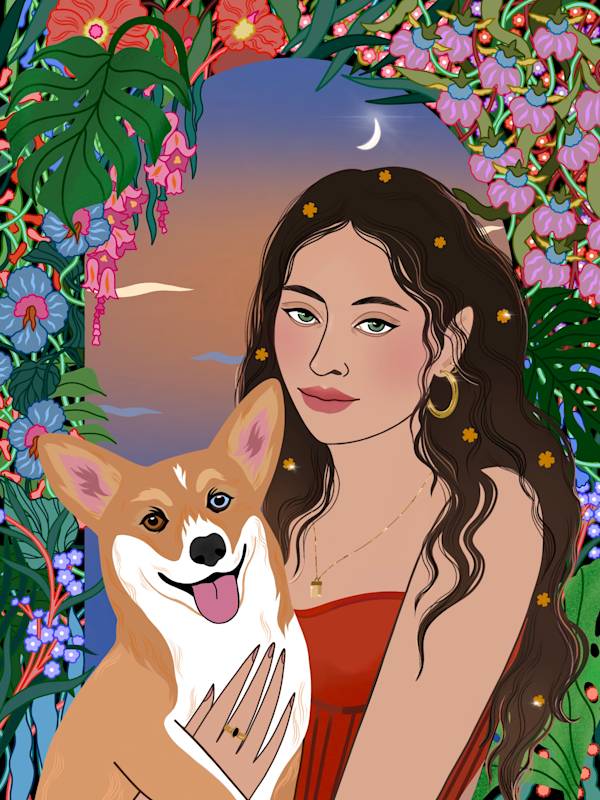
The Panamanian singer-songwriter, who comes from a genuinely storied musical line, her great-grandfather was the bandleader Miguelito Valdés and her great-grandmother the singer Silvia De Grasse, who performed alongside Louis Armstrong, has a Corgi named Padmé, after the Star Wars character. Padmé is, by her own account, tiny, cute, sassy, sweet, smart, and evil.
The evil is the interesting part, and not for the reason you would expect.
A dog with a filing system for grievances
Padmé keeps score.
Greet her wrong, or fail to play when play has been requested, and she will jump onto the bed, make eye contact, and pee on the pillow. Not out of confusion. Out of stated objection, delivered while watching you.
The suitcase is a whole separate protocol. She sees a bag come out, and she gets in it. She does not want you to leave. So she waits, patiently, while the packing happens, and the moment you step away, she goes back in and pees on everything you were going to take.
She is the product of two Corgis, one conventionally marked and one decidedly not. Padmé’s mother, in Valdés’s description, is essentially a small dairy cow in Corgi form, patched in black, white, and brown. Padmé herself has two bright blue eyes, the kind you would expect on a Husky, which is odd enough that strangers ask about it.
The part nobody puts in the caption
Padmé arrived at a bad time, which is to say the only time a dog like this ever really arrives.
It was the pandemic, and Panama’s lockdowns were severe enough that leaving the house was barely an option. Valdés’s Shih Tzu, eighteen years old, was dying. The dog had canine cognitive dysfunction, the dementia-like syndrome that takes older dogs apart from the inside, and near the end her walking had narrowed to slow circles. House training was gone, erased. Every bodily function had become something her family did for her.
And Valdés was going through a breakup.
Into that came a phone call. A friend of her mother’s had a pregnant Corgi and did not want to hand the puppies to strangers. So one of them came to them, and Valdés knows where all the siblings live, and the whole family gets together, mother, father, littermates, for what she describes, with total sincerity, as Corgi gatherings.
It is a very specific kind of good luck: not a dog who fixed the grief, but a dog who arrived in the middle of it and demanded, loudly and continuously, to be dealt with.
What a puppy does to a debut EP
The demanding was not metaphorical.
Padmé was about four months old while Valdés was making her first EP at home, which meant every session was interrupted. She needed to play roughly every half hour. She needed feeding, constantly. She needed to go out. She was screaming and crying, and she was being potty trained, all at once, while her person was trying to talk to a producer about a song.
Piano was worse. When Valdés played, Padmé would station herself directly in front of her and start biting the piano. Valdés eventually resorted to the one room in the house with a door she could fully close, so she could practice, while the dog watched her through the window. Attempts to film anything ended with a Corgi in her lap, chewing the strings of the guitar.
If you have ever tried to do focused creative work with a four-month-old puppy in the house, you already know that this is not a charming anecdote. It is a description of a person being systematically defeated.
The love song that sounds like it is about a man
Here is the thing that makes this more than a funny-dog story.
Valdés has written a song about Padmé. It is a sad love song, written from Los Angeles, about how much she loved this dog and could not be with her because Padmé was home in Panama. It has not been released.
And, she says, it sounds like she is singing about a person.
That detail is the whole business. The emotional register we reserve for romantic longing, for missing someone across a distance, for the ache of loving something you cannot currently reach, turns out to be exactly the register that fits a dog. The song did not have to be adapted. It just works, and a listener would never know.
People apologize to me for grieving a dog ‘too much,’ as though there were a scale. There is not a special, smaller emotion reserved for animals. It is the same one. The song knows that even if we do not.
In Panama, she is a mermaid
At home, the ledger-keeping tyrant becomes something else entirely.
They go to the beach, and Valdés lets her off leash immediately, and Padmé swims. She loves it. She plays with balls and sticks, and she chases Valdés down the sand. Her best friend is a bigger rescue dog named Domino, who belongs to Valdés’s mother’s cousin, and they go to the beach together.
The other thing Padmé does not care for: televisions. Valdés remembers her catching one of her own live performances on TV and nearly attacking the screen, barking at it furiously. Valdés is fairly sure this was not a review. She thinks Padmé simply does not like TVs.
What’s new since this was written
The Corgi boom that this story sits inside has since crested and receded, and it left a mess behind.
Interest in the breed spiked hard following Queen Elizabeth II’s death in September 2022, which is exactly the sort of demand shock that breed-rescue organizations dread, because it is driven by an image rather than by the animal. Corgis are herding dogs. They are loud, opinionated, energetic, and prone to being underestimated by people who bought a shape.
They also carry a structural problem worth knowing about before you fall for one: their long back and short legs put them at meaningfully elevated risk of intervertebral disc disease, a spinal condition that can cause severe pain and, in bad cases, paralysis. Keeping a Corgi lean, discouraging repeated jumping down from furniture, and using ramps for the couch and the car are not fussy precautions. They are the standard veterinary advice for the breed’s most common serious problem.
Which, if you have been paying attention to Padmé, is its own kind of joke. The dog most likely to launch herself off a bed in protest is the dog whose spine can least afford it.
References
- American Kennel Club. “Pembroke Welsh Corgi.” akc.org/dog-breeds/pembroke-welsh-corgi/
- Merck Veterinary Manual. “Intervertebral Disk Disease in Dogs.” merckvetmanual.com
- Cornell University College of Veterinary Medicine. “Canine Cognitive Dysfunction.” vet.cornell.edu
- Royal Veterinary College VetCompass. “Breed Health Profiles.” rvc.ac.uk/vetcompass
Sara Lim leads our Product Picks coverage, testing and comparing the things pets and their owners actually use. From everyday essentials to home-and-style finds, she focuses on honest, useful recommendations rather than hype.
Meet our experts ↗Keep reading
 LivingChewbacca's Soul Came From a Dog, His Voice From a Zoo BearJames Okafor · 5 min
 LivingSF Is a Dog's City. The Leash Line Moves Every Few Hundred Feet.Jordan Ellis · 12 min
 LivingYou Have 900 Photos of Your Dog Asleep. Here's What That's About.Tom Hadley · 5 min
 Living'Certified' Pet Sitter Means Almost Nothing. Here's What Actually Vets OneSara Lim · 6 min
 LivingHe's Dressed Beyoncé and Michelle Obama. His Irish Terrier Won't Wear a Thing.Nina Vasquez · 5 min
 LivingYour Dog Is the Cheapest Anti-Anxiety Tool You Own. Most People Waste It.Dr. Nina Kohl · 5 min