


He's Dressed Beyoncé and Michelle Obama. His Irish Terrier Won't Wear a Thing.
Fashion designer Derek Lam has built a career on elevated, effortless clothes. At home, the star of the show is Roscoe, an Irish Terrier who refuses to be dressed and organizes the whole household around his routine.

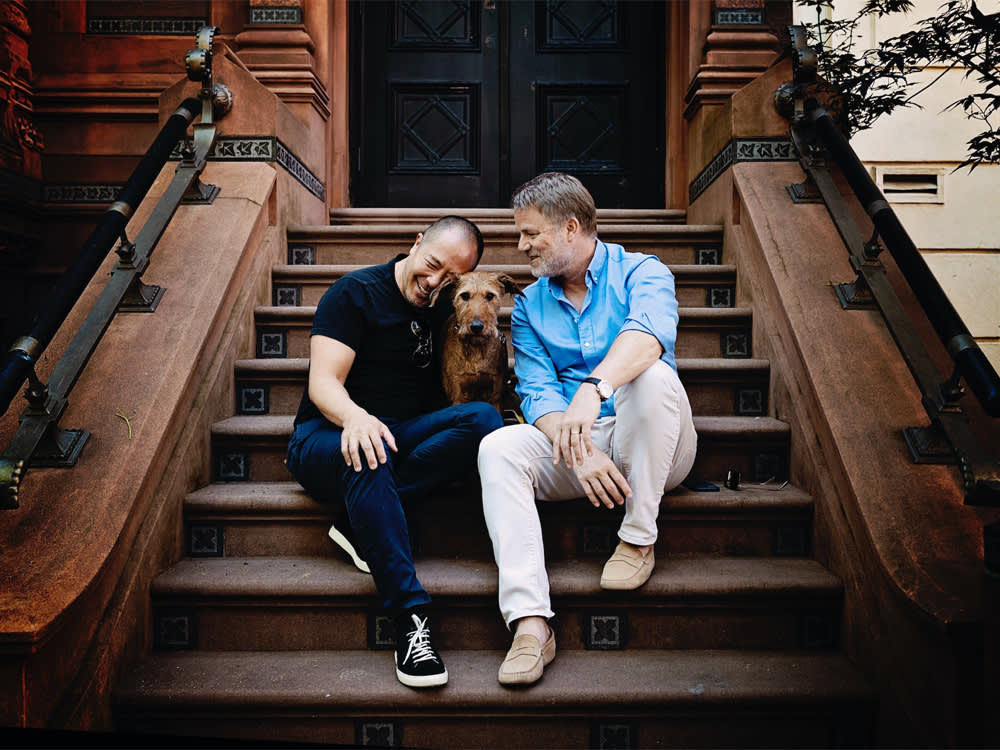
Derek Lam has dressed some of the most photographed women in the world, from Beyoncé to Michelle Obama. He built his eponymous label and the contemporary line 10 Crosby into a defining look for a generation: clothes that manage to be polished and easy at the same time. But ask about the most reliable scene-stealer in his life, and it isn’t a runway. It’s a wiry, bewhiskered Irish Terrier named Roscoe.
Lam and his partner, Jan-Hendrik Schlottmann, have been together in life and work for close to two decades. Roscoe, by their own account, quietly runs the household. And the thing that makes his story worth telling isn’t that he belongs to a famous designer. It’s what a dog with a strong personality does to the shape of a person’s day, even a very busy person’s.
The dog who wasn’t supposed to be a terrier
Roscoe arrived almost by accident. The couple had been circling the idea of a dog for a while, and Lam had his heart set on a Wheaten Terrier. When he reached out to a breeder, the last Wheaten was already spoken for, but there was an Irish Terrier puppy available. One photo, a puppy with an oversized bow and a knowing side-eye, was enough. The plan changed on the spot.
Irish Terriers are not a low-energy breed, and Roscoe came stocked with the usual allotment. As a puppy he was a zoomies machine, and, in the way of high-drive terriers, deeply interested in any squirrel unlucky enough to cross his path. That energy needs somewhere to go, which is part of why the couple splits his life between the city and time at the beach, where he can run off-leash and burn down the terrier engine. In town, Lam has said, it’s less about exercise and more about curiosity: Roscoe is happy to sit and watch the street go by, cataloguing passersby.
What a strong-willed dog does to a schedule
The more interesting thread in Lam’s story is about routine. He’s described his entire schedule as essentially organized around the dog, and framed that as a gift rather than a burden. A working creative life can blur into one long, undifferentiated stretch of tasks. A dog who thrives on predictability breaks the day into pieces, forces real breaks, and creates a rhythm that a to-do list never will.
That’s not a designer’s quirk; it’s one of the most consistent, well-documented benefits of living with a dog. The obligations of a pet, the walks, the meals, the built-in pauses, tend to improve the humans’ structure and stress levels, not just the dog’s. Roscoe didn’t just join Lam’s life. He gave it a metronome.
The one place his taste doesn’t apply
There’s a satisfying irony in a fashion designer’s dog being a committed nudist. Roscoe, by Lam’s telling, hates being dressed. He’ll tolerate a good rain jacket or a puffer in genuinely cold weather, but costumes and styling are a non-starter; he looks miserable, so they don’t push it. The occasional exception aside, the terrier prefers, as Lam puts it, to let it all hang out.
It’s a small thing, but it says something about the household’s whole approach: the dog’s preferences win. That extends to the bigger stuff too. When Lam first interviewed trainers and was asked what he wanted to accomplish, his answer wasn’t a list of commands. It was, more or less, that he wanted Roscoe to have the best possible life. Everything else was negotiable.
Why the terrier is the point
Talk to enough people about their dogs and a pattern emerges: the animal becomes a lens. Caring for a creature who depends entirely on you tends to widen your sense of responsibility outward, toward other animals, toward the environment, toward being a little more careful with the world. Lam has connected the two directly, tying the instinct to protect Roscoe to a broader awareness that shows up in how he thinks about his work and Schlottmann’s sustainability-minded ventures.
That’s the real reason a fashion story ends up being a dog story. The Irish Terrier who wouldn’t wear the clothes turned out to be the most influential presence in the house, not because he’s photogenic, though he is, but because he reorganized two very full lives around something simpler than a schedule: showing up for someone who’s glad you did.
What’s new since this was written
If Roscoe’s routine-driven life sounds indulgent, the science increasingly says it’s good for both ends of the leash. Recent research on dog ownership and human health continues to link the daily structure and social contact a dog provides with lower stress, more physical activity, and, in some studies of older adults, better cardiovascular markers and reduced loneliness. The mechanism is exactly the one Lam describes: not the abstract idea of a pet, but the concrete, repeating obligations that break up a day and get a person moving and outside.
For the terrier’s part, the modern guidance on high-energy working breeds like the Irish Terrier has only firmed up around enrichment. Trainers now emphasize that dogs bred to work need mental jobs, not just physical exhaustion, sniff-based games, problem-solving toys, and varied environments, to stay balanced. Roscoe’s split city-and-beach life, curiosity in town and full-tilt running by the water, reads less like a luxury and more like a textbook enrichment plan for the breed.
Nina Vasquez writes about life at home with pets and the relationships at the heart of it. Her work covers day-to-day living, people-and-pet stories, and the products that fit into a real household, with a warm, grounded take on everyday pet ownership.
Meet our experts ↗Keep reading
 LivingHis Dog Walks Into the Office at 5 P.M. and Ends the WorkdayJames Okafor · 6 min
 LivingYour Dog Isn't Getting Sweeter in Winter. They're Getting Cold.Dr. Lena Park · 7 min
 LivingThe Standard Poodle Who Rebuilt a Writer's DisciplineJordan Ellis · 6 min
 LivingYour Dog Is the Cheapest Anti-Anxiety Tool You Own. Most People Waste It.Dr. Nina Kohl · 5 min
 LivingWalking Dogs for a Living Is a Real Business. The Boring Parts Are What Make It WorkJames Okafor · 7 min
 LivingThe #1 Thing People Love Doing With Their Dogs Isn't the WalkMarcus Webb · 5 min