


Your Dog Buries the Ball Under the Couch to Watch You Suffer. Kind Of.
That maddening habit of shoving the ball just out of reach is part instinct, part game, and one cheap barrier ends the standoff without ruining the fun. Here's what's really going on, and how to fix it.

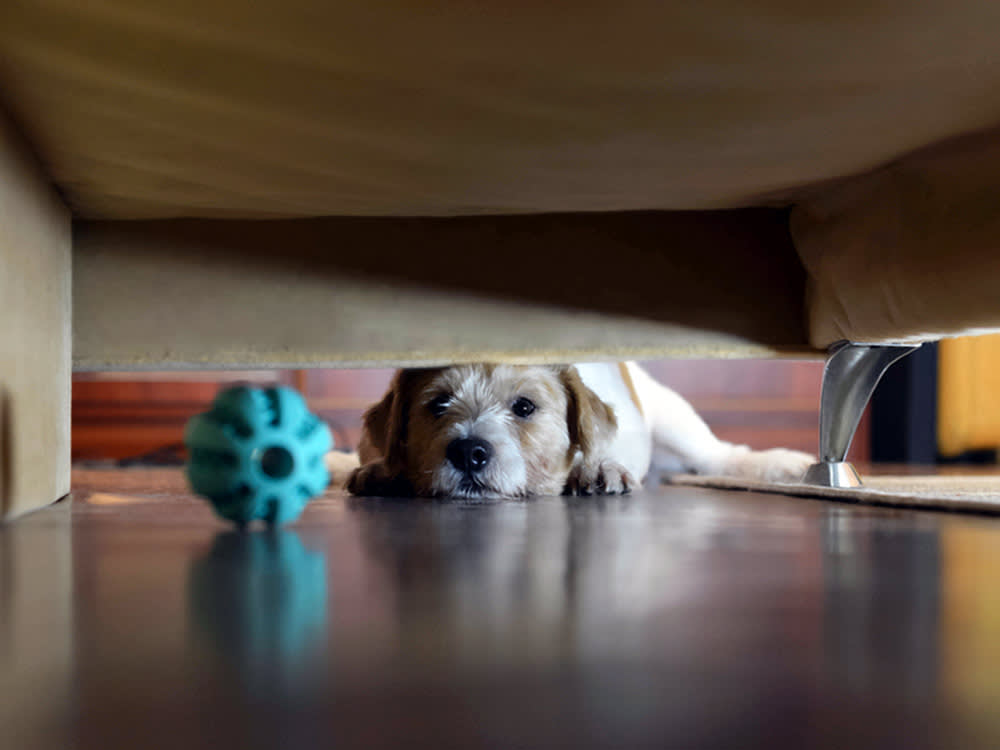
There is a specific flavor of exhaustion known to anyone whose dog has turned fetch into a hostage negotiation. You throw the ball. Your dog sprints after it, gallops back, and then, instead of dropping it into your waiting hand, wedges it as far under the couch as physically possible. Cue the whining, the frantic scratching at the floorboards, and you, phone flashlight in your teeth, cheek pressed to the hardwood, sweeping a broom handle through the dust bunnies to retrieve a slobbery tennis ball. Then your dog does it again. And again.
If this is your nightly life, here is the good news up front: the behavior makes complete sense, it is almost never a problem, and there is a five-minute fix that ends the whole ordeal without taking a thing away from your dog. Let’s start with why they do it, because the reason is more interesting than “my dog is messing with me.” (Although, to be fair, your dog is also a little bit messing with you.)
The instinct underneath the annoyance
Long before dogs shared our couches, their ancestors survived by caching. When food was plentiful, they would stash the extra somewhere safe and come back for it when times got lean. That drive to squirrel away something valuable never left the modern dog. It just lost its original job. Your dog does not need to hoard calories, so the instinct latches onto whatever they prize most, which is often a favorite toy.
A November 2025 piece from animal-behavior researchers writing in The Conversation made the point nicely: your dog is not a doomsday prepper stockpiling for the apocalypse. The caching drive is ancient and real, but in a house where dinner arrives on schedule, it shows up as harmless treasure-hiding rather than genuine survival behavior. Under the couch is simply the most defensible vault your dog can reach.
There is often a social layer, too. In a multi-pet home, tucking a toy out of sight is a quiet way to keep it away from the other animals, a soft form of resource guarding that usually never escalates into anything tense. And in a single-dog home, the stash spot can double as a self-soothing ritual when a dog feels a little understimulated or unsettled. On election night in one household I heard about, a dog spent the evening compulsively depositing his ball under the couch, clearly picking up on the humans’ anxiety and grabbing at the one thing he could control. Honestly, relatable.
So is your dog trolling you?
Here is where it gets funny. For a lot of dogs, the couch move genuinely becomes part of the game, and they know exactly what they are doing.
Plenty of dogs figure out that stashing the ball kicks off a whole sequence: you get up, you dig around, they get the payoff of watching you work for it, and then the throw happens again. That anticipation is the fun. It’s not spite, but it is absolutely intentional, and some dogs milk it for everything it’s worth.
So yes. After a full day of you working to buy the food and the endless replacement balls, some dogs would like you to work just a little harder, thank you. It is not malice. It is a dog who has discovered that this particular routine reliably produces an entertained, mildly frustrated human, which from their point of view is a great outcome.
The fix that keeps everyone happy
You have three real options, and the right one depends on how stubborn your dog is and how much you want to keep parking yourself on the sofa.
The simplest is a physical barrier. Translucent couch blockers, sold in sets of small interlocking panels, slot under the base of the sofa so the ball simply bounces off instead of vanishing into the void. They disappear visually within a day or two, and most dogs stop even testing them once they realize the trick no longer works. If you go this route, size up: a 16-piece set covers a standard couch, and a few spares are handy for any other furniture your dog treats as a toy graveyard. It is the least effort for the most peace.
If you would rather train the habit out than buy your way around it, you can. The cleanest approach is to change where you play, moving fetch to a room without a bottomless couch. If you are committed to staying planted on your own sofa, work on a reliable “give” so your dog hands the ball over before the stashing instinct kicks in, and reward that exchange heavily. Both take more patience than the panels, but they address the behavior directly.
There is one important caveat if your dog is a genuine caching type rather than a game-player. If hiding things is how your dog feels secure, do not just wall off the couch and leave them with nowhere to put their valuables. Give them a sanctioned alternative, such as a crate or a dedicated bed where they are allowed to “bury” and guard their treasures in peace. Take away one vault, offer a better one.
When to actually pay attention
For the overwhelming majority of dogs, couch-stashing is a charming, mildly irritating quirk and nothing more. It crosses into worth-addressing territory only when it comes bundled with real guarding, meaning your dog stiffens, freezes, or growls when you come near the hiding spot, or when the stashing looks anxious and compulsive rather than playful. Those are the cases where a certified trainer or your vet can help you read what is driving it.
Everything short of that, you can file under “things my dog does that I will miss someday.” Block the couch, keep the game going, and reclaim your evenings. You should be able to watch a bad movie start to finish without spending half of it with your head next to the dust bunnies.
References
- Bekoff, Marc, and colleagues. “Your dog is not a doomsday prepper. Here’s why they hide food and toys.” The Conversation, November 2025.
- Patterdale, Sassafras. Certified professional dog trainer, commentary on resource-related hiding behavior.
- American Veterinary Society of Animal Behavior. Resource guarding and normal canine behavior resources.
Common questions
Why does my dog keep pushing toys under the couch?
It's usually a mix of instinct and play. Dogs are wired to stash valuable things in a safe spot, an echo of ancestors who cached food to survive lean stretches. Many dogs also learn that hiding the ball starts a fun little routine where you fish it out and the game keeps going.
Is hiding toys under furniture a sign of a problem?
Almost never on its own. It becomes worth a closer look if it comes with tense guarding, growling when you approach the hiding spot, or anxious, compulsive stashing. In that case, loop in a trainer or your vet. For most dogs, it's just a quirk.
Will blocking the couch frustrate my dog?
Not if your dog isn't distressed by losing the hiding spot. Most dogs adjust within days. If your dog genuinely relies on caching to feel secure, give them a different approved stash spot, like a crate or a bed, so they still have somewhere to tuck their treasures.
Dr. Kohl is a board-certified veterinary dentist with a particular interest in preventive oral care. She reviews all dental health content at The Pet Times and contributes practical guides on home dental routines, professional cleaning, and oral disease prevention.
Meet our experts ↗Keep reading
 Health & WellnessYour Dog's Sleep-Twitching Is Almost Always a Dream. Here's When It Isn't.Dr. Ravi Mehta · 6 min
 TrainingThat Embarrassing Baby Voice? Your Dog Is Begging You to Keep Doing It.Dr. Amara Solis · 5 min
 TrainingYour Dog Isn't Antisocial. They're an Introvert.Dr. Nina Kohl · 6 min
 TrainingWhat 47,000 Dogs Tell Us About the Male-vs-Female Question (and What They Don't)Dr. Lena Park · 6 min
 TrainingThat Head Tilt Isn't One Thing. It's at Least Three.Dr. Lena Park · 5 min
 TrainingThe Frozen Stare Isn't the Fight. It's Your Last Few Seconds to Stop One.Dr. Amara Solis · 6 min