


That Head Tilt Isn't One Thing. It's at Least Three.
The most photographed move in dogdom hides several different behaviors under one adorable pose. Sometimes it's your dog aiming its ears, sometimes it's concentration that maps to real intelligence, sometimes it's a trick you accidentally taught, and once in a while it's a warning sign.

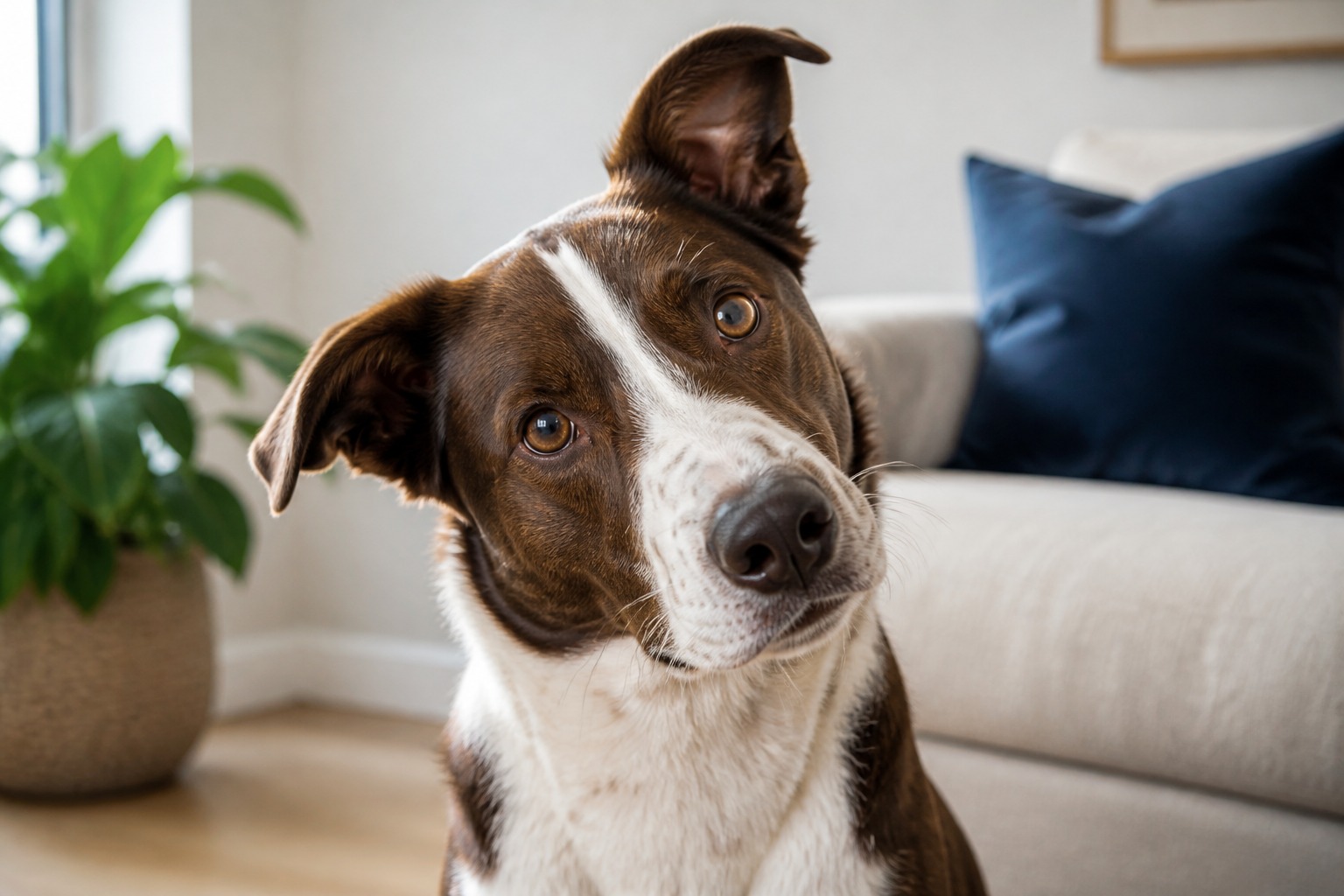
The head tilt is probably the single most beloved thing a dog does, the move that melts even people who swear they won’t hand over the steak. It’s so universal you could imagine cave-painting dogs doing it. But here’s what all that adoration obscures: the tilt isn’t one behavior. It’s at least three separate things that happen to look identical, plus a rare medical impostor wearing the same costume. Figuring out which one you’re watching is more interesting than the pose itself, and occasionally it matters.
Sometimes it’s your dog aiming its ears and eyes
The most common driver is plain sensory work. A dog hears something strange or distant and tilts to gather more information, and part of that is literally about hearing better. A dog’s floppy ear flaps act as a partial sound barrier, muffling noise arriving from certain angles. Cocking the head repositions the ears to pin down where a sound is coming from, which is why the tilt so reliably appears the instant kibble hits a bowl in the next room. A dog that’s hard of hearing may tilt even more as it works harder to locate faint sounds.
Vision plays a supporting role. Human noses barely intrude on our sight lines, but a dog’s muzzle is a large object parked right below its eyes. To get a clean look at the source of a sound, or at your face while you talk, a dog may angle its head around its own snout. There’s an easy way to feel this yourself: make a fist, hold it in front of your nose, and notice how much you’d want to tilt to see past it. Long-haired dogs that seem to tilt constantly are sometimes just contending with fur hanging over their eyes, which a trim can fix.
Sometimes it’s genuine concentration
Here’s where it gets more impressive. A 2021 study in the journal Animal Cognition, run at Eötvös Loránd University in Hungary, followed 40 dogs learning the names of toys. Most were “typical” family dogs who, like the vast majority of pets, never really master toy names. A handful were “gifted word learners” who could reliably learn several, and, unsurprisingly, the standouts were Border Collies.
The result was stark. When asked to fetch a toy by name, the gifted dogs tilted their heads 43 percent of the time. The typical dogs did it just 2 percent of the time. The gap suggested the tilt wasn’t random cuteness but a visible sign of mental effort, the dog hearing a familiar word, retrieving its meaning, maybe conjuring a mental image of the object before trotting off to find it. A telling detail: the gifted dogs tilted the same direction regardless of where their owner stood, which argues the movement was about processing the sound rather than merely locating it.
A separate 2014 study in Current Biology found that the direction of the turn could depend on the type of sound. Dogs tended to turn to the left for familiar spoken commands and to the right for unfamiliar or meaningless noises, a hint that the brain routes different kinds of auditory information a little differently.
The concentration tilt is my favorite, because you’re basically watching a dog think. It shows up most when a dog is trying to match a sound to something it already knows. It’s not proof your dog is a genius, but it’s a real window into the effort behind those ears.
Sometimes it’s a trick you taught by accident
Not every tilt is about the dog’s inner life. Some of it is about yours. Dogs are exquisite readers of our reactions, and the head tilt reliably triggers a jackpot of human delight, cooing, phones out, treats materializing. A dog that notices the pattern will happily run it back. As the training truism goes, what gets reinforced gets repeated. If you light up every time your dog cocks its head, don’t be surprised to see it become a go-to move at dinnertime.
And once in a while, it’s a warning
The overwhelming majority of head tilts are harmless and adorable. But there’s a version that isn’t, and it’s worth being able to tell them apart. A tilt that becomes persistent, that your dog seems unable to straighten, is a different animal from the momentary tilt at a curious noise. When a head tilt is fixed and accompanied by trouble standing or walking, circling, flicking eye movements, or nausea, it can point to a vestibular problem, the canine equivalent of vertigo, or an ear infection, or, less often, a more serious cause such as a nerve being compressed. The good news is that the common causes, vestibular disease and ear infections, are often very treatable with medication. The key is not ignoring a tilt that won’t quit. If your dog’s head tilting is new, constant, or paired with any of those other signs, call your vet promptly rather than assuming it’s just active listening.
What newer research adds
The 2021 head-tilt findings remain the freshest science on the concentration angle, and notably the researchers have said they haven’t yet followed up on that specific thread, so the “tilt as a sign of processing” idea is an intriguing lead rather than settled fact. What has solidified is the broader recognition that dogs process human speech more actively than we used to assume, with brain-imaging work showing they distinguish familiar words and even tone, which fits neatly with the notion that a tilt can mark real cognitive effort. For owners, the practical takeaway hasn’t changed: enjoy the cute tilt, take pride in the thinking one, and stay alert to the rare persistent tilt that’s actually asking for help.
This piece includes some health information. The everyday head tilt is nothing to worry about, but a persistent tilt or one paired with balance problems, eye flicking, or nausea deserves a prompt vet visit.
References
- Sommese, A., et al. “An exploratory analysis of head-tilting in dogs.” Animal Cognition, 2021. https://link.springer.com/article/10.1007/s10071-021-01571-8
- Ratcliffe, V.F., and Reby, D. “Orienting Asymmetries in Dogs’ Responses to Different Communicatory Components of Human Speech.” Current Biology, 2014. https://www.cell.com/current-biology/fulltext/S0960-9822(14)01339-6
- “Why Do Dogs Tilt Their Heads?” VCA Animal Hospitals. https://vcahospitals.com/know-your-pet/why-dogs-tilt-their-heads
Common questions
Does a dog tilting its head mean it's smart?
There's a hint of that. In one study, dogs that could learn multiple toy names, the 'gifted' word learners, tilted far more often than typical dogs when asked to fetch by name. The tilt seemed to track mental processing. It's a clue, not an IQ test, and plenty of clever dogs rarely tilt.
Should I worry about my dog's head tilting?
Not the occasional cute tilt in response to a sound or a word. Worry if the head stays tilted persistently, or if it comes with stumbling, circling, rapid eye movement, or vomiting, which can signal a vestibular or ear problem. That version needs a vet promptly.
Why does my dog tilt toward a specific side?
Research suggests the direction can depend on the sound. Dogs tended to turn one way for familiar spoken words and the other for unfamiliar or meaningless sounds, hinting that different kinds of information are handled a little differently.
Dr. Park is a board-certified emergency and critical care specialist. She reviews our health and safety content for clinical accuracy and contributes guides on recognising urgent conditions. Her focus is helping owners act quickly and correctly when it matters most.
Meet our experts ↗Keep reading
 TrainingBelly Up Isn't Always 'Rub Me.' Read the Rest of the Dog.Dr. Priya Nair · 7 min
 TrainingA Growl Is a Gift: The Silent Dog Is the One to Worry AboutDr. Nina Kohl · 7 min
 TrainingYour Dog Isn't Holding a Grudge. Their Fear Memory Just Works DifferentlyDr. Amara Solis · 8 min
 TrainingYou Don't Have to Spell Out W-A-L-K. Your Dog Is Listening for Something Else.Dr. Ravi Mehta · 4 min
 First DaysYour Puppy Isn't Manipulating You. Stop Letting Them Cry It Out.Dr. Nina Kohl · 6 min
 TrainingYour Dog Isn't Rude. Your Dog Is Overstimulated.Dr. Mara Chen · 6 min