


You Don't Have to Spell Out W-A-L-K. Your Dog Is Listening for Something Else.
Dog parents turn into walking thesauruses to avoid setting off their pups. But dogs mostly track who you're talking to, not just which words you use, and that changes the whole strategy.

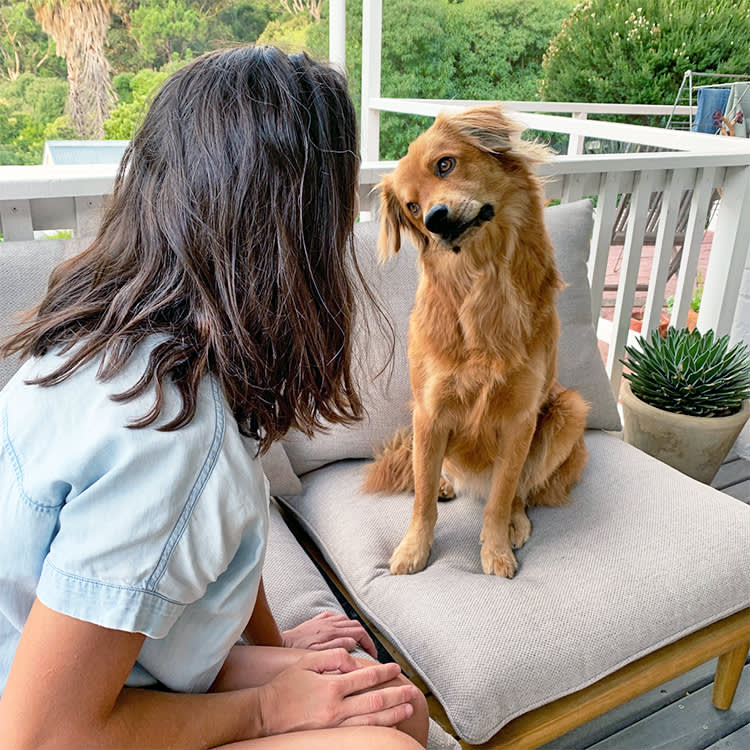
If you live with a dog, you’ve probably developed a secret vocabulary. “Walk” becomes “the thing,” “dinner” gets spelled out one letter at a time, “beach” turns into a code word only your partner understands. It’s the same reflex parents of small kids have when they quietly mouth “c-a-n-d-y” across the kitchen. Nobody wants to watch a beloved face light up with hope and then crumple when the promised outing doesn’t happen.
But is the whole cloak-and-dagger routine actually necessary? The answer is a satisfying “sometimes,” and once you understand the why, you can stop working so hard.
Yes, a broken promise registers
Start with the guilt, because it’s not entirely misplaced. If you’ve spent months making “walk” mean we are going outside right now, saying it and then not delivering can genuinely deflate your dog.
When a word reliably predicts something wonderful and then it doesn’t pay off, some dogs do seem let down or confused in the moment. If it keeps happening, the smart move is to redirect that energy into something else they enjoy rather than leaving them stewing. And if a particular word keeps causing that letdown, it’s fine to just retire it.
The good news is proportion. Dogs don’t carry these disappointments the way we would. A single “dinner” that fails to produce dinner won’t scar your dog for life; their memory for that kind of slight is mercifully short.
The longer-term concern is trust, and it’s real but manageable. A dog’s trust is built through follow-through, you say a thing and it happens, you ask for a behavior and the reward comes. Repeatedly stoking expectations and then whiffing can, over time, teach a dog to tune you out, including on cues you actually need. Consistency is the whole ballgame.
The part that lets you off the hook
Here’s the insight that makes the spelling-bee routine mostly unnecessary: dogs pay close attention to how you’re talking, not only to the words themselves.
There’s a mode of speech researchers call “dog-directed speech,” and most of us already do it without thinking. It’s that slightly higher, slower “dog voice,” usually aimed right at the animal, often starting with their name: “Lucky, want to go outside?” Dogs learn new words faster when they’re taught this way. Just as importantly, that register acts as a flag. It tells your dog this sentence is for you.
“Context does a lot of the work people think words are doing,” Dr. Mehta says. “A dog who’s used to being addressed in that dog-directed way tends to treat a word as meaningful only when it arrives in that package. Say ‘walk’ flatly, mid-conversation with another person, and a well-tuned dog often lets it slide right by.”
That’s the trick, and it’s the opposite of spelling things out. If you only use dog-directed speech when you genuinely mean to involve your dog, and use the same words in a normal voice the rest of the time, your dog learns the difference on their own. “Beach” said to your dog with eye contact and that lilt means pack the towels. “Beach” dropped casually into adult conversation becomes background noise.
What dogs can and can’t do with language
It helps to be realistic about the machinery. Dogs form associations between words and things through repetition, say “outside” every time you head out and they’ll eventually connect the two. But their brains don’t work like ours. They learn words more slowly, and they lack the flexibility to tell “let’s head out” apart from “we’ll head out after lunch.” To a dog, the operative word landed, and the clock is now running. That’s a reason to be deliberate, not a reason to panic.
Attentiveness also varies enormously from dog to dog. Some pups hang on your every syllable; others treat you as ambient noise until the leash appears. If you use an exciting word and your dog doesn’t react, that’s usually fine, they heard it, they just haven’t decided it always means something for them.
What newer research keeps confirming
Ongoing work on canine cognition keeps reinforcing the same practical picture: dogs are sensitive to speech register and to whether talk is aimed at them, and they pick up vocabulary most reliably through that direct, warmer style of address. The takeaway for your kitchen is steady rather than shocking, less “guard every word” and more “be intentional about which voice you use.”
So retire the thesaurus if you like. Talk to your dog in your dog voice when you mean it, use those words normally the rest of the time, follow through when you make a promise, and your dog will sort out the rest. And if all else fails, sure, you can still spell it out.
References
- Benjamin, Alex, and Katie Slocombe. “‘Who’s a good boy?!’ Dogs prefer naturalistic dog-directed speech.” Animal Cognition, vol. 21, 2018. doi.org
- Fugazza, Claudia, et al. “Rapid learning of object names in dogs.” Scientific Reports, 2021.
- Gábor, Anna, et al. “Multilevel fMRI adaptation for spoken word processing in the awake dog brain.” Scientific Reports, 2020.
Dr. Mehta is a board-certified veterinary nutritionist who evaluates pet food formulations, ingredient quality, and the science behind dietary trends. He writes and reviews all nutrition content at The Pet Times, including our food rankings and feeding guides.
Meet our experts ↗Keep reading
 TrainingOne in Three Toy-Obsessed Dogs Couldn't Calm Down. That's the Number That Matters.Dr. Ravi Mehta · 8 min
 TrainingTeaching Your Dog 'Shake' Does Something Bigger Than You ThinkDr. Mara Chen · 5 min
 Health & WellnessA Longer Walk Won't Fix This. 7 Signs Your Dog Is Under-Exercised.Dr. Amara Solis · 9 min
 Health & WellnessThat Cute Snorting Noise Has a Name. So Do the Two That Aren't Cute.Dr. Mara Chen · 7 min
 TrainingToy Theft Is Normal. What Happens in the Next Two Seconds Isn't Always.Dr. Amara Solis · 6 min
 Training"You Can't Teach an Old Dog New Tricks"? They're Teaching Themselves.Dr. Nina Kohl · 6 min