


Your Cat Isn't Liquid. It Just Fits Anywhere Its Head Fits.
The #CatsAreLiquid videos aren't lying about what they see. Here's the real reason a solid animal can pour itself into a vase, and the one place that talent turns dangerous.

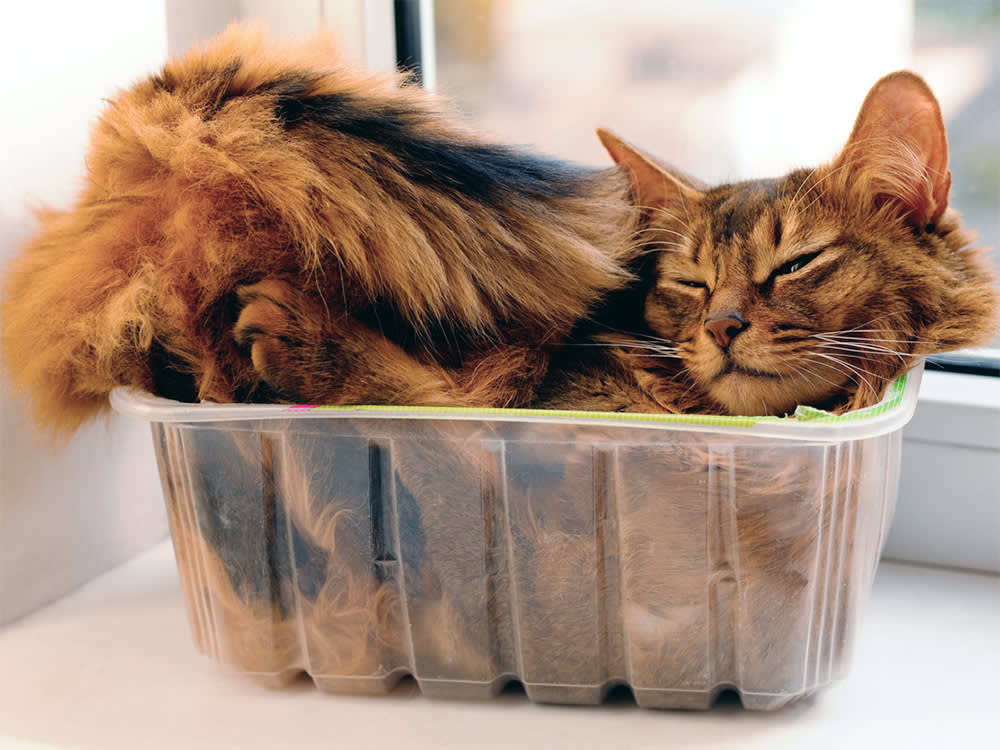
Scroll for thirty seconds and the internet will hand you a cat folding itself into a drinking glass, a tissue box, or a vase with a neck the width of a soda can. The hashtag writes itself: #CatsAreLiquid. It is a good joke with a kernel of physics in it, because one definition of a liquid is something that takes the shape of its container, and that is precisely what your cat appears to do when it decants itself into a mixing bowl.
Cats are, of course, fully solid vertebrates. But the reason they read as pourable is real, and it is more interesting than “they’re just bendy.” Their bodies are built for a very specific job, and squeezing into impossible spaces is a side effect of being extremely good at it.
The head is the whole trick
Here is the single most useful rule for predicting what your cat can get into: if the head fits, the cat fits. The skull is the one part of a cat that does not compress. Everything behind it, the spine with its extra vertebrae and cushioned discs, the shoulder blades that float free of the collarbone rather than locking into it, can narrow and rotate to thread through a gap. So the moment a cat pokes its head through the mouth of a vase and it clears, the rest is a formality, provided there is somewhere for the body to go.
They are not guessing, either. Those whiskers fanning out from the muzzle are calibrated roughly to the width of the cat’s own body, which turns them into a built-in set of calipers. A cat brushing its whiskers against the rim of an opening is taking a measurement, deciding whether the shoulders will make it before committing.
The question I get is whether this is safe, and for most everyday spots the honest answer is yes, it’s just deeply weird to watch. A cat that can work its way into a container can almost always work its way back out. What I actually want owners thinking about isn’t the vase, it’s the gap behind the appliances.
Why a comfort-seeking animal wants to feel squished
The deeper question is not how but why. What does a cat get out of wedging itself into a container barely bigger than it is?
The answer sits in the strange double life every cat leads: predator and prey at the same time. A snug space with walls on most sides means nothing can sneak up from behind and nothing can pounce from the flank. That is why a nervous or unwell cat vanishes into a closet or under the bed, and it is the same instinct that makes a tight box feel less like a trap and more like a fortress. The pressure of the sides is not uncomfortable to a cat. It reads as safe.
This behavior also skews young. A lean, limber, healthy adult cat is the one most likely to attempt the vase. Older cats often opt out, not because they lost interest but because stiff joints and the everyday aches of arthritis make contorting into a jar a lot less appealing than it used to be. If your once-liquid cat has stopped pouring itself into things, that is worth a mental note rather than a shrug.
The one time “liquid” turns dangerous
For all the comedy, this talent has a genuinely hazardous version, and it has nothing to do with glassware. The problem spaces are the ones with something deadly waiting inside: the narrow slot between a running dryer and the wall, the gap behind a refrigerator with exposed wiring, a recliner mechanism, an open dishwasher. Cats have been electrocuted or crushed squeezing into places that looked like just another cozy nook to them.
The fix is boring and effective. If you know your cat is a gap-seeker, block off the genuinely dangerous crevices, especially around large appliances and machinery. Then give the urge a safe outlet: leave a few cardboard boxes out. A box scratches the exact same itch as a vase, minus the risk, and your cat will thank you by immediately climbing into the smallest one available and ignoring the expensive bed beside it.
References
Common questions
Do cats get stuck in tight spaces?
Rarely. A cat that can wiggle in can almost always wiggle back out. The real danger isn't getting stuck, it's squeezing into hazardous gaps like the space behind a dryer.
Dr. Nair is a veterinarian focused on diet and feeding. She covers everyday nutrition, treats, and the many "can they eat this?" questions owners ask, grounding each answer in what is actually safe and sensible for dogs and cats.
Meet our experts ↗Keep reading
 Health & WellnessCats Don't Always Land on Their Feet. Scientists Just Found the Part That Does the WorkDr. Priya Nair · 6 min
 Health & WellnessOne Common Bouquet Flower Can Put a Cat in Kidney Failure. Here's the Full List.Dr. Amara Solis · 8 min
 Health & WellnessYour Cat's Purr Sounds Like an Engine. Usually That's Great News, Sometimes It Isn't.Dr. Nina Kohl · 4 min
 Health & WellnessHalloween Is Your Cat's Least Favorite Night. Six Ways to Fix That.Dr. Lena Park · 5 min
 TrainingYour Cat Is Not Judging You. Your Cat Cannot Judge You.Dr. Mara Chen · 9 min
 LivingYour Party's Biggest Risk Isn't the Cat Getting Scared. It's the Front Door.Dr. Amara Solis · 7 min