


The Field-Invader Cat Video Is Fun for the Crowd and Terrifying for the Cat
A cat sprinting across the outfield reads as comedy from the stands. Inside the cat's body it's a full flight response, and the roar of the crowd is the part making it dangerous.

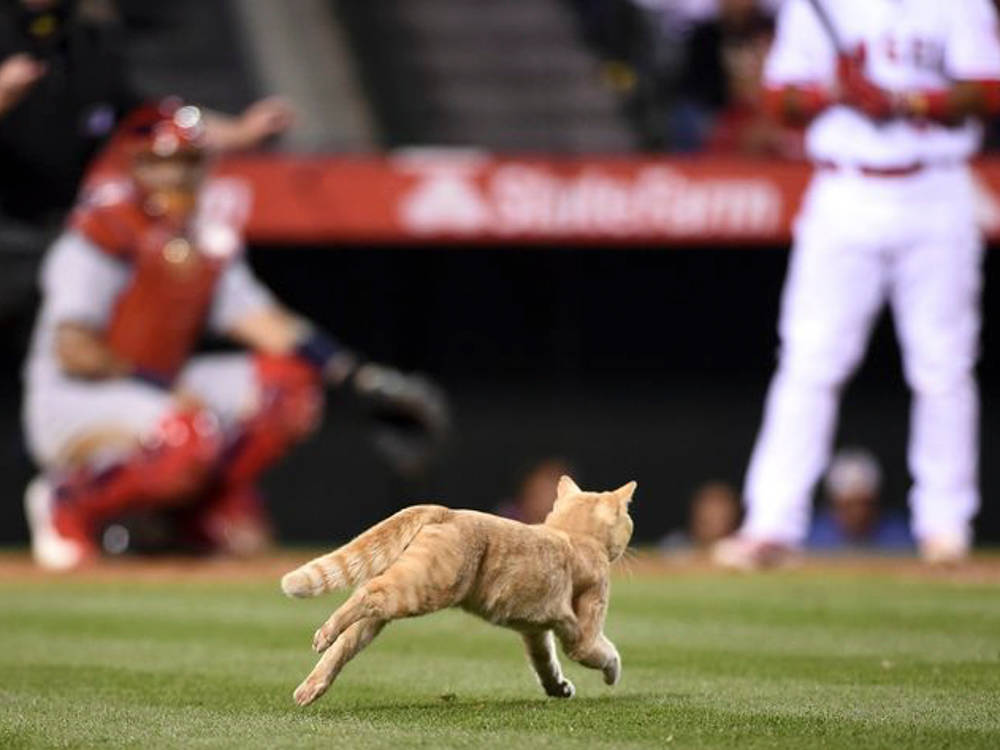
The clip is always the same shape. A blur of fur streaks across the outfield, players lunge and miss, the broadcast booth cracks up, and forty thousand people rise to their feet cheering. It plays as pure joy. But run the same thirty seconds through the cat’s nervous system instead of the crowd’s, and it stops being funny. What the stadium is watching is an animal in the middle of a full-blown flight response, and the thing everyone loves most about the moment, the noise, is the exact thing making it worse.
What’s actually happening inside the cat
A cat that finds itself on open turf during a live game is not being playful or naughty. It is terrified, and its body has already made the decision for it.
People see a cat ‘zooming around’ and read it as fun, but that flat-out sprint is a survival reflex. The cat’s sympathetic nervous system has flipped on, heart rate spikes, and the whole animal is running on one instruction: get away from the threat and find somewhere to hide.
The problem is that a baseball field is engineered to have nowhere to hide. Cats are ambush predators and, just as importantly, prey for larger animals, so their default safety strategy is cover: get under something, behind something, into a gap too small to follow. Drop a cat into a manicured expanse ringed by tiered noise and there is no cover anywhere, which is why the animal keeps running in loops. It is not evading capture for sport. It is searching, at a dead sprint, for an exit that the stadium’s design has erased.
Why chasing backfires every single time
The instinct in the stands and on the field is to corner the cat and scoop it up. It almost never works, and when it does, it tends to go badly.
“You are not going to out-sprint a panicking cat, and every person running toward it just confirms the story its brain is already telling: I am being hunted,” Dr. Park says. “Worse, if you do manage to trap it, you now have a cornered animal with no escape route, and that is exactly when a scared cat bites or claws. Those are deep, defensive wounds, not warning swats.”
That plays out in the real cases. The famous “Rally Cat” that appeared during a St. Louis Cardinals game drew blood from the person who caught it, a completely predictable reaction from a kitten that believed it was fighting for its life. The chase does not calm the situation down. It escalates it.
The freeze protocol: what actually helps
Here is the part the viral framing skips entirely, and it is the most useful thing to know. There is a genuinely cat-friendly way to handle a field invasion, and it is close to the opposite of what a crowd instinctively does.
“If it were up to me, the whole place would go still and quiet,” Dr. Park says. “Players step back and stop moving. Someone pops a can of wet food or lays a short trail of treats leading toward an open gate. Then everyone waits. Give the cat a silent, low-stimulation window and it will usually collect itself, get its bearings, and leave on its own, no hands on the animal at all.”
The logic tracks with how cats de-escalate anywhere. Fear responses wind down when the perceived threat recedes, and to a cat the threat is the movement and the sound. Remove those and you hand the animal back the one thing the stadium took away: the ability to make a calm choice. It is a big ask in the middle of a packed game, which is why it almost never happens. But it is the correct answer, and worth knowing for the far more common version of this, a frightened cat loose in a parking lot, a warehouse, or your own garage.
The mythology says more about us than the cat
Part of why these moments spread is that we can’t resist writing a story onto them. The Rally Cat became a good-luck charm after the Cardinals won on a grand slam minutes later. Field cats get anointed as mascots, omens, and folk heroes.
“The cat has no idea a game is happening, no idea it’s on television, and is not anyone’s mascot,” Dr. Park notes. “We’re projecting meaning onto a scared animal because a lucky-cat story is more fun than a frightened-animal story. It’s a very human thing to do, and it’s worth noticing that the cat gets none of the payoff.”
The stakes are higher than a funny clip
Treating these as comedy also obscures how wrong they can go. At one college football game, a cat ended up dangling from the lip of an upper deck during the first quarter, losing its grip while the crowd screamed, until people below stretched an American flag into a net and caught it as it fell. Panic doesn’t just make a cat run. It pushes the animal toward ledges, machinery, and traffic it would never approach in a calm state, and a fall or a bolt into a concourse can be fatal.
So the next time the outfield cat trends, it’s fine to find it charming. Just hold both things at once: it is a delightful blip of chaos, and it is a small animal having one of the worst thirty seconds of its life. If you’re ever the person closest to a loose, frightened cat, the kindest instinct is the quiet one. Picture, Dr. Park suggests, that the thing chasing you across an open field wasn’t a house cat but a pack of mountain lions. Then lower your voice, hold still, and give it room.
References
- American Society for the Prevention of Cruelty to Animals. “Common Cat Behavior Issues: Aggression Toward People.” aspca.org
- Cornell Feline Health Center. “Feline Behavior Problems: Fears and Phobias.” vet.cornell.edu
- Amat, Marta, et al. “Stress in Owned Cats: Behavioural Changes and Welfare Implications.” Journal of Feline Medicine and Surgery, vol. 18, no. 8, 2016, pp. 577–586. doi.org/10.1177/1098612X15590867
Common questions
Is it safe to try to catch a cat that runs onto the field?
Not really. A cornered, panicking cat will often bite or scratch hard in self-defense, and chasing a fast, frightened cat rarely works anyway. The kinder and safer move is to reduce noise and let the cat find its own exit.
Do these cats usually get hurt?
Most escape on their own, but the danger is real: some end up in precarious spots, like the cat that dangled from a stadium upper deck before fans caught it in a flag. Panic drives cats toward risky places they would never choose calmly.
Not a substitute for your vet. Our guidance is educational. For urgent symptoms, contact a vet or emergency clinic right away. Editorial standards
Dr. Park is a board-certified emergency and critical care specialist. She reviews our health and safety content for clinical accuracy and contributes guides on recognising urgent conditions. Her focus is helping owners act quickly and correctly when it matters most.
Meet our experts ↗Keep reading
 Health & WellnessYour Cat vs. the Christmas Tree: The Climbing Isn't the Real DangerDr. Ravi Mehta · 6 min
 LivingA Five-Month-Old Kitten Turned On a Faucet, Blocked a Drain, and Closed a Cat CafeSara Lim · 6 min
 Health & WellnessAnother Blue Ridge Beef Recall: Why This Raw Kitten Food Keeps Hitting the FDA's ListDr. Mara Chen · 4 min
 TrainingThe Paw on Your Mouth at 4 A.M.? You Trained That.Dr. Amara Solis · 6 min
 Health & WellnessPothos and Cats: The Burn Is Instant, Which Is Why It Rarely Turns SeriousDr. Nina Kohl · 7 min
 Health & WellnessCat Scratch Fever Isn't a Rock Song. It's a Real Infection (You Still Don't Need to Panic).Dr. Nina Kohl · 5 min