


Pothos and Cats: The Burn Is Instant, Which Is Why It Rarely Turns Serious
Pothos is toxic to cats, but the way it hurts, an immediate mouth-burning sting from calcium oxalate crystals, is also what usually stops a cat before real damage is done. Here is how to read the risk and respond.

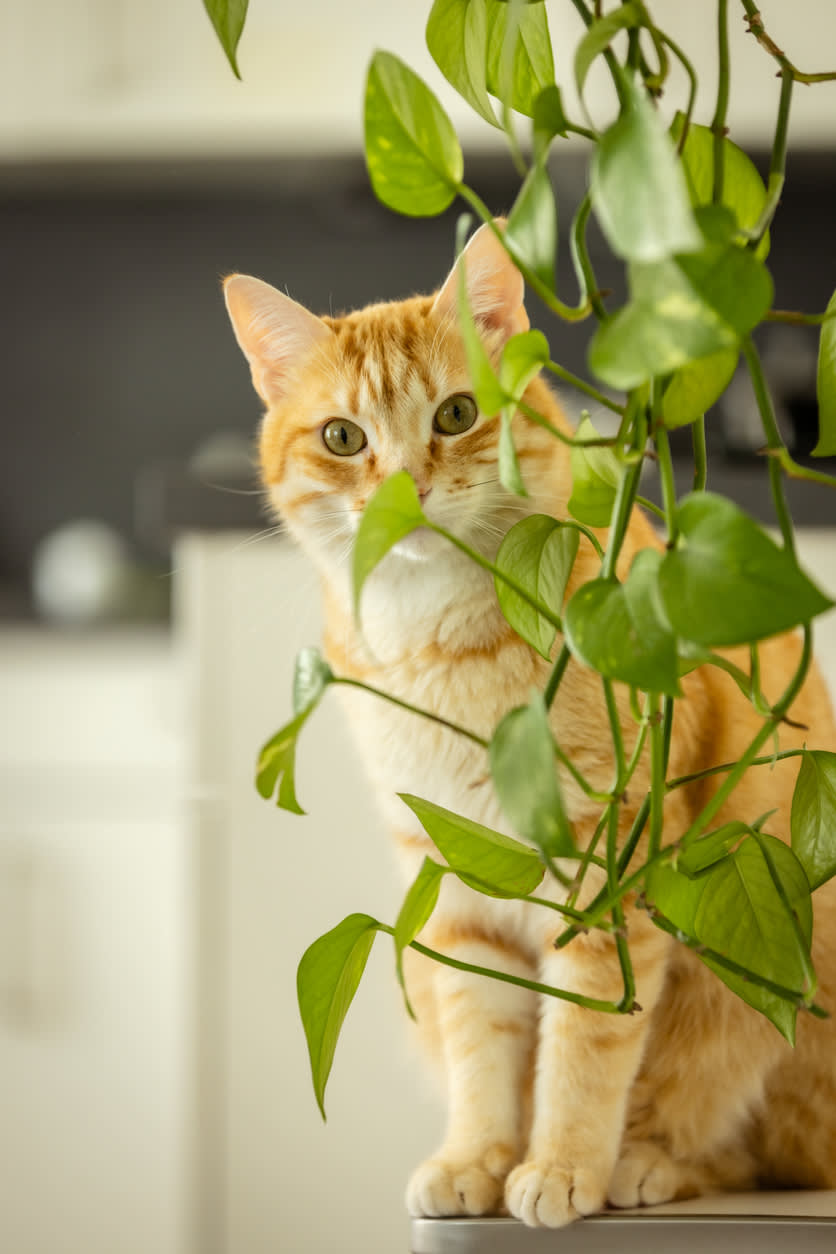
Most plant-toxicity questions leave you waiting and worrying. You see a chewed leaf, you cannot tell how much your cat ate, and you spend the next several hours watching for symptoms that may take a long time to appear. Pothos is different, and understanding why changes how you should react to it.
Pothos hurts on contact. The same feature that makes it toxic, the microscopic calcium oxalate crystals packed into its leaves and stems, also makes it one of the more self-announcing poisonings a cat can have. The burn is instant. And that instant burn is usually what saves the cat, because it stops most of them after a bite or two. So yes, pothos is toxic and it belongs out of reach. But the useful way to think about it is not “deadly plant” so much as “painful plant that tells on itself,” and knowing the difference tells you exactly when to relax and when to move fast.
What is actually in a pothos leaf
Pothos (Epipremnum aureum), also sold as Devil’s Ivy, golden pothos, or marble queen, is one of the most forgiving houseplants in existence. It trails beautifully, tolerates low light, survives inconsistent watering, and propagates from a cutting in a glass of water. That resilience is exactly why it ends up on so many shelves, and why so many cats encounter it.
The thing that makes it toxic is not a poison your cat absorbs and metabolizes. It is a physical weapon. Pothos tissue is loaded with bundles of needle-shaped insoluble calcium oxalate crystals called raphides, stored inside specialized cells. When a cat bites down, those cells rupture and fire the crystals like a handful of tiny glass splinters into the soft, wet lining of the lips, tongue, and throat. The result is immediate mechanical irritation: stinging, swelling, and a burning sensation, not a slow chemical toxicity.
This matters for two reasons. First, the crystals are insoluble, meaning they do not dissolve and get carried into the bloodstream to poison the kidneys or heart the way a truly systemic toxin would. The damage stays mostly local, in and around the mouth. Second, because the pain is instant and intense, the plant essentially defends itself: a cat gets one nasty mouthful and almost always quits. That self-limiting quality is the whole reason fatal pothos poisoning in cats is so rare.
Why “instant” is the key word
The single most useful distinction this article can give you is between contact toxins and absorbed toxins, because they demand completely different responses.
An absorbed toxin, the dangerous lily being the catastrophic example for cats, can be swallowed with no immediate reaction at all. The cat seems fine for hours while the poison quietly attacks the kidneys, and by the time symptoms appear the damage may be done. With those plants, you cannot wait to see how your cat looks.
Pothos sits at the opposite end. The signs show up in seconds to minutes because the injury is happening right then, on contact:
- Sudden, heavy drooling
- Pawing at the mouth or face
- Head-shaking, lip-smacking, or gagging
- Foaming or visible distress
- Reluctance to eat or trouble swallowing
- Sometimes vomiting
You will usually know exactly what happened and when. That immediacy is the reason a single chewed pothos leaf, while genuinely painful for the cat, is far more often a miserable afternoon than an emergency.
“The calcium oxalate plants are intensely uncomfortable, and the cat will tell you so within seconds,” says Dr. Priya Nair, a veterinarian who contributes to Pet Times. “But that same sting is a built-in brake. The cases I actually lose sleep over are the silent ones, the lily on the counter, not the pothos the cat bit once and immediately regretted.”
The line between “ride it out” and “go now”
Because pothos is self-limiting, most exposures are managed at home with monitoring. But “usually mild” is not “always mild,” and the failure mode, though uncommon, is specific and serious: significant swelling in the mouth and throat that interferes with breathing or swallowing. Use this as your dividing line.
Watch and call your vet for advice when you see the typical contact signs: drooling, pawing, mild gagging, a cat who is clearly uncomfortable but breathing and behaving normally otherwise.
Go to a vet or emergency clinic immediately, without waiting, if you see any of these:
- Swelling of the lips, tongue, or muzzle that is visibly progressing
- Any change in breathing, including noisy breathing, open-mouth breathing, or effort
- Inability to swallow, or drooling that will not stop
- Repeated vomiting, weakness, or collapse
- A kitten, a very small cat, or a cat with existing health problems, which have less margin
The breathing and swelling signs are the ones that turn a painful nuisance into a true emergency, so they override everything else.
What to do in the first five minutes
If you catch your cat with a mouthful of pothos, here is the sequence that actually helps, in order:
- Take the plant away and move it somewhere genuinely unreachable, not just higher on the same shelf.
- Gently wipe out the mouth with a soft damp cloth if your cat will tolerate it, to clear loose plant material and crystals. Do not force it and do not get bitten.
- Offer something cold and soothing to eat or drink. A spoonful of plain yogurt, a little milk, or chicken broth helps rinse the crystals away and calms the stinging tissue. This is the rare case where dairy is useful rather than discouraged.
- Do not induce vomiting. It serves no purpose here and risks dragging the irritating crystals back across the throat a second time.
- Call your vet or the ASPCA Animal Poison Control Center at (888) 426-4435 (a consultation fee may apply) and describe what happened, how much, and how your cat looks now.
- Watch for the red-flag signs above for several hours.
Veterinary treatment, when needed, is supportive: pain control, anti-nausea medication, sometimes fluids, and in the rare swelling cases, careful airway monitoring. Cats typically recover fully within a day or two.
Why your cat went for it in the first place
Cats are obligate carnivores, so a pothos binge is not a nutritional craving. The usual drivers are simpler: curiosity about a new dangling object, the satisfying texture of a glossy leaf, the irresistible movement of a trailing vine, or plain boredom and under-stimulation. A cat with too little to do will often invent a job, and your houseplant is a tempting candidate.
That points to the most durable fix. Beyond moving the plant, give the chewing urge a legal outlet: a tray of cat grass (oat, wheat, or rye), more interactive play, and food puzzles to occupy the part of the brain that was hunting your pothos. Addressing the boredom does more long-term good than any single deterrent spray.
Build a cat-safe trailing shelf instead
You do not have to choose between cats and a green home. If you specifically want the cascading-vine look that pothos gives you, these confirmed cat-safe plants deliver it without the crystals:
- Spider plant (Chlorophytum comosum): the closest direct swap, trailing and tough, and many cats enjoy batting the babies it sends out.
- Boston fern (Nephrolepis exaltata): lush and full for a hanging basket, non-toxic to cats.
- Calathea (several species): dramatic patterned leaves, pet-safe, ideal for a shelf.
- Hoya (Hoya carnosa), the wax plant: trailing, waxy-leaved, and listed as non-toxic to cats.
- Cat grass: not décor exactly, but the single best redirection for a determined chewer.
One important warning while you shop: do not swap pothos for a philodendron. They look alike and get confused constantly, but philodendron carries the very same insoluble calcium oxalate crystals and is also toxic to cats. The look is similar; the safety is not.
The bottom line
Pothos is toxic to cats, and the responsible move is to keep it out of reach. But the kind of toxicity matters. Because the harm is a mechanical, on-contact sting from insoluble calcium oxalate crystals rather than an absorbed poison, the reaction is immediate and almost always self-limiting: the burn stops most cats after a single bite, and serious cases are uncommon. Treat a one-bite incident as a painful afternoon to monitor and soothe, treat any throat swelling or breathing change as a real emergency, and keep the ASPCA poison control number handy for everything in between. Then build yourself a trailing shelf out of plants that cannot bite back.
References
- “Pothos.” ASPCA Animal Poison Control Center, Toxic and Non-Toxic Plants. https://www.aspca.org/pet-care/animal-poison-control/toxic-and-non-toxic-plants/pothos
- Siroka, Zuzana. “Toxicity of House Plants to Pet Animals.” Toxins, vol. 15, no. 5, 19 May 2023, p. 346. https://doi.org/10.3390/toxins15050346
- “Insoluble Calcium Oxalates.” Pet Poison Helpline. https://www.petpoisonhelpline.com/poison/insoluble-calcium-oxalates/
- “Animal Poison Control.” ASPCA. (888) 426-4435. https://www.aspca.org/pet-care/animal-poison-control
Common questions
Will my cat die from eating pothos?
Almost never. Pothos poisoning is painful but rarely life-threatening for cats, because the calcium oxalate sting is self-limiting, meaning it hurts so fast and so much that most cats spit it out and walk away long before they could eat a dangerous quantity. The real emergencies are rare and involve significant swelling of the throat that affects breathing or swallowing, which is why any breathing trouble is an immediate vet visit.
How fast do pothos symptoms show up in cats?
Within seconds to minutes. Unlike toxins that take hours to absorb, calcium oxalate crystals cause a mechanical, physical irritation on contact, so the drooling, pawing at the mouth, and head-shaking start almost immediately. That speed is useful: it tells you what happened right away, rather than leaving you guessing hours later.
What should I do right now if my cat bit a pothos?
Gently wipe out the mouth and offer something cold and palatable to eat or drink, such as a little plain yogurt, milk, or chicken broth, which helps flush crystals and soothe the tissue. Remove the plant, watch closely for the next few hours, and call your vet or the ASPCA Animal Poison Control Center at (888) 426-4435. Go in immediately if you see facial swelling, repeated vomiting, or any change in breathing or swallowing.
What plants look like pothos but are safe for cats?
The cat-safe trailing look-alike most people reach for is the spider plant (Chlorophytum comosum), which gives you the same cascading vines from a shelf or hanging basket without the oxalate crystals. Note that pothos is often confused with philodendron, which is not a safe swap: philodendron contains the same insoluble calcium oxalates and is also toxic to cats.
Not a substitute for your vet. Our guidance is educational. For urgent symptoms, contact a vet or emergency clinic right away. Editorial standards
Dr. Kohl is a board-certified veterinary dentist with a particular interest in preventive oral care. She reviews all dental health content at The Pet Times and contributes practical guides on home dental routines, professional cleaning, and oral disease prevention.
Meet our experts ↗Keep reading
 Health & WellnessAnother Blue Ridge Beef Recall: Why This Raw Kitten Food Keeps Hitting the FDA's ListDr. Mara Chen · 4 min
 LivingYour Party's Biggest Risk Isn't the Cat Getting Scared. It's the Front Door.Dr. Amara Solis · 7 min
 Health & WellnessYour Cat Begs to Go Outside. The Honest Case for Keeping Them In.Dr. Priya Nair · 8 min
 Health & WellnessOnly 5% of a Flea Problem Lives on Your Cat. Here's the Other 95%.Dr. Ravi Mehta · 9 min
 Health & WellnessOne Common Bouquet Flower Can Put a Cat in Kidney Failure. Here's the Full List.Dr. Amara Solis · 8 min
 Health & WellnessYour Cat vs. the Christmas Tree: The Climbing Isn't the Real DangerDr. Ravi Mehta · 6 min