


Scientists Wired People to an EEG to See What Dogs Do to Your Brain
A small study measured people's brainwaves during eight different activities with a dog. The results say something more useful than 'dogs are good for you': different ways of hanging out with your dog do different things to your head, so you can match the activity to what you actually need.

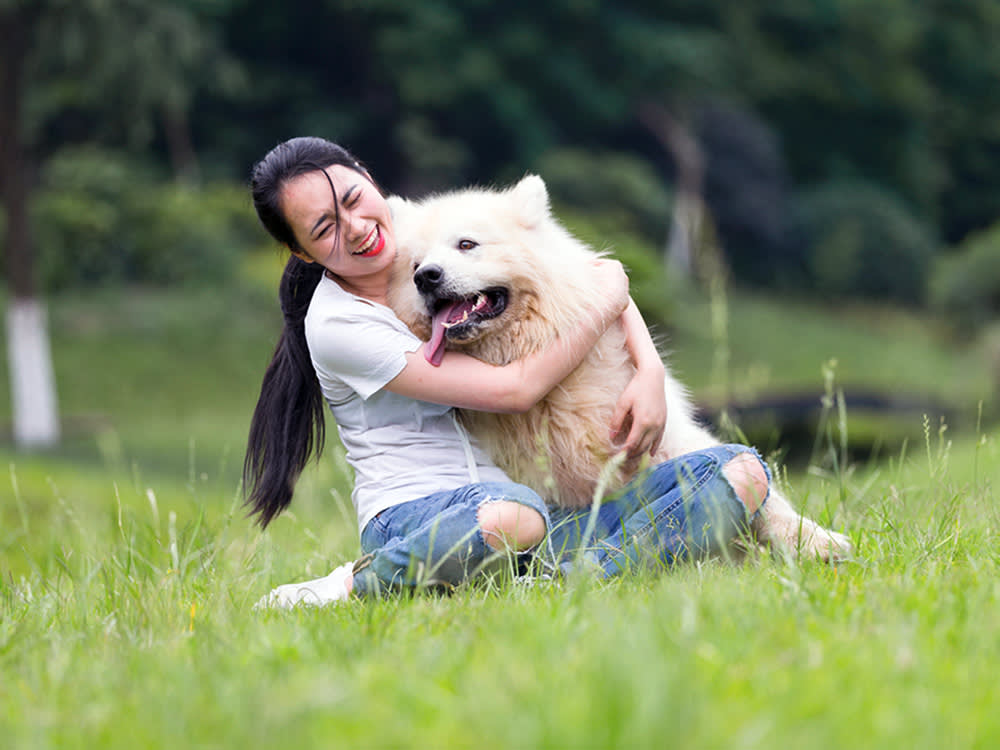
Nobody needs a lab to tell them a dog makes a bad day better. But “dogs are good for you” is the kind of true-but-vague statement that doesn’t help you on a Wednesday when you’re wound up and can’t focus. A study in PLOS ONE went a step past the platitude. Researchers strapped people into brain-monitoring equipment and had them do eight specific things with a dog, and the payoff is a small, practical map: playing with your dog and grooming your dog don’t affect your brain the same way, so you can pick the one that fits your mood.
How the study worked
The study was small, which matters for how much weight to put on it: 30 adults and a single dog, the lead researcher’s own four-year-old poodle. Each person moved through eight activities with the pup, meeting, playing, feeding, massaging, grooming, hugging, walking, and photographing, in a randomized order, except that meeting always came first and walking always came last. The researchers deliberately chose ordinary things people do with a companion dog rather than tasks aimed at a service or working animal, so the results would speak to normal pet life.
Throughout, each participant wore an electroencephalogram, an EEG, which reads the brain’s electrical activity through electrodes on the scalp. After every activity, people also filled out a short questionnaire about their mood and stress. So the study captured both what people said they felt and what their brains were doing while they felt it, and the two lined up.
What the questionnaires said
The self-reports were about what any dog lover would guess. Across every activity, people reported meaningfully lower fatigue and lower feelings of depression, and their stress dropped too. Two activities stood out. Walking the dog produced the greatest sense of comfort, and massaging the dog produced the deepest relaxation. Nice, but not surprising. The interesting part was underneath, in the brainwaves.
What the brainwaves showed, activity by activity
Brainwaves come in bands, and different bands are associated with different mental states. This is where the study earns its keep, because the activities split cleanly.
Playing and walking with the dog boosted alpha waves in parts of the frontal brain. Higher alpha activity is linked to relaxation and emotional stability, and also to better memory and reduced mental stress. So the loose, low-pressure activities nudged people toward a calm-but-present state.
Play did something extra: it raised what the researchers call relative fast alpha, a pattern tied to focused attention in a relaxed condition, and associated with creative thinking and learning. In plain terms, playing with the dog looked like the sweet spot of calm plus sharp, the state you’d want before doing something that needs both ease and focus.
Grooming and massaging the dog told a different story. Those raised beta waves, which are linked to concentration and alertness rather than relaxation. And the effect scaled with contact: the more hands-on the interaction, the stronger the brain response. So the hands-busy, attentive activities pointed the brain toward focus.
Why a dog does this to a brain
The mechanism isn’t mysterious. Time with dogs has been shown to raise oxytocin, the bonding hormone behind that warm, connected feeling, and to lower cortisol, a hormone tied to stress. The study’s authors also noted their findings echoed earlier work showing alpha waves rise during other calming physical activities. The dog, in other words, is doing to your body the same chemistry a lot of wellness advice is trying to buy you, and asking only for a walk in return.
“What I like about this kind of research is that it stops treating a dog as one undifferentiated dose of happiness,” says Dr. Lena Park. “Playing, walking, grooming, they nudge your nervous system in different directions. Once you know that, you can be a little strategic about which one you reach for on a hard day.”
The honest caveats
This is one small study built around a single dog, so it’s a promising signal, not a settled fact. Thirty people and one very good poodle can’t stand in for every human and every dog, and effects seen in a calm lab session may look different in a chaotic living room. Treat the specific brainwave findings as a hypothesis worth more research, not a prescription.
What’s new since this was written
Since this study, the broader research on dogs and the human nervous system has kept building in the same direction. Work using brain imaging has found that petting a dog activates the prefrontal cortex, the region tied to attention and emotional regulation, and that the effect is stronger with a real dog than with a stuffed one. Large public-health reviews continue to link pet companionship with lower stress markers and better mental health. The picture that’s emerging isn’t that any single study proves dogs heal us, it’s that many small, independent studies keep pointing the same way.
How to actually use this
Here’s the practical version. If you’re anxious and want to come down, take the low-key route: go for a walk, or just play. Those track with the relaxed, stable alpha state. If you’re scattered and need to lock in, the hands-on, attentive activities, a real grooming session, a slow massage, track with the alert, focused beta state, so do that first and then sit down to work. And if you want the best of both, calm and creative, play is the closest thing this study found to a two-for-one. None of it requires equipment, an app, or a subscription. It requires a dog and an hour, which, if you’re reading this, you probably already have.
References
- Yoo, Onyoo, et al. “Effects of Interaction with a Companion Dog on Human Brain Activity and Emotion, Measured by Electroencephalography.” PLOS ONE, vol. 19, no. 3, 2024. https://journals.plos.org/plosone/article?id=10.1371/journal.pone.0298384
- Odendaal, J.S.J., and R.A. Meintjes. “Neurophysiological Correlates of Affiliative Behaviour Between Humans and Dogs.” The Veterinary Journal, vol. 165, no. 3, 2003, pp. 296–301. https://www.sciencedirect.com/science/article/abs/pii/S109002330200237X
Sara Lim leads our Product Picks coverage, testing and comparing the things pets and their owners actually use. From everyday essentials to home-and-style finds, she focuses on honest, useful recommendations rather than hype.
Meet our experts ↗Keep reading
 LivingA 'Luxury' Dog Boarding Chain Just Paid $150K to Settle Neglect ClaimsNina Vasquez · 4 min
 TrainingYour Dog Isn't Being Rude at the Door. It Just Never Learned the Boring Version.Sasha Ford · 5 min
 LivingThe Internet's Most Fashionable Dog Has Died. Tika the Iggy Was 14.Sara Lim · 5 min
 LivingThere's No Right Time for Another Dog. Ask This Instead.Leila Torres · 6 min
 LivingA Dog With No Nostrils Became Philadelphia's Most Famous RescueLeila Torres · 6 min
 LivingThe One Thing Anna Wintour Doesn't Control Is Her DogsNina Vasquez · 5 min