


Your Dog Isn't Being Rude at the Door. It Just Never Learned the Boring Version.
The jumping, barking, licking meltdown when guests arrive isn't a discipline problem. It's an untrained one. The fix isn't suppressing the excitement, it's teaching your dog a specific, calmer thing to do instead.

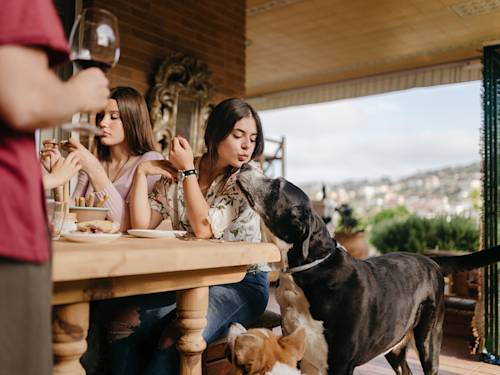
Every dog owner with a friendly, exuberant dog knows the routine. The doorbell rings and the animal loses its mind, jumping, barking, licking every hand and face that crosses the threshold. Your dog-loving friends laugh it off. The ones who aren’t so sure edge toward the wall.
It is easy to read this as a manners failure, a dog being rude. It isn’t. An overexcited greeting is not a discipline problem, it is a training gap. Your dog has never been taught what to do at the door instead, so it defaults to the most natural thing: unfiltered joy at full volume. The fix is not crushing the enthusiasm. It is giving it somewhere to go.
Why “stop that” doesn’t work
The instinct is to focus on what you don’t want, no jumping, no barking, and to try to shut it down in the moment. The problem is that a dog vibrating with excitement at the arrival of a new person is in no state to absorb a correction, and suppressing one behavior without offering a replacement just leaves a vacuum the excitement fills another way. You block the jumping and get frantic barking instead.
The dogs that greet guests politely aren’t the ones with more discipline. They’re the ones who were taught a specific job to do at the door. Once a dog has a clear, rewarded alternative, going to a mat, holding a chew, the excitement has a channel. You’re not fighting the feeling, you’re redirecting it.
The good news is that small adjustments make a big difference, and if you have already tried redirection, confinement, and a designated dog-watcher, you are further along than you think. A few targeted tactics turn a chaotic greeting into a manageable one.
Redirect with something genuinely great
This works beautifully, on one condition: whatever you offer has to be exciting enough to compete with a new human at the door. A toy-motivated dog can have the whole spike of arousal poured into a tug rope or a thrown ball right as the door opens. For most dogs, though, the winner is a top-tier, rarely-given chew or treat.
The things that reliably out-compete a visitor: a real bone; a hollow rubber toy stuffed with something outrageous, steak or chicken or peanut butter driven down into it; a bully stick, though go carefully with puppies; a dental chew; a stuffed cow hoof. One caveat worth taking seriously: check with your vet about which items are safe for your particular dog and which to avoid, since chew safety varies by dog and by product.
Manage the arrival itself
Consider moving your dog to another room, or behind a gate or into a pen, while guests come in and settle. The full spectacle of an entrance, new people appearing as the door swings open, then crossing the threshold and walking in, is intensely stimulating for a lot of dogs. Many greet far more politely if they miss the arrival and simply find people already seated when they come out.
The same logic applies to a gate, which keeps a dog from rushing up to a guest. But watch your individual dog: some get more revved up when gated off, likely out of frustration at being blocked. Test how yours reacts before the day itself, so you know which setup helps and which backfires.
Teach a “place,” the real solution
Management buys you calm in the moment. Training buys you a dog who greets well for life, and it starts with flipping your focus. Stop cataloguing the behavior you’re trying to eliminate and describe, concretely, the greeting you’d actually like to see. Picture the dog doing it. Then go teach that, rather than punishing its absence.
A reliable version is training your dog to go to a designated spot and stay, when visitors arrive. Make it a genuinely comfortable place, a dog bed or bean bag, so settling there is pleasant. The rule for guests is simple and low-pressure: if they want to greet the dog, they can, and if they’d rather not, the dog stays quietly on its spot.
Build it in stages. Begin teaching the “go to your place” behavior with zero distractions, in a calm room on an ordinary afternoon. Reward the dog for going to the spot and staying. Only once that is solid do you work up to harder, more exciting scenarios, a knock at the door, a family member coming in, and eventually a real guest. You are not asking an over-threshold dog to learn a new skill in the chaos. You are teaching the skill in calm and then proofing it against the excitement.
What newer research adds
Modern training science keeps reinforcing the core move here: rewarding an incompatible alternative behavior, a dog on its mat cannot also be jumping on a guest, is more effective and more durable than punishing the unwanted one. Studies comparing reward-based and aversive methods consistently find reward-based training produces better outcomes and lower stress, which matters for a behavior rooted in over-arousal, adding fear or frustration tends to make greeting problems worse, not better.
The other practical shift is the growing emphasis on managing arousal before it peaks rather than reacting after. Trainers increasingly coach owners to set the environment up in advance, the chew ready, the gate in place, the mat established, so the dog succeeds by default instead of being asked to exercise self-control it doesn’t yet have. The excitement isn’t the enemy. An untrained door is.
References
- Todd, Z. “Barriers to the Adoption of Humane Dog Training Methods.” Journal of Veterinary Behavior, vol. 25, 2018, pp. 28–34. https://doi.org/10.1016/j.jveb.2018.03.004
- Ziv, G. “The Effects of Using Aversive Training Methods in Dogs: A Review.” Journal of Veterinary Behavior, vol. 19, 2017, pp. 50–60. https://doi.org/10.1016/j.jveb.2017.02.004
- American Veterinary Society of Animal Behavior. “Position Statement on Humane Dog Training.” https://avsab.org
Sasha Ford is a certified cat behaviour consultant who has worked with shelters, catteries, and private clients across the country. They review all feline behaviour content at The Pet Times, with expertise in multi-cat households, indoor enrichment, and stress-related disorders.
Meet our experts ↗Keep reading
 TrainingYou Can't Train Your Dog in a Moving Car. Start in the Driveway.Dr. Ravi Mehta · 8 min
 TrainingYour Dog Doesn't Fail at Restaurants. They Fail in the First 90 Seconds.Dr. Nina Kohl · 7 min
 TrainingYour Dog Isn't Wrecking the Yard. They're Doing a Job. Name It.Dr. Mara Chen · 8 min
 TrainingYour Dog Digs Up Your Sheets. The Timing Tells You Whether to Worry.Dr. Nina Kohl · 7 min
 TrainingYour Dog's Toy Stash Is Adorable. The Growl Over It Isn't.Marcus Webb · 7 min
 TrainingThe 'Hybrid Vigor' Myth Is Backwards: Doodles May Stack Their Parents' ProblemsDr. Nina Kohl · 5 min