


Dogs Kept Dying Near the Venice Canals. The Investigation Never Named a Cause.
In summer 2025, a cluster of sudden dog deaths terrified a Los Angeles neighborhood. The county's investigation found algal toxins in the water but could not close the case. Here's the full story, and what it teaches about urban water.

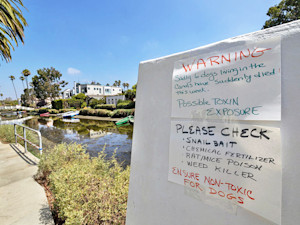
The scariest outbreaks are the ones that end without an answer. In the summer of 2025, dogs living near or visiting the Venice Canals in Los Angeles began collapsing, seizing, and dying with no warning, and by the time the cluster faded, a county investigation had produced toxin detections, plausible theories, and no confirmed cause. The case is worth revisiting not as a scare story but as a lesson in how these investigations actually work, and why the practical advice that came out of it applies to far more places than Venice.
A neighborhood watches its dogs collapse
The first reports reached Los Angeles County health officials in late July 2025, when a resident flagged a wave of severe, fast-moving illness in local dogs. The pattern that emerged was chilling. Previously healthy dogs of different ages, from different households, were deteriorating within hours. Owners and veterinarians described sudden neurological collapse, seizures and tremors, and cardiac arrest in the fatal cases. Dogs who survived tended to show lethargy, vomiting, diarrhea, and loss of appetite. The common thread: in most cases, a canal-side walk sat somewhere in the previous 48 hours.
The individual stories drove the fear home. One six-year-old rescue came home from a normal day, collapsed without warning, and died of heart failure that emergency veterinarians could not explain. Another dog, a longtime canal-side resident’s companion, declined from her first symptoms to death at home within days; she had a habit of licking her paws after walks, a detail her owner could not stop thinking about afterward. By early August, local outlets had counted seven deaths, including a visiting Arizona terrier whose only local exposure was a walk along the canals.
Residents reported other omens: an unusually foul smell along the eastern canals and a dead duck found in a docked boat. Early theories ranged from toxic algae to rodenticide to an unknown virus.
What officials told dog owners to do
County animal and public-health officials issued guidance for the Venice Canals area and neighboring Marina del Rey that remains a solid template for any urban waterway scare:
- Supervise pets closely outdoors, and keep dogs leashed on walks.
- Do not let dogs sniff or eat anything off the ground.
- Keep dogs away from standing water, and skip communal water bowls.
- If a dog shows any illness after visiting the area, call a veterinarian immediately and mention the exposure.
The county’s veterinary public-health team emphasized how unusual the cluster was: apparently healthy dogs from separate households, spanning young to senior, becoming critically ill or dying with peracute speed.
What’s new since this was written: the inconclusive verdict
In October 2025, the county released the results of its investigation, and the answer was that there was no clean answer. Investigators ultimately documented 27 canine illnesses and five confirmed deaths between June 6 and August 11, with about three-quarters of the cases packed into the two weeks from July 17 to 30. (Media tallies had run higher; the county’s confirmed count was stricter.)
The most suggestive finding came from the water. On July 30, the Regional Water Quality Control Board sampled canal water, algae, and surface scum, and detected microcystins, cylindrospermopsin, and anatoxin-a, a trio of toxins produced by cyanobacteria, the organisms behind harmful algal blooms. Anatoxin-a in particular is infamous in veterinary medicine for killing dogs quickly with neurological signs, which fit the case descriptions disturbingly well.
But the link could not be proven. Because many cases were reported late, biological samples existed for only three affected dogs, and none tested positive for the toxins. Officials noted that this does not rule out exposure, since several of these toxins degrade quickly and the right post-mortem samples were never collected. Harmful algal bloom exposure remains the leading possibility. Officially, the cause is undetermined, and the case file stays open.
The lesson that outlives the mystery
Three takeaways deserve to survive this story. First, urban standing water, canals, ponds, fountains, and gutters, can carry cyanobacterial toxins that kill dogs at small doses, and a bloom is not always visible from the path. Warm, still, nutrient-rich water in late summer is the classic setup. Second, paws count as exposure: dogs do not need to swim or drink to take in toxins if they walk through contaminated water or scum and lick themselves clean afterward. Rinsing a dog’s paws and belly with clean water after any contact with questionable water is cheap protection.
Third, and the one that could have changed this investigation: report fast. The Venice case went unsolved partly because samples did not exist by the time officials knew there was a pattern. If your dog becomes suddenly, severely ill after contact with a waterway, tell your veterinarian about the exposure explicitly, and ask them to notify local animal-health authorities the same day. It may not save the case, but it might solve the next one.
References
- What to know about mysterious deaths of dogs recently walked in the Venice Canals (LAist)
- Venice Canals mystery: Seventh dog dead amid unexplained illness outbreak (KTLA)
- County Unable to Find Cause After Investigation into Venice Canal Dog Deaths (Yo! Venice)
- Algae toxins found in water of Venice Canals amid investigation of dog deaths (ABC7 Los Angeles)
- Venice dog deaths prompt public health warnings for canal waters (CBS Los Angeles)
Not a substitute for your vet. Our guidance is educational. For urgent symptoms, contact a vet or emergency clinic right away. Editorial standards
Dr. Park is a board-certified emergency and critical care specialist. She reviews our health and safety content for clinical accuracy and contributes guides on recognising urgent conditions. Her focus is helping owners act quickly and correctly when it matters most.
Meet our experts ↗Keep reading
 FoodRaw Feeding Promises a Lot. The Evidence Delivers a Lot Less.Dr. Amara Solis · 8 min
 LivingCharleston Is a Dog Town on a Clock. Miss the Hours and the Trip Falls Apart.Leila Torres · 10 min
 Health & WellnessHalloween Looks Like the Safe Holiday for Dogs. It's Quietly One of the Worst.Dr. Priya Nair · 7 min
 Health & WellnessThere's an Actual Number for 'My Dog Drinks Too Much Water'Dr. Lena Park · 7 min
 Health & WellnessTwo Ounces of Gorilla Glue Can Put Your Dog in SurgeryDr. Ravi Mehta · 5 min
 TrainingThe Most Dangerous Dog Isn't a Breed. It's the One Nobody's Reading.Dr. Mara Chen · 7 min