


AirTags Still Aren't Pet Trackers. But the 2026 Model Closed Two Big Gaps
Apple never built AirTags for pets, and three flaws made that obvious: short range, a choking-hazard size, and no off switch. The new U2 AirTag fixes one and a half of them. Here's how to decide between a tag, a GPS collar, and the one thing both can't replace.

Affiliate disclosure. This article contains affiliate links. We may earn a small commission if you buy through a link, at no extra cost to you. How we handle recommendations.
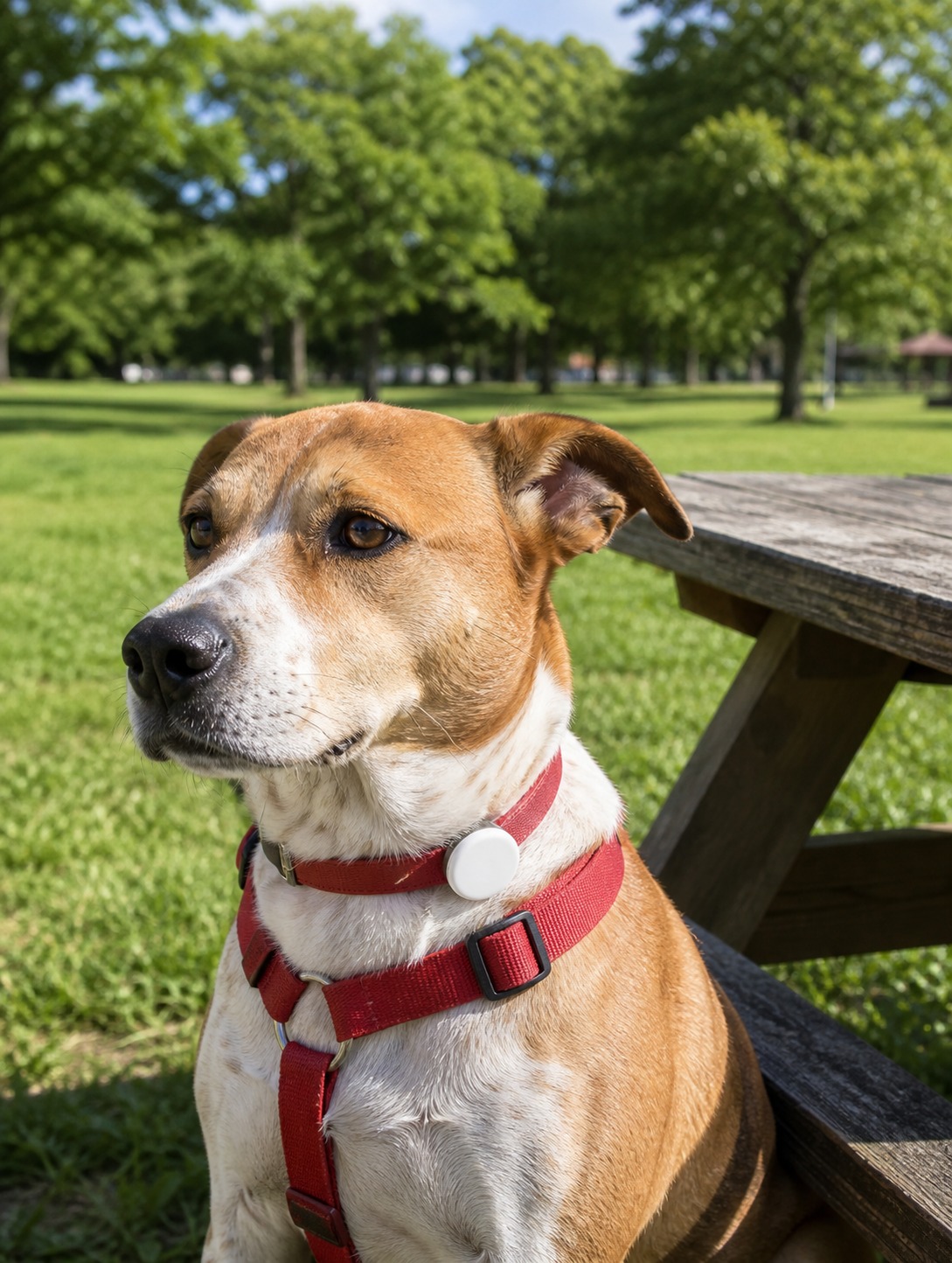
Apple has been clear from day one that AirTags are not for pets. Kaiann Drance, Apple’s VP of worldwide iPhone marketing, said as much to Fast Company right after launch in 2021. Owners ignored that immediately, and a whole accessory market sprang up to bolt a keys-and-luggage tracker onto a collar.
That gap between what AirTags are for and what people use them for produced three concrete problems: the range was too short for an animal that actually runs off, the size made it a choking hazard, and the device couldn’t be switched off. The useful news, and the reason this is worth revisiting now, is that Apple shipped a second-generation AirTag in January 2026, and it directly addresses one and a half of those three. So the real question isn’t “are AirTags good for pets” in the abstract; it’s “does the new one clear the bar, and against what.” Let’s run it down honestly, pro and con.
The case for an AirTag on your pet
It’s small and light, and that’s genuinely useful. At 1.26 inches across and 11 grams, an AirTag disappears into a collar mount without bothering most dogs or cats. For a small pet, that weight advantage over a chunkier GPS unit is real.
Find My is everywhere, and now it locks on faster. AirTags work by silently pinging the enormous network of nearby Apple devices running Find My. The original used Apple’s U1 ultra-wideband chip for Precision Finding; the 2026 model upgrades to the U2 chip, which locks on faster across large spaces, sees through walls and floors better, and notably improved floor-to-floor vertical tracking. In a city or a busy building, that’s the difference between “somewhere nearby” and “behind that closet door.”
The radiofrequency exposure is safe. If you’ve worried about constant emissions against your pet’s skin, the evidence is reassuring. A 2021 study in the National Library of Medicine found that the radiofrequency electromagnetic fields from trackers like these keep pet exposure well within healthy limits.
The case against, and where the new model falls short
Range is still the dealbreaker for a true escape. Here’s the half-fix. The U2 AirTag improved connectivity and added a louder speaker, but the core mechanic is unchanged: an AirTag has no GPS and no cellular radio of its own. It is only as findable as the density of nearby Apple devices. In a dense city, fine. On a rural road or in open country where your dog actually bolts, there may be no Apple device within range for hours, and the tag goes dark. A GPS collar like Tractive reports its own location anywhere with cell service. For a dog who genuinely roams, that distinction is the whole point, and no chip upgrade changes it.
It’s still a choking hazard, and still always on. The size that makes it convenient also makes it dangerous if it comes loose and is swallowed; removal can mean surgery. And because an AirTag emits constantly with no off switch, even the researchers behind that safety study recommended limiting wear time, putting a tracker on only when there’s an immediate need, like heading outside or leaving town, rather than 24/7. The 2026 model did not add an off switch, so this caution still stands.
Thieves know what an AirTag is. A quieter risk: if someone takes your pet, an AirTag is easy to recognize and toss. A GPS collar that looks like a collar is harder to spot and ditch.
How to actually choose
Strip away the brand talk and it comes down to three questions:
If you live somewhere dense, want to find a pet who’s hiding or wandered a few blocks, and already live in Apple’s world, a U2 AirTag in a secure mount is a cheap, light, sensible tool. Buy the new one for the better lock-on; the old one still works but you’ll feel the range limit sooner.
If your pet could genuinely cover distance, off-leash hikes, a rural property, an escape artist, skip the tag and get a GPS collar with a subscription. You’re paying for the one thing AirTags structurally can’t do: locate without borrowed devices.
Either way, mount it so it can’t be swallowed. Use a flush, secure holder rather than a dangling tag a playmate could grab. Two solid options: the ONEONTA waterproof collar holder, which sits tight against a one-inch collar, and the GOCII two-pack silicone holders for smaller pets. Both keep the tag flush instead of swinging.
The thing neither one replaces
A real pet parent named Frank (not his real name) used to AirTag his dog, Bill, until a neighbor’s sitter lost a dog and the family found the AirTag but never the dog, likely because whoever took her knew to remove it. He switched to a GPS collar. The lesson he drew is the one worth ending on: a tracker, any tracker, is a convenience layered on top of the actual safety net.
That net is a microchip. It needs no battery, can’t be tossed by a thief, and is the first thing a shelter or vet scans when a lost pet turns up. Confirm yours still reads at your next visit and that your contact info is current with the registry. Do that first. Then, if you want a tag or a collar on top, choose by the three questions above, mount it so it can’t be swallowed, and you’ll be in good shape either way.
References
Marcus Webb writes about the gear, gadgets, and everyday choices that make life with a pet easier. His coverage runs from product picks to training and the causes worth paying attention to, always with an eye on what actually earns a place in your home.
Meet our experts ↗Keep reading
 LivingYour Dog Can Now Call You. It Costs $105 and a Monthly Data Plan.James Okafor · 4 min
 Product PicksTikTok Sold You the Demo, Not the Dog. 7 Gadgets That Survive Real Life.Sasha Ford · 8 min
 Product PicksSkip the 'Pet Cam.' The Best One Is a Security Camera.Marcus Webb · 5 min
 Product PicksSmart Pet Gear, Sorted by the Problem It Actually SolvesMarcus Webb · 8 min
 Product PicksHow to Actually Buy an Air Purifier for a Pet Home (Plus 7 We'd Pick)James Okafor · 8 min
 Product PicksI Doubted a $30 Plastic Box Could Beat Litter Smell. It Did.Tom Hadley · 4 min