


Your Dog Is Breathing You In: How Your Own Exhale Becomes a Training Tool
Breathwork with your dog isn't woo. Dogs mirror your nervous system, so a slow, deliberate exhale can lower your dog's arousal as reliably as a treat. Here's the science and a two-minute practice.

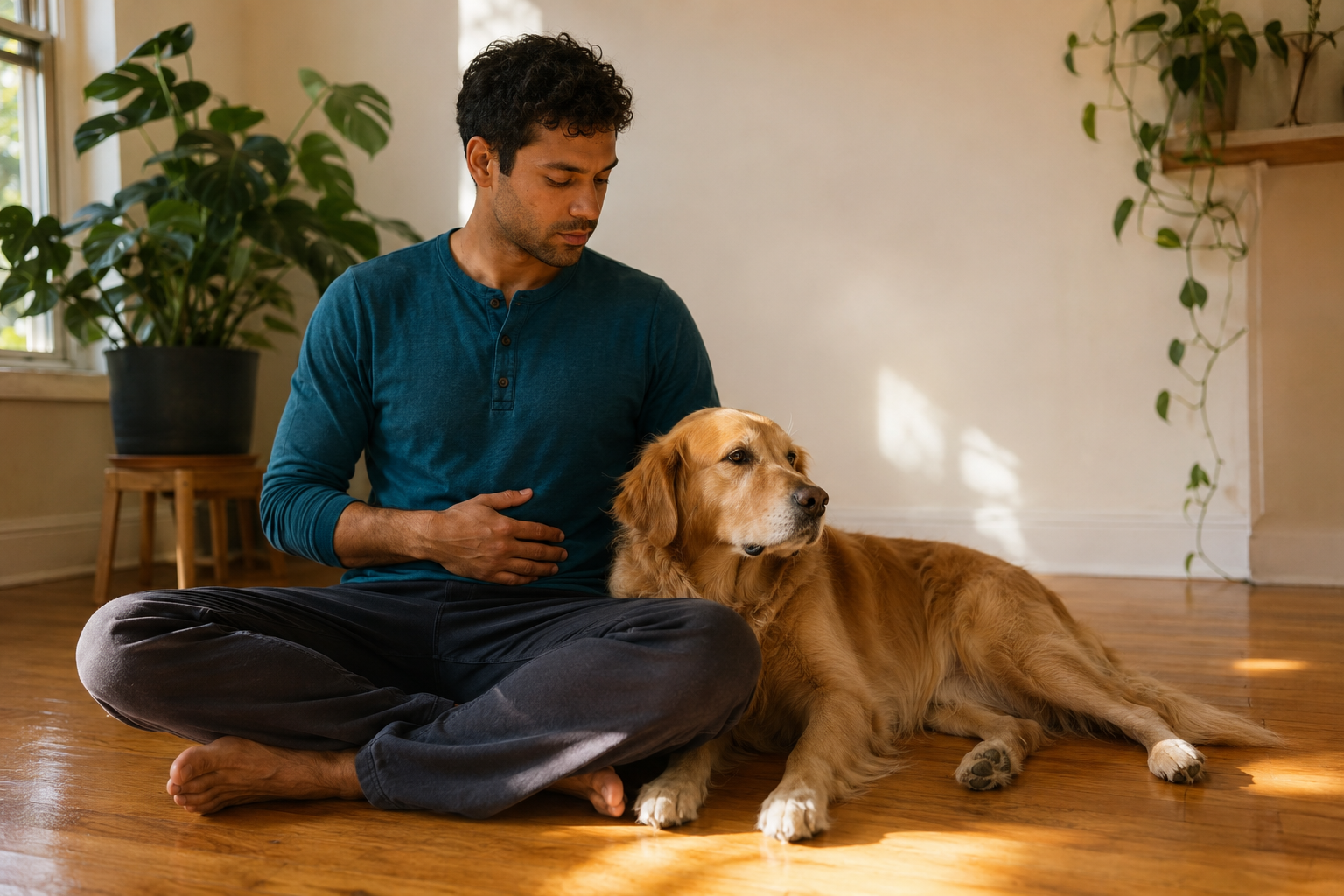
Here is a claim that sounds like a wellness-influencer fever dream and happens to be supported by a pile of randomized trials: the single most underused tool in your dog-training kit is your own breath. Not because your dog is doing breathwork. Because your dog is doing you. Dogs are relentless readers of the people they live with, and one of the loudest signals you send, whether you mean to or not, is the rhythm and depth of your breathing. Slow it down on purpose and you can pull your dog’s arousal down with you. Speed it up under stress and you drag them up.
This is the part the “breathe with your dog” advice usually skips. The benefit is not mystical, and it is not really about the dog’s lungs. It is about a well-documented loop between two nervous systems sharing a room. Understand that loop and breathwork stops being a vibe and becomes a technique, one you can deploy at the vet, during a thunderstorm, or in the half-second before your dog decides to lunge at the mail carrier.
The mechanism: your dog mirrors your state
Dogs co-regulate. That is the technical way of saying they tune their internal state to ours. When you are settled, you become a kind of thermostat for the room, and your dog tends to drift toward the temperature you set.
“Dogs read us constantly, far more than we read them,” says Dr. Nina Kohl, a veterinarian who works with anxious dogs. “A dog with a high baseline arousal, met by a person who is also wound up and breathing fast and shallow, has nowhere to land. The dog can’t bring itself down because the most important animal in the room is telling it, through breath and posture and heart rate, that there’s something to worry about.” Meet that same dog with a slow exhale and a soft body, and you have handed it a way down.
You can feel this in the obvious failure mode. Ask any dog walker who pulls out their phone mid-walk how it lands on the other end of the leash. The attention leaves, the dog notices, the connection drops. Presence is something dogs can detect, and breath is one of its clearest tells.
The evidence is better than the genre suggests
“Breathwork” gets lumped in with crystals, so it is worth being precise about what the research actually shows. A 2023 meta-analysis in Scientific Reports pooled randomized controlled trials and found that breathwork produced a small-to-medium reduction in self-reported stress compared with control conditions (effect size g = -0.35), with similar significant effects for anxiety (g = -0.32) and depressive symptoms (g = -0.40). Translation: across studies, people who did structured breathing felt measurably calmer than people who did not.
The mechanism has a name and a tempo. Breathing slowly, around five to six breaths per minute with the exhale at least as long as the inhale, is sometimes called coherent breathing, and it nudges the brain, heart, and lungs into a more synchronized rhythm that improves heart rate variability, a marker of a resilient, less reactive stress response. Cortisol, the stress hormone, tends to run lower during slow-paced breathing. (Honesty compels a caveat the influencers omit: a larger 2023 trial of coherent breathing did not beat a well-matched placebo on subjective stress at its primary endpoint, so the effect is real but not a miracle.) None of these trials studied dogs. But the relevant fact, that deliberate slow breathing reliably down-shifts a human nervous system, is exactly the input your co-regulating dog is reading off you.
Why a calmer you produces a more trainable dog
This is where breathwork earns its keep as a behavior tool rather than a self-care indulgence. A regulated handler does not just feel better, they get a dog who learns better.
“When you change your own state, you change the association the dog has with you, and you get a different dog in return,” Dr. Kohl says. “It’s why a dog can be perfectly fine with one person’s energy and on edge with another’s. Most of my work is teaching people the art of doing almost nothing on purpose, because that’s what lets the dog settle enough to take in a lesson.” A dog stuck in high arousal cannot absorb a cue; a dog that has co-regulated down to baseline can. Breathwork is one of the fastest ways to give them that baseline, and to let your dog start associating you, specifically, with the feeling of calm.
There is a bonus mechanism for dogs in particular. Modern pet dogs rarely use their noses the way they evolved to, and that under-stimulation feeds a lot of low-grade restlessness. Scent work helps because sniffing forces slower, deeper breathing, which itself is calming. In a sense, breathwork is to you what a good sniffari is to your dog: a way of slowing the breath until the body stops bracing.
A two-minute practice you can do right now
You do not need an app, a cushion, or a free hour. Sit near your dog and try this.
- Inhale slowly through your nose for a count of about four, letting your belly expand rather than your shoulders rising.
- Exhale longer than you inhaled, through your mouth, for a count of about six. The long exhale is the active ingredient, it is what signals “stand down” to your own nervous system.
- Repeat for two minutes, aiming for that five-to-six-breath-per-minute pace. If it helps, rest a hand on your dog’s chest or belly (only if they enjoy being touched there) and feel their breathing alongside yours.
- Notice the shift. Many people watch their dog yawn, sigh, reposition, or flop down within a few minutes. That is co-regulation happening in real time.
Use the same pattern strategically, not just on the meditation cushion. In a vet waiting room, before opening the door to a delivery, during fireworks: a few slow exhales reset the signal you are broadcasting before your dog can spiral on it.
When it clicked for me
When I started a regular breathing practice, my blind and deaf senior Pit Bull, Wally, began clomping over from wherever he was, nosing the door open, and flopping onto the rug beside me every single time. I used to think he was just following the sound. Now I am fairly sure he was reading the drop in my tension the way he read everything else, through proximity and the slow rhythm of a body that had stopped bracing. The nights I came home wound up, he stayed wound up with me. The nights I sat and breathed first, he melted. He was, in the most literal sense, breathing me in.
That is the reframe worth keeping. You are not performing a ritual at your dog. You are the regulating presence in their environment, and your breath is the dial. When you do not like the behavior you are seeing, the most reliable first move is not a sharper correction. It is a longer exhale.
References
- Fincham, Guy William, et al. “Effect of Breathwork on Stress and Mental Health: A Meta-Analysis of Randomised-Controlled Trials.” Scientific Reports, vol. 13, no. 1, 9 Jan. 2023. https://www.nature.com/articles/s41598-022-27247-y. Accessed June 2026.
- Fincham, Guy William, et al. “Effect of Coherent Breathing on Mental Health and Wellbeing: A Randomised Placebo-Controlled Trial.” Scientific Reports, 2023. https://www.nature.com/articles/s41598-023-49279-8. Accessed June 2026.
- Salamon, Maureen. “Co-Regulation: Helping Children and Teens Navigate Big Emotions.” Harvard Health, 3 Apr. 2024. https://www.health.harvard.edu/blog/co-regulation-helping-children-and-teens-navigate-big-emotions-202404033030. Accessed June 2026.
- American Kennel Club. “Keeping Calm in a Crisis: Why It’s Important for Both You and Your Dog.” https://www.akc.org/expert-advice/advice/keeping-calm-in-a-crisis/. Accessed June 2026.
Leila Torres leads our Living coverage, from home life and travel to the products and rescue stories that come with sharing a life with animals. She edits and writes across the section, with a soft spot for pieces about the bond between people and their pets.
Meet our experts ↗Keep reading
 Living'Unadoptable' Is a Description of the Building, Not the DogDr. Amara Solis · 7 min
 Health & WellnessThe Hot Car Isn't What Gets Most Dogs. The Walk Is.Dr. Priya Nair · 9 min
 TrainingYour Dog Isn't Shy at Your Party. Six Signs They Want Out.Dr. Lena Park · 8 min
 TrainingYou Can't Train Your Dog in a Moving Car. Start in the Driveway.Dr. Ravi Mehta · 8 min
 LivingThe Dog That Got You Through Lockdown Can Quietly Become a CrutchNina Vasquez · 5 min
 LivingYour City Dog Isn't 'Reactive.' The Sidewalk Is Screaming at Them.Dr. Mara Chen · 8 min