


Trapping the Cats Was Never the Hard Part
Sterling 'TrapKing' Davis quit a rap career to run TNR out of an RV. His real innovation is not the trap, it is a recruiting model he calls inreach, and in 2022 he took it to Greece to find out whether it travels.

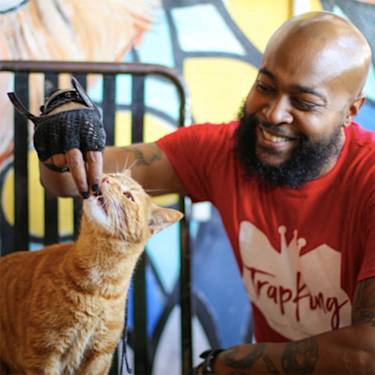
The best moment in Sterling Davis’s job is not the trapping. It is the part where he explains the terms.
He shows up, he says he will trap the cats in your yard, get them spayed or neutered and vaccinated, hand you the paperwork, and bring them back. And the person listening does the math, and asks what they owe him. And he tells them nothing, and watches their face.
That reaction is the whole business, because the thing standing between American cities and their community cats has never been a shortage of traps.
The problem TNR actually has
Trap-neuter-return is not complicated. Community cats get humanely trapped, sterilized, vaccinated, ear-tipped so everyone knows they have been done, and returned to the territory they already live in. It is the only approach that reduces the population over time. You cannot adopt your way out of it, because there are far too many cats, and a large share of them are genuinely feral and would be miserable in a living room.
The technique is settled. The bottleneck is human. TNR only works if it happens at scale in a specific neighborhood, and it only happens at scale if the people who live there let it happen, which means they have to trust the person carrying the traps.
That is where most programs quietly fail. An organization drives in from somewhere else, does a weekend of trapping, and drives out. The cats it missed keep breeding. The residents, who were never consulted, remember mostly that strangers were in their yards after dark.
Davis built his entire model around that failure.
From a tour bus to a shelter’s litter room
He was a Navy operations specialist first, then a rapper with a career going somewhere. In 2015, between tours, he took a job scooping litter at a county shelter. It was supposed to be a gap.
It was not. He was promoted into outreach, discovered TNR, and by 2017 had launched his own nonprofit, TrapKing Humane Cat Solutions. He has spent the years since living and working out of an RV with his name on the side, running TNR in cities across the country, rehoming the cats who are actually adoptable, teaching people how to care for the ones who are not, and pushing, hard, on who gets to belong in animal welfare. A Netflix docuseries put a camera on him. His slogan, printed on the truck, is that you do not lose cool points for compassion.
His own cats have travelled most of it with him.
Inreach
Outreach means an organization coming into a community to fix something. Davis’s word for what he does instead is inreach, and the difference is not semantic.
The method, in his telling, is disarmingly small. He arrives at an apartment complex and runs a contest with the teenagers who live there. Watch my traps, he tells them. The first one who texts me when a cat goes in gets thirty dollars, the second gets twenty-five, the third gets twenty, and so on down the line.
Then he leaves, and comes back, and the kids ask when he is doing the cat thing again. And on the day he tells them he cannot pay this time, somebody says they will do it anyway.
That person is the point of the entire exercise. Davis has just found the one resident who cares, who already knows every yard on the block, who can knock on a door that would never open for him, and who will still be there in six months when he is three states away. He is not delivering a service. He is recruiting a colleague and handing over the resources.
He has developed the approach alongside CARE, a BIPOC-led nonprofit working on equity in animal welfare, and it maps onto a truth that anyone who has worked in this field knows and few say out loud: the misunderstanding is usually mutual, and the fix is almost always communication rather than enforcement.
The messenger is part of the message
Davis is blunt about the optics he walks into. A bald, tattooed Black man is standing near your fence at two in the morning saying he is only here for the cats.
The joke has a serrated edge, because the reason it lands is that American animal welfare is overwhelmingly white, and both halves of that fact cause damage. Communities of color get treated as the problem rather than the partner. And people who would be extraordinary rescuers never see anyone who looks like them doing the work, so it never occurs to them that the work is available.
Changing who is visible in this field is not a side project of Davis’s. It is arguably the main one, and the cats are how he does it.
“Sterilizing a colony is the easy part, and I say that as the person holding the surgical schedule,” says Dr. Nina Kohl. “What determines whether that colony is smaller in three years is whether somebody who lives on that street is still watching it after the van leaves. That is not a veterinary problem. That is a trust problem, and we are only now taking it as seriously as the medicine.”
Then he took it to Greece
In May 2022, Davis found out whether any of this exports.
He spent roughly two weeks in Greece, from the ninth to the twentieth, on a national awareness campaign built with the animal welfare organization Let’s Be SMART. They called it Rap to Trap, which tells you exactly how much of his old career he brought along. He travelled with a team of vets and vet techs, ran clinics, and did what he does in Atlanta: got in front of people and made sterilizing cats sound like something a normal person does.
The scale of the Greek problem is genuinely difficult to hold in your head. The country is estimated to have around two million stray and feral cats. Rescuers there are not indifferent, they are overwhelmed and under-resourced, which is the same sentence you could write about most American cities, in a place where the cats are a postcard.
The interesting result was not the number sterilized in two weeks, which was never going to dent two million. It was that the model survived translation. The bottleneck in Greece turned out to be the same one it is in Georgia: not the surgery, not the traps, but whether the people who live with the cats see the work as theirs.
The arithmetic that keeps him driving
The United States is thought to hold something on the order of 70 million stray cats. Kitten season, the spring surge when unsterilized cats produce litter after litter, arrives every year like weather.
Against that, one man in an RV is a rounding error, and he knows it. Which is precisely why he spends his time recruiting rather than trapping. Every teenager who texts him about a trap is a person who might still be doing this in a decade, in a neighborhood he will never revisit.
The recognition has followed. He was named the ASPCA’s Cat Advocate of the Year in 2021, which is a strange sentence to write about someone whose entire pitch is that the work does not require a special sort of person.
If you want to do something
- Find your local TNR group. Almost every city has one, and almost every one of them is short on hands rather than on need. You do not need to know anything yet.
- Learn to run a trap. It is a skill you can pick up in an afternoon from people who will be delighted to teach you.
- Fund the surgery, not the sentiment. The single most useful dollar in this field pays for a spay. Donate directly to TrapKing Humane Cat Solutions or to a local clinic doing high-volume sterilization.
- Feed responsibly, or not at all. Feeding a colony without sterilizing it makes the problem worse, not better. If you feed, commit to getting them fixed.
- Be the person on your block. That is the whole model. Somebody has to be the one who notices, and it might as well be you.
References
- TrapKing Humane Cat Solutions, official site
- ASPCA, “Meet the 2021 ASPCA Cat Advocate of the Year”
- Let’s Be SMART, Rap to Trap campaign
- Kreisler, R.E., Cornell, H.N., Levy, J.K. “Decrease in Population and Increase in Welfare of Community Cats in a Twenty-Three Year Trap-Neuter-Return Program.” Frontiers in Veterinary Science, 2019.
- CARE (Companions and Animals for Reform and Equity), careawo.org
James Okafor covers rescue, adoption, and the causes shaping animal welfare. His work follows the people and organisations working to give more pets a home, and the issues owners and advocates care about most.
Meet our experts ↗Keep reading
 LivingA Guy Who Mows Lawns for Free Accidentally Saved a Cat SanctuaryNina Vasquez · 4 min
 LivingBrooklyn's Cat Cafe Flipped the Model: It's a Rescue Clinic With a Cafe AttachedSara Lim · 6 min
 LivingYou Can't Adopt Your Way Out of a Cat Crisis. This Brooklyn Nonprofit Proved ItLeila Torres · 7 min
 LivingThe Only Part of TNR People Fight About Is the Part That WorksLeila Torres · 7 min
 LivingThe Nonprofit Getting Hundreds of Businesses to Bankroll Cat RescuesNina Vasquez · 5 min
 LivingShe Rented a House in Tucson and Inherited 30 Cats. The Internet Did the Rest.Nina Vasquez · 6 min