


She Rented a House in Tucson and Inherited 30 Cats. The Internet Did the Rest.
Courtney Gustafson moved in and discovered a feral colony living in the carport. What started as updates for her dad became a movement, a down payment, and eventually a bestselling book.
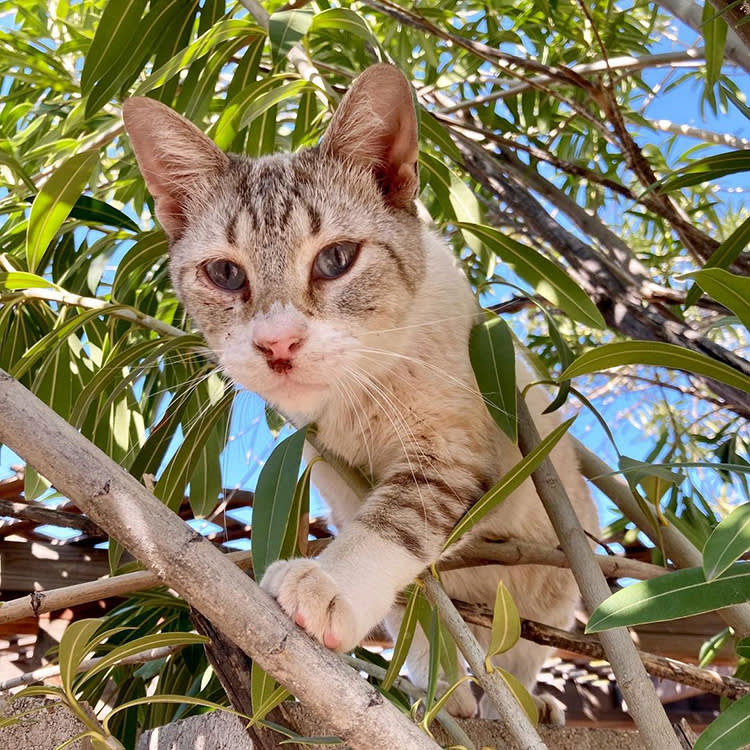
When Courtney Gustafson and her partner signed the lease on a rental in Tucson, Arizona, the listing did not mention the roommates. There were thirty of them. All cats. None of them theirs, at least not yet.
They did not appear all at once. For a while there was not a cat in sight. Then, slowly, one materialized outside the house, then another, then more, until the couple realized their carport had become the neighborhood’s unofficial cat sanctuary. Some were friendly. Some were hungry. Some were visibly pregnant. The couple started putting out food twice a day, and named the colony after the street: Poets Square.
Then a car killed one of them, and feeding stopped being enough.
From feeding to fixing
That death is what turned two people quietly leaving out kibble into an actual rescue operation. Gustafson connected with the local rescue community and started trapping the cats for a trap-neuter-return program, the humane standard for stabilizing a feral colony. You catch each cat, get it spayed or neutered and vaccinated, and return the ferals to their territory while the friendly ones get adopted out.
It worked. The friendly cats found homes. The truly feral ones stayed, cared for, no longer reproducing. Month by month the colony of thirty shrank to eight core residents, plus the occasional drifter from a neighboring colony with a name too good to leave out, Jurgen, Karl Havoc, Banjo, Crunchwrap Supreme. Every new arrival got trapped, fixed, and folded in.
“Trap-neuter-return is the part of cat rescue that actually solves the problem instead of chasing it,” says Dr. Amara Solis. “You are not just helping the cats in front of you, you are stopping the next three litters before they happen. A stabilized, vaccinated colony is healthier, quieter, and steadily gets smaller. It is slow, unglamorous work, and it is the thing that works.”
An accidental audience
Gustafson originally started the @poetssquarecats Instagram account for an audience of essentially one: her dad, a fellow cat lover who wanted updates on the crew. It grew into something else, a place to connect with other people who found daily meaning in the small dramas of eight outdoor cats.
The turn came on a holiday. Gustafson cooked the colony a proper Thanksgiving, tiny plates of cat-safe roasted Cornish hen, vegetables, and mashed potatoes, served on little dishes, and posted it. The internet lost its mind over the image of neighborhood cats being hand-delivered miniature Thanksgiving dinners. The post rocketed to the top of Reddit, got picked up by the news, and the following exploded overnight. Suddenly hundreds of thousands of strangers were emotionally invested in a carport in Tucson.
Meet a few of the regulars
Sad Boy. The colony’s white-furred elder statesman, a big wise face who never warmed to humans but very much warmed to wet food, cozy beds, and Lola.
Lola. Sad Boy’s devoted partner, usually found on the roof beside him at sunset, and perpetually suspicious that Gustafson had designs on her man.
MK. A tiny calico who slept with her paws in the air, favorite yellow mouse toy nearby, and who once scandalized Lola by trying to befriend Sad Boy.
Monkey. A playful calico with a comically small head whose main hobbies were napping with her tongue out and chasing rocks around the yard.
When the fame collided with real life
Just as the cats went viral, the ground shifted. The couple’s landlord decided to sell the house they were renting, and buying it had never been on their radar. They could not cover a down payment, and moving the colony felt impossible and wrong, since the carport was the only safe, sheltered, twice-fed home these cats had ever known.
Gustafson told her nearly-a-million followers what was happening. Unprompted, donations started arriving through the PayPal she had set up for cat food. She launched a GoFundMe with what she thought was an ambitious $5,000 goal.
The colony hit it in under an hour. Fans begged her to raise the ceiling. Within a single day, between Instagram and TikTok, the fundraiser pulled in $50,000, enough that Gustafson found herself explaining to a mortgage lender how eight cats had raised a down payment in 24 hours. They bought the house. The colony stayed.
What she did with it
Gustafson did not stop at saving her own eight. After closing, she began trap-neuter-return work on a second colony she named Big Cheddar, and started organizing supply drives for underfunded rural shelters across the area, all while continuing to care for the original Poets Square residents. Followers wrote to say she had inspired them to get into cat rescue themselves.
What’s new since this was written
Gustafson turned the colony’s story into a book. Poets Square: A Memoir in Thirty Cats was published in the spring of 2025 and went on to become a New York Times bestseller, named a best book of the year by outlets including NPR. It is less a cute-cat book than it looks: alongside the colony’s rise, Gustafson writes about hunger, community, and care, drawing a line between the cats living precariously outside her door and the human precariousness she saw in her own life and in the food-bank work she did.
The eight core cats and the movement they sparked are the seed of all of it. Sad Boy, the old white patriarch, died in September 2023 of an inoperable abdominal mass, and Lola grieved him openly. In a detail Gustafson shared afterward, birds arrived the next morning to gather bits of his fur from his towel, presumably to line their nests, so that, as she put it, he would live on woven into homes all over the neighborhood. It is a fitting note for a project that was always, underneath the memes, about making sure the vulnerable have somewhere safe to land.
References
Nina Vasquez writes about life at home with pets and the relationships at the heart of it. Her work covers day-to-day living, people-and-pet stories, and the products that fit into a real household, with a warm, grounded take on everyday pet ownership.
Meet our experts ↗Keep reading
 LivingTrapping the Cats Was Never the Hard PartJames Okafor · 8 min
 LivingThe Nonprofit Getting Hundreds of Businesses to Bankroll Cat RescuesNina Vasquez · 5 min
 LivingOne Ohio Shelter Turned Your Worst Ex Into Its Best FundraiserSasha Ford · 3 min
 LivingYou Can't Adopt Your Way Out of a Cat Crisis. This Brooklyn Nonprofit Proved ItLeila Torres · 7 min
 LivingA San Diego Judge Redefined 'Abandonment' for Cats. Shelters Everywhere Are Watching.Marcus Webb · 6 min
 LivingThe Only Part of TNR People Fight About Is the Part That WorksLeila Torres · 7 min