


Tortie or Calico? It's Not About the Colors. It's About the White.
Tortoiseshell and calico cats run on the exact same two pigments and the exact same coin-flip. A completely different gene decides which one you're looking at.

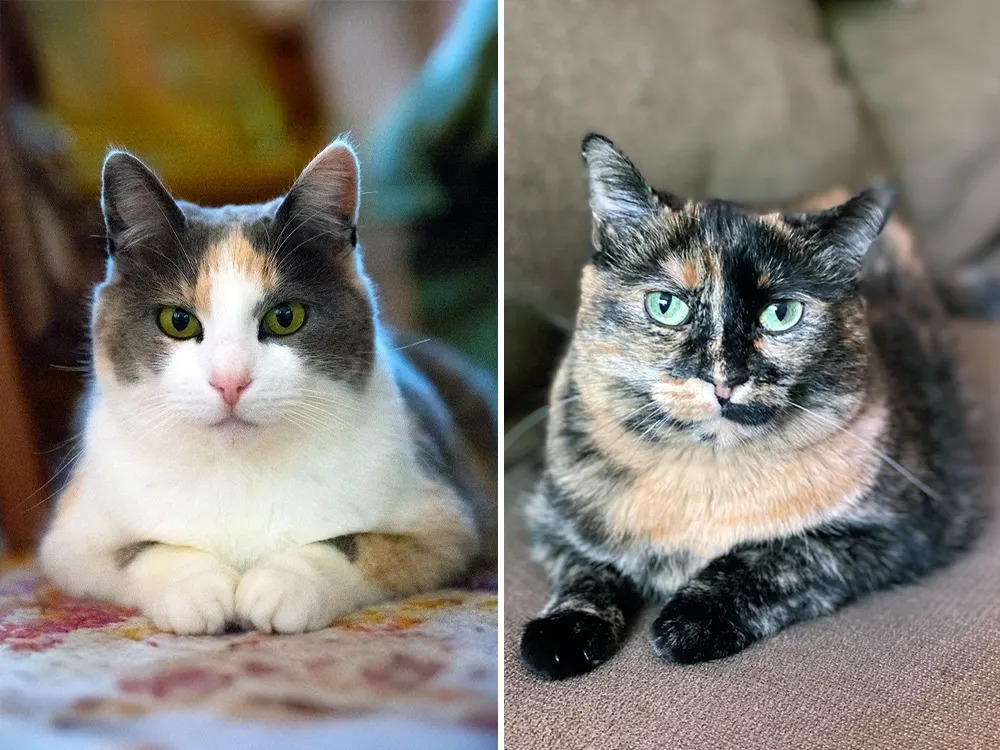
Ask which cat is the tortie and which is the calico and you will hear an answer about color. Torties are darker. Calicos are brighter. Torties are marbled, calicos are patchy.
All true, and all beside the point.
Here is the thing almost nobody says out loud: a tortoiseshell and a calico are running the exact same genetic program. Same two pigments. Same coin-flip. The difference between them is not written in black or orange at all. It is written in white, by a completely separate gene that has nothing to do with either color.
Once you see that, the whole thing stops being a color quiz and starts making sense.
The two pigments, and the coin-flip that shuffles them
Cats really only have two pigments to work with. One makes black and its softer variations, brown and grey. The other makes orange, red, and cream.
There is a switch that decides which of the two a given patch of skin will produce, and that switch lives on the X chromosome. That single fact drives everything else.
A female cat carries two X chromosomes. Very early in development, in every cell, one of those two X chromosomes shuts down at random and stays down. Every cell that descends from it inherits the same choice. If one X carries the orange version of the switch and the other carries the non-orange version, the result is a body built out of two interleaved populations of cells, some running orange, some running black. That is a tortoiseshell.
A typical male has one X and one Y. He gets one copy of the switch, so he gets one answer: orange all over, or not orange at all. He cannot be both.
That is the whole mechanism, and it is the reason both patterns are overwhelmingly female.
For 100 years nobody could name the gene. In 2025, two teams did.
The X-linked orange switch is one of the most famous unsolved puzzles in mammal genetics. Researchers have known roughly where it sat and exactly what it did since the early 1900s. They just could not find it.
They found it in 2025. Two independent teams, one at Stanford and one at Kyushu University in Japan, published in Current Biology that orange in cats comes from a small deletion near a gene called ARHGAP36 on the X chromosome. The deletion switches the gene on in pigment cells where it normally has no business being active, and its presence flips those cells from making dark pigment to making orange.
Two details are worth pausing on.
The first is that this mutation appears to be unique to cats. No other mammal makes orange this way. The ginger cat is, genetically speaking, doing something no other animal on earth does.
The second is that it finally puts a name on the thing your tortie is doing every square inch of her body. Each patch of orange on her is a cluster of cells where the X carrying the ARHGAP36 deletion won the coin toss. Each black patch is a cluster where it lost. She is not a cat with a pattern painted on her. She is a live mosaic of two genetically different cell populations, and you can see the seam.
So where does the calico come from?
Now for the part the color descriptions skip.
If tortoiseshell is the whole mechanism, a calico must be something added on top. And it is. Calico is a tortoiseshell plus white spotting, and white spotting is controlled by a different gene on a different chromosome entirely.
White spotting works by interfering with pigment cells before they ever finish migrating out to cover the skin. Where they do not arrive, no pigment gets made, and the fur grows in white. It is not a third color. It is an absence.
And here is why that absence changes the look so dramatically. On a cat with no white, the orange and black cell populations grow into each other and blend at the edges. You get that soft, swirled, marbled coat, orange and black bleeding into one another with no clear border. On a cat with a lot of white, the pigmented cells are pushed into separate territories with white in between them. They cannot blend, because they never touch. So you get blocks. Crisp, distinct, defined patches of orange and black sitting on a white base.
Same two pigments. Same coin-flip. Different amount of white. That is it. That is the entire difference, and it means the honest way to tell a tortie from a calico is not to squint at the colors at all. It is to ask a much simpler question: how much white is this cat wearing?
Little to none, blended: tortie. A lot, with defined patches: calico.
People come in convinced they need to learn to read the black and the orange. They don’t. Both cats have the same black and the same orange. Look at how much white is underneath it, and you’ve already got your answer.
The male tortie, and what the rarity actually costs him
Because the orange switch is on the X, a cat needs two Xs to show both colors. So a male tortie or calico needs an extra one. He is XXY.
He is genuinely rare, and cat people treat him as a novelty, but it is worth being clear about what the rarity actually is. XXY is a chromosomal disorder, not a lucky roll. These males are almost always sterile. They are not a valuable breeding line and they are not a lottery ticket. They are cats with an extra chromosome, and they should be neutered and cared for like any other cat.
There is a rarer route as well. A very small number of fertile male torties turn up that are not XXY at all, and appear instead to be genetic mosaics or chimeras, carrying two different cell lines from a single early event. These are the true genetic oddities, and they are documented in the literature precisely because they are so unusual.
”Tortitude” and “calico sass,” handled honestly
Both patterns arrive with a reputation. Torties are supposed to be feisty, independent, vocal, opinionated, and bonded ferociously to one person. Calicos are supposed to be sweet but spicy: energetic, playful, strong-willed, affectionate on their own terms.
Ask a room full of cat people and you will get near-total agreement. Ask the research and you get much less. Coat color is not a reliable predictor of personality in cats, and the confident personality legend around these two patterns is not something science has established.
That does not make the observation worthless. It makes it an observation. Vets, breeders, and long-time cat parents have been reporting the same thing for decades, and it is fair to say the pattern has a reputation while being honest that the reputation is not a finding. What is not fair is picking a cat because you were promised a personality. You will not be choosing tortitude. You will be choosing a cat, who will have whatever personality she has.
Care: genuinely identical, and here is where people get it wrong
There is no such thing as tortie care or calico care. The coat pattern changes nothing about what the cat needs.
- Grooming tracks with coat length, not pattern. A shorthair of either pattern is fine with a weekly brush. A longhaired one, a Persian or Maine Coon in either pattern, needs brushing several times a week.
- Nutrition is the same as any cat: a complete, balanced diet, real portion control, and fresh water always available.
- Enrichment is the same: daily play, vertical space to climb, scratching posts, and interactive or puzzle feeders.
- Veterinary care is the same: yearly exams, moving to twice a year as they age, with the usual vaccines, dental work, worming and flea cover, and a check on the scale each visit.
- Health risk does not track with coat at all. There is no known association between coat color or pattern and disease in cats. Health risk follows breed, age, and body condition.
The one place the reputation does earn a practical note: if your cat is one of the bold, opinionated ones, environmental enrichment and positive reinforcement will get you much further than trying to out-stubborn her.
Which breeds carry which
Neither pattern belongs to a breed, but plenty of breeds carry them.
Purebreds that commonly show tortoiseshell: American Shorthair, British Shorthair, Persian, Maine Coon, Cornish Rex, Devon Rex, Oriental Shorthair, Japanese Bobtail, and Sphynx. The longhaired ones, particularly Persians and Maine Coons, wear it spectacularly, because the length lets the marbling spread out.
Purebreds that commonly show calico: American Shorthair, Persian, Maine Coon, Japanese Bobtail, Norwegian Forest Cat, Scottish Fold, Manx, Turkish Van, Oriental Shorthair, and British Shorthair. Calico Persians and calico Japanese Bobtails are the showstoppers here.
And two terms worth having: a torbie is a tortie with tabby stripes layered on top. A caliby is a calico with the same. Both are common, and both are just the tabby gene making itself visible through the pattern underneath.
Choosing one
If you want a coat that blends and swirls and shifts depending on the light, you want a tortoiseshell, and specifically one with very little white. If you want crisp, high-contrast, unmistakable patches, you want a calico, and the more white she has, the more defined those patches will be. Torties with no white at all are the less common of the two.
Coat length and breed are entirely up to you, because both patterns turn up across most breeds and in mixed-breed cats everywhere.
But choose the cat. Not the pattern. Sit with her, watch how she handles a stranger’s hand and a new room, and pick the one whose actual temperament fits your actual home. The genetics are a beautiful story. They are not a personality test.
What newer research adds
The big one is the 2025 discovery of ARHGAP36 as the orange gene. It closed a question that had been open for over a century, and it did it twice over, with two teams landing on the same answer independently.
It matters for more than trivia. Now that we know the gene, we know that orange in cats is caused by a deletion that turns a gene on in the wrong place, rather than by breaking a pigment gene the way most coat-color mutations do. That is an unusual mechanism, and it is why cats are the only mammal that makes orange this way.
For you, standing in a shelter looking at a tortie, it does not change a single thing about her care. But it does mean the cat in front of you is carrying one of the strangest and most-studied mutations in mammalian biology, and she has been carrying it, unbothered, the entire time we were looking for it.
References
- Kaelin, C. B., et al. “Molecular and genetic characterization of sex-linked orange coat color in the domestic cat.” Current Biology, 2025. https://www.cell.com/current-biology/fulltext/S0960-9822(25)00552-4
- Toh, H., et al. “A deletion at the X-linked ARHGAP36 gene locus is associated with the orange coloration of tortoiseshell and calico cats.” Current Biology, 2025. https://www.cell.com/current-biology/fulltext/S0960-9822(25)00391-4
- Foster, R. A. “Disorders of sexual development in the cat: current state of knowledge and diagnostic approach.” Journal of Feline Medicine and Surgery, vol. 24, no. 3, 2022, pp. 257–265. https://doi.org/10.1177/1098612X221079710
- Owen, R. E. “Half-chromatid mutation as a possible cause of mosaic males and females in Hymenoptera and rare fertile male tortoiseshell cats.” Genome, vol. 66, no. 11, 2023, pp. 295–304. https://doi.org/10.1139/gen-2023-0018
Common questions
Is a tortoiseshell a breed?
No. Tortoiseshell is a coat pattern, not a breed. Plenty of purebreds carry it, including American Shorthairs, British Shorthairs, Persians, Maine Coons, Cornish Rex, Devon Rex, Oriental Shorthairs, Japanese Bobtails, and Sphynx, and so do countless mixed-breed cats.
What is the actual difference between a tortie and a calico?
White. Both cats are running black and orange pigment from the same X-linked switch. A calico has large white patches, which push the black and orange apart into distinct blocks. A tortie has little or no white, so the two colors stay marbled together.
Why are almost all torties and calicos female?
The orange switch sits on the X chromosome. A cat needs two X chromosomes to run both black and orange at once, and typical males only have one. A male tortie or calico usually has an extra X (XXY), which is rare and almost always leaves him sterile.
What is a torbie or a caliby?
A torbie is a tortoiseshell with tabby striping layered on top. A caliby is a calico with tabby striping. Both are the same underlying pattern with the tabby gene showing through.
Do tortie and calico cats have different health risks?
No. Coat color and pattern are not linked to any known health condition in cats. Health risks track with breed, age, and body condition, not with the color of the fur.
Dr. Chen is a small-animal veterinarian who leads health and safety coverage at The Pet Times. She writes and reviews the bulk of our illness, condition, and safety content, translating clinical guidance into clear, practical advice owners can act on at home.
Meet our experts ↗Keep reading
 TrainingIntroducing Two Cats? Go Slower Than You ThinkDr. Nina Kohl · 7 min
 Health & Wellness16 Hours of Sleep Is Normal. The Cat You Should Worry About Sleeps 'Fine.'Dr. Lena Park · 8 min
 LivingAnimal Communicators Aren't Reading Your Cat. They're Reading You.Leila Torres · 8 min
 LivingCan Cats Sense When Death Is Near? Inside the Mystery of Oscar the CatTom Hadley · 7 min
 Health & WellnessA Blind, Paralyzed Cat Isn't a Tragedy. It's a Setup Problem.Dr. Nina Kohl · 7 min
 LivingShe Says 'Meow' Instead of 'Hello.' Meet Fashion's Most Committed Cat Lady.Claire Sutton · 4 min