


The Greenest Cat Toy Is the One Your Cat Doesn't Reject in a Week
Sustainable cat gear is mostly theater if the cat ignores it. Six eco-friendly picks judged on the only metric that matters: whether the thing survives contact with an actual, deeply unimpressed cat.
There is a version of eco-conscious pet shopping that is really just a nicer-looking landfill.
You buy the bamboo thing, the felted thing, the compostable thing. The cat sniffs it once, files it under Not For Me, and goes back to sleeping in the box the bamboo thing arrived in. The item was renewable, recyclable, and responsibly sourced, and it is now waste, because the cat did not want it.
A sustainable product that gets rejected is not a sustainable product. It is just a better-mannered piece of garbage.
So the picks below are sorted by the only test that actually matters: does the cat engage with it, and does it survive being engaged with. Materials come second, which is a slightly heretical thing to say in an eco gift guide, and it is also the only honest way to write one.
1. A cat grass growing kit
Why it earns a spot: it is the rare cat product that is consumed rather than discarded, which means it generates almost no waste by design.
If you have ever tried to grow cat grass from one of those little plastic pouches, you know how temperamental it is. A proper cultivating kit is both better for the environment, since it eliminates the endless single-use pouches, and a substantially more rewarding process. You get farm-to-table service for an animal who will still act like you owe them something.
Who it is not for: a cat who has never shown any interest in plants. Start with a cheap test before you commit to a kit.
2. Catalyst upcycled soft wood litter
Why it earns a spot: litter is the highest-volume, highest-waste category in cat ownership by an enormous margin, which makes it the one place a switch actually moves the needle.
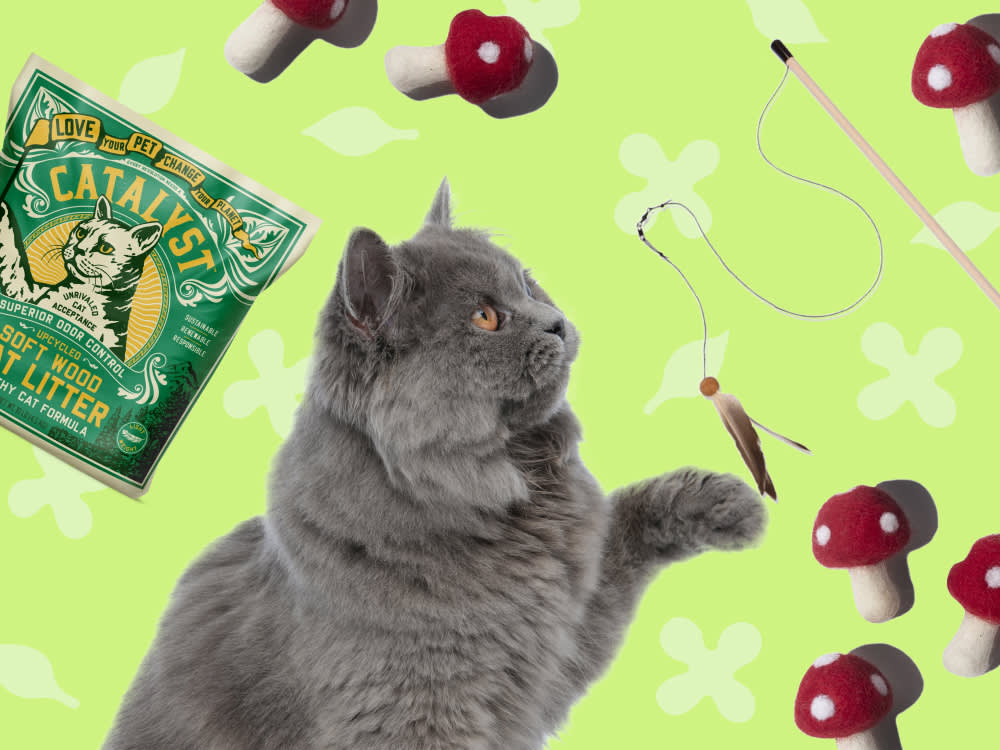
Everything else on this list is a toy or a piece of furniture bought once. Litter is bought forever. Catalyst’s upcycled wood litter delivers a month’s supply with strong odor control, and it is made from a waste stream rather than strip-mined clay.
That last part deserves emphasis. Conventional clumping litter is largely sodium bentonite clay, obtained through surface mining. If you make exactly one sustainable swap in your cat’s life, this is the one with the largest footprint attached to it.
Who it is not for: a cat with a strong, established texture preference. Cats can be intensely conservative about litter, and a cat who refuses the new litter will simply go somewhere else, which is a far worse outcome than the clay. Transition slowly, mixing it in over a couple of weeks.
3. A bamboo cat cave
Why it earns a spot: it is furniture, so it is the item on this list most likely to still exist in five years.
Handmade and carved from actual bamboo, which is a genuinely fast-renewing material, with a washable velvet cushion so it does not become permanently disgusting. It also has the underrated virtue of not being an eyesore, which matters more than eco-shoppers like to admit: the pet furniture that gets thrown away early is usually the pet furniture nobody could stand to look at.
Who it is not for: a cat who does not do enclosed spaces. Some cats want a cave and some want a lookout. Watch which one yours already chooses.
4. Felted mushroom toys from Package Free Shop
Why it earns a spot: they are the correct size, which is the entire secret of cat toys and almost nobody gets it right.
Package Free Shop notes that these Friendsheep felted toys are the perfect size for a cat’s mouth, and that is not a throwaway detail. A cat toy has to be carryable. A cat that can pick a thing up, walk around with it, and deposit it in a shoe is a cat who has adopted the toy. A toy too large to carry is a decoration.
They are wool, they are hand-felted, and they are roughly $14 for a set. They are also, undeniably, tiny mushrooms, and there is a strong argument that watching a cat batter a small red mushroom around a kitchen is worth the money on its own.
Who it is not for: a hard-core shredder. Wool felt holds up well to batting and poorly to sustained dismemberment.
5. A cork, hemp, and wood twirling toy
Why it earns a spot: it gives the cat a job, which is the difference between a toy that lasts and a toy that gets abandoned.
Made from all-natural biodegradable materials including cork, hemp, and wood, this one is built to trigger the hunting sequence rather than just sit there being sustainable. That matters: cats do not get bored of prey, they get bored of objects. A toy that moves unpredictably is engaging a drive; a toy that lies inert on the rug is engaging nothing.
Who it is not for: a cat who needs a human on the other end. Some cats will only hunt what you are moving. If yours is one, put the money into a good wand toy instead and use it twice a day.
6. P.L.A.Y. Arty Cat Scratcher, made from recycled paper
Why it earns a spot: it is the item on this list that saves you money, and it is made of the thing that would otherwise be in your recycling bin.
There is no better way to protect your furniture than to give the cat a scratching surface they actually prefer, and this one is built from recycled paper. That is a neat closed loop: waste paper becomes the object that prevents your couch from becoming waste.
The buying rules for any scratcher, and they matter more than the material: it has to be tall enough for a full stretch, heavy or stable enough not to wobble, and placed where your cat already scratches, not where it matches your rug. A scratcher that tips over gets used once.
Who it is not for: a horizontal scratcher. Watch your cat. Some are vertical scratchers and some work flat, and buying the wrong axis is the most common reason a scratcher gets ignored.
The rules underneath all six
People buy a sustainable cat product and feel good for about four days, which is roughly how long it takes the cat to decide. Watch what your cat already does, then buy the greener version of that. Do not buy the greener version of a cat you wish you had.
Three principles do most of the work here:
Buy for the cat you have. Observe first: does yours hunt, hide, climb, or shred? Buy along that axis. Every unused item is a wasted item regardless of what it is made of.
Spend the money where the volume is. Litter, food, and food packaging dwarf everything else in a cat’s lifetime footprint. A bamboo toy is nice. Your litter choice is the actual decision.
Durability is the sustainability metric. An item that lasts eight years beats four “eco” items that last two, every time, no matter what either is made of.
What’s new since this was written
The market has grown up a bit, and the biggest change is that the labels have gotten more scrutiny than the products.
The word doing the most unearned work in this aisle remains “biodegradable,” which is close to meaningless on its own, since nearly everything degrades eventually. Look instead for an audited certification: BPI Compostable for packaging that genuinely breaks down in an industrial facility, FSC for wood and bamboo goods, and B Corp for a brand whose whole operation has been assessed rather than one attribute of one product.
The compostable poop bag has become the cautionary tale of the category, and the cat equivalent is the compostable litter liner. Both are frequently sold on the implication that they will vanish in your backyard, and both usually require industrial composting to break down at all. If your municipality does not accept them, and most do not, they behave like plastic in a landfill.
Which is the theme of this entire piece, really. The question is never what the thing is made of. It is what actually happens to the thing.
References
- Biodegradable Products Institute. “BPI Certification Program.” bpiworld.org
- Forest Stewardship Council. fsc.org
- B Lab. “B Corp Certification.” bcorporation.net
- International Cat Care. “Choosing and Using a Litter Tray.” icatcare.org
- The Ohio State University Indoor Pet Initiative. “Scratching Behavior in Cats.” indoorpet.osu.edu
Jordan Ellis is a certified professional dog trainer with a decade of experience working with rescue organisations and private clients. They specialise in anxiety, reactivity, and positive reinforcement methods, and review all training and behaviour content at The Pet Times.
Meet our experts ↗Keep reading
 Product Picks6 Eco Cat Swaps That Don't Feel Like a SacrificeSara Lim · 5 min
 Living"Eco-Friendly" Cat Gear Is Mostly a Sticker. 6 Swaps That Aren't.Nina Vasquez · 8 min
 Product PicksThe Ripple Rug Isn't a Cat Toy. It's Reconfigurable Terrain.Nina Vasquez · 4 min
 Product PicksA Third of Cats Get Absolutely Nothing From Catnip. Check Before You Buy the Cute One.Sasha Ford · 7 min
 Product PicksScore Your Cat's Toys by the Four-Act Hunt They Let It FinishDr. Mara Chen · 6 min
 Product PicksThe Cat Puzzle Toy Plan: Start Easy, Level Up, Actually Change BehaviorNina Vasquez · 5 min