


Your Cat Can't Taste Your Ice Cream: 11 Body Facts That All Trace to One Thing
Three eyelids, a floating collarbone, a tongue full of hooks, and a total blind spot for sweetness. Nearly every strange fact about your cat's body comes back to one design brief: a small, efficient predator. Here are 11 of them.

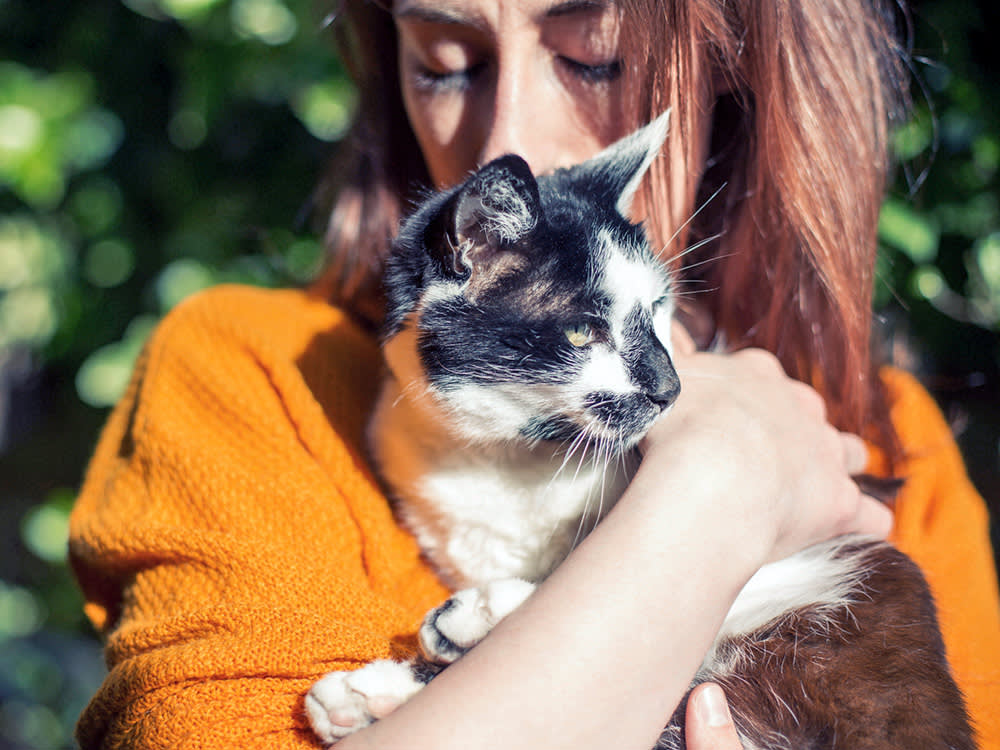
Ask a cat person about their cat and you’d better pull up a chair. But past the personal trivia, every cat shares a set of genuinely strange physical traits, and here is the fun part: almost all of them make sense the moment you remember what a cat actually is. Not a small dog, not a tiny person, but an obligate carnivore, an animal so specialized for hunting and eating meat that evolution has trimmed away anything it doesn’t need. Read the list below with that one idea in mind, and a pile of random facts turns into a single coherent story about a purpose-built predator living on your couch.
1. Cats can’t taste sweetness at all
Start with the strangest one, because it captures the whole theme. Cats are effectively blind to sweet flavor. The gene that builds the sweet-taste receptor, Tas1r2, is broken in cats, missing a chunk of its DNA so that the receptor never forms. Researchers at the Monell Chemical Senses Center confirmed this, and it holds for every cat from a house tabby to a tiger. The reason is pure carnivore logic: an animal that evolved to live on meat got no survival benefit from detecting sugar, so the machinery for it quietly rusted away. Your cat ignoring your ice cream isn’t pickiness. They literally cannot perceive what you’re offering.
2. Their tongues are covered in hooks
That sandpaper lick comes from hundreds of tiny backward-facing barbs called papillae covering the tongue. In your cat they rake dirt, debris, and loose hair out of the coat during grooming. In a wild cat, the same hooks strip meat cleanly off bone. Your indoor cat almost certainly never needs that second function, but they’re carrying the tool anyway.
3. Their intestines are remarkably short
A human digestive tract runs about 30 feet. A cat’s whole intestinal tract runs to only around three body-lengths of the cat itself. Meat is far easier to break down than the fibrous carbohydrates in plants, so a dedicated carnivore never evolved the long, elaborate gut that plant-eaters and omnivores rely on. Short and efficient is exactly what a meat diet calls for.
4. They have three eyelids
Every cat has a third eyelid, a nictitating membrane tucked behind the lower lid. It sweeps across to shield and moisten the eye, guarding it against debris and infection, useful equipment for an animal that hunts through brush and grass. If you ever glimpse it fully across the eye in a cat who isn’t sleepy, that’s worth a vet’s attention, since a visible third eyelid can signal illness.
5. Their eyes glow in the dark
That eerie green flash from a cat’s eyes at night comes from the tapetum lucidum, a reflective layer behind the retina that bounces light back through it, giving the eye a second chance to catch every photon. It’s why cats see so well in near-darkness. It pairs with another predator trait: cats are crepuscular, most active at dawn and dusk, precisely the low-light hours when their vision gives them the biggest edge over prey.
6. They have a free-floating collarbone
Cats have a small collarbone buried in the muscle of the shoulder that connects to no other bone. In us, the collarbone anchors to the rib cage and limits how far the shoulder can move. Freed from that, a cat can squeeze through any gap its head fits through and take long, fluid strides, part of why your cat can vanish into a space you’d swear was too small.
7. They purr or roar, but never both
Cats fall into two camps. The purring species, including our domestic cats, can purr but cannot roar. The roaring big cats, like lions and tigers, can roar but cannot truly purr. The difference lies in the anatomy of the voice box and the small hyoid bone in the throat. So your cat’s contented rumble is, in a real sense, the trade-off for never being able to let loose a roar.
8. They’ve barely changed in thousands of years
Walk through a natural history museum and you’ll see how dramatically dogs, horses, and cattle have been reshaped by domestication. Cats are the outlier. Since they were domesticated in ancient Egypt more than 3,000 years ago, they’ve stayed remarkably close to their original form in appearance, ability, and temperament. The leading theory is that cats essentially domesticated themselves, drawn to the rodents around human grain stores, so we never bred them hard toward a purpose the way we did working animals.
9. They can go feral in a single generation
Because that domestication is so light, it undoes easily. A cat can become feral, living successfully wild, within one generation. If a mother cat accustomed to people raises her kittens away from humans, those kittens grow up wild and will neither seek nor tolerate human contact. The tameness is a thin layer, not a deep rewrite.
10. They’re genuinely fine on their own
Where dogs, horses, and cattle are all wired for group living, a cat does equally well on its own or in company. That independence traces straight back to how cats hunt: as solitary ambush predators going after small prey, they never needed the cooperative pack structure that social species evolved. Your cat enjoying your company is a preference, not a need, which is part of their particular charm.
11. Their whiskers are a measuring and balance system
Whiskers aren’t just decorative face hair. They’re deeply rooted, nerve-rich sensors that feed the brain a constant stream of information about the world and the cat’s own body. They help a cat judge whether a gap is wide enough to fit through, and specialized cells at their base respond to head position and movement, contributing to the balance and body-awareness that underlies a cat’s famous knack for landing on its feet. It’s another quiet piece of predator hardware, and a good reason never to trim them.
What I love about these facts is that none of them are random, they’re all the same answer to the same question. Everything from the broken sweet gene to the short gut to the barbed tongue is evolution optimizing one specific animal: an efficient little meat-eater. Once you see your cat as a predator that happens to nap on your bed, the whole species suddenly makes sense.
The next time your cat turns up their nose at a bite of dessert, stares you down with glowing eyes at 3 a.m., or folds into an impossibly small box, you’ll know you’re not looking at quirks. You’re looking at a hunting machine, beautifully preserved, doing exactly what it was built to do.
References
Dr. Chen is a small-animal veterinarian who leads health and safety coverage at The Pet Times. She writes and reviews the bulk of our illness, condition, and safety content, translating clinical guidance into clear, practical advice owners can act on at home.
Meet our experts ↗Keep reading
 TrainingYour Cat Is Not Judging You. Your Cat Cannot Judge You.Dr. Mara Chen · 9 min
 TrainingYour Cat Isn't Begging at Dinner. They're Waiting for You to Sit Still.Dr. Nina Kohl · 7 min
 TrainingToilet-Training Your Cat Means Throwing Away Their Health ChartDr. Ravi Mehta · 8 min
 LivingA Cat's Homing Instinct Is Real. It's Also the Last Thing You Should Rely OnTom Hadley · 6 min
 TrainingIntroducing Two Cats? Go Slower Than You ThinkDr. Nina Kohl · 7 min
 LivingYou and Your Cat, by the Stars: A Compatibility Guide Built on EnergyLeila Torres · 16 min