


The Airport Therapy Dog's Real Job Is Getting Strangers to Talk
Airport therapy dogs lower your blood pressure, sure. But the program directors say the bigger magic is what happens between the people standing around the dog.

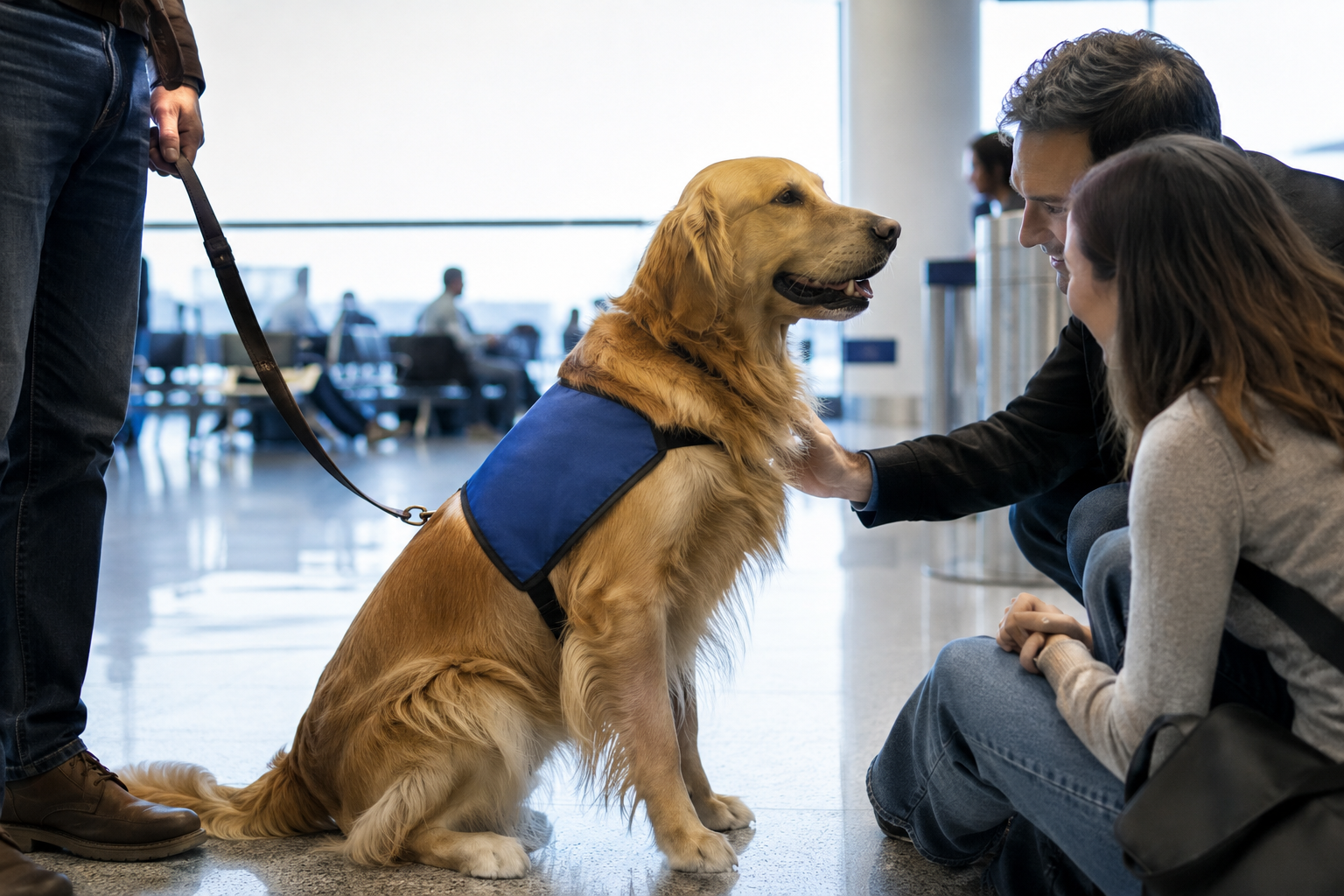
Watch what actually happens when an airport therapy dog stops in a terminal. Yes, the people who kneel down to pet the dog relax, their shoulders drop and their faces soften. But look one ring out, at the small crowd that forms around the dog. Strangers who would never otherwise speak start trading stories. Someone pulls out a phone to show a photo of the dog they left at home. Someone else mentions the pet they recently lost. A delayed traveler and a nervous flyer end up laughing together. The dog is the excuse. The conversation is the point.
That is the part the people who run these programs talk about most, and it reframes what an airport therapy dog is actually for. We tend to describe them as little stress-reduction machines, walking blood-pressure cuffs in vests that say “Pet me.” They are that. But the directors who recruit and deploy them will tell you the deeper service is social: in the most isolating public space most of us ever stand in, a dog gives permission for a roomful of guarded strangers to briefly become a community.
Not the dogs you’re used to seeing
The working dogs you usually spot at an airport, the ones sniffing luggage, are strictly off-limits. Airport therapy dogs are the opposite proposition. Their entire job is to be approached and touched, and their presence reflects a real shift in how the travel industry thinks about the passenger experience, especially during the white-knuckle stretch of holiday travel.
The idea traces back to California’s Mineta San Jose International Airport, which began experimenting with therapy dogs shortly after 9/11 to take the edge off traveler anxiety. Videos of those early dogs at work did the convincing, and other airports followed. What started as a novelty is now close to standard equipment at large hubs.
How far the programs have spread
A frequently cited count put the number at 37 U.S. airport programs back in 2021. It has grown well past that, and the programs themselves have gotten bigger and more ambitious. A snapshot of where things stand:
- Denver International runs the Canine Airport Therapy Squad, with more than 90 registered therapy animals, and notably has expanded beyond dogs to include therapy cats.
- Los Angeles International fields the Pets Unstressing Passengers (PUP) program, which puts teams in nearly every terminal and hands out trading-card-style IDs of each dog.
- Dallas Fort Worth runs Dogs of DFW, welcoming dogs of every size.
- San Diego International has its Ready Pet Go squad.
- Detroit Metro deploys the DTW Dogs.
- Charlotte Douglas, San Francisco, Phoenix Sky Harbor, Minneapolis-Saint Paul, Pittsburgh, Sacramento, and New Orleans all field their own crews.
The teams almost always stay put in open areas rather than roaming, a deliberate choice so that travelers who want a dog encounter can come find one, while anyone who would rather not, because of fear, allergies, or simply mood, can give them a wide berth.
What the directors actually notice
Lauri Golden, who supervises Charlotte’s CLT Canine Crew, expected children to be the program’s biggest fans. The adults surprised her. “We assumed the kids would be the ones drawn in, but honestly it’s the grown-ups who get the most out of it,” she says. “They’ll whip out pictures of their own dogs, mention the ones they’ve lost, snap selfies, ask how old the dog is and what breed. A little crowd forms, and that crowd becomes its own community, everyone swapping dog stories with strangers.”
That gathering effect is the recurring theme. Heidi Heubner, who directs LAX’s PUP program, describes the same thing from the other coast. “A dog pulls total strangers into the same conversation,” she says. “Normally we’re too wary to speak, or buried in our phones, but a dog gets people trading pet photos and stories and telling each other where they’re headed. Some days I watch it unfold and grin until my cheeks ache.”
The dogs earn their keep most in the moments travel falls apart. Heubner remembers a canceled flight where a flight attendant asked whether a dog could come visit the stranded passengers. “Everyone was thrilled. People kept telling me the delay didn’t even matter, that getting to meet the dogs made it worthwhile.” A grounded plane is a small crisis of helplessness and irritation; a dog converts a waiting area full of frustrated individuals into a group of people having an unexpectedly nice time together.
There are quieter moments, too. One Charlotte handler met a woman flying to her brother’s funeral. Her brother had owned a dog of the same breed, and she took the encounter as a sign he was okay. No vest or trading card was doing that. The dog simply opened a door, and the person walked through it.
What it takes to be a team
The dogs come in every breed and size, but they share one credential: certification through a recognized therapy-dog organization, such as the Alliance of Therapy Dogs or Pet Partners. Charlotte requires its dogs to be registered and to have at least six months of therapy-work experience before they set foot in the terminal.
The vetting is real, and it screens the humans as much as the dogs. A new team starts with a walk-through of the airport to confirm the dog stays relaxed amid the noise, the smells, the rolling luggage, and the constant churn of strangers. If the dog passes, the human half goes through background and security checks, the same scrutiny any airport volunteer faces. Approved teams typically work a single shift a week. It is a meaningful commitment for a volunteer, which is why directors like Golden are perpetually recruiting. The demand from travelers, it turns out, is effectively unlimited.
References
- “Airports and Therapy Dogs: A Complete Guide.” Alliance of Therapy Dogs, therapydogs.com.
- “Canine Airport Therapy Squad.” Denver International Airport, flydenver.com.
- “PUP Program.” Los Angeles World Airports, lawa.org.
- “San Jose Airport Experiments With Therapy Dogs to Ease Passengers’ Anxiety.” The Mercury News, 7 Feb. 2013, mercurynews.com.
Claire Sutton writes about life with pets, from the first days home to the small daily routines that make a household work. Her reporting spans people-and-pet relationships, training basics, and the practical side of bringing a new animal into the family.
Meet our experts ↗Keep reading
 LivingA Nightlife Guy, a Stubby Bulldog Mix, and 7-Minute Trail MilesMarcus Webb · 6 min
 LivingChicago Treats Dogs Better Than It Treats TouristsJordan Ellis · 12 min
 LivingWhy Boston's Airport Put a Schnauzer, a Westie, and a Frenchie on the FloorNina Vasquez · 4 min
 LivingBring the Dog: 11 NYC Date Spots Where Your Pup Is the Best WingmanSasha Ford · 5 min
 LivingHalf of Dog Parents Can't Relax on Vacation. The Science Says the Dog Is Fine.Dr. Mara Chen · 4 min
 LivingStrangers Get Exactly Two Questions About Your Service Dog. Here's Your Script.Leila Torres · 6 min