


Strangers Get Exactly Two Questions About Your Service Dog. Here's Your Script.
The ADA lets a business ask a service dog handler two things, and nothing else. Most handlers over-answer anyway. Here is the exact script, the questions nobody is allowed to ask, and the one place the rules genuinely change.

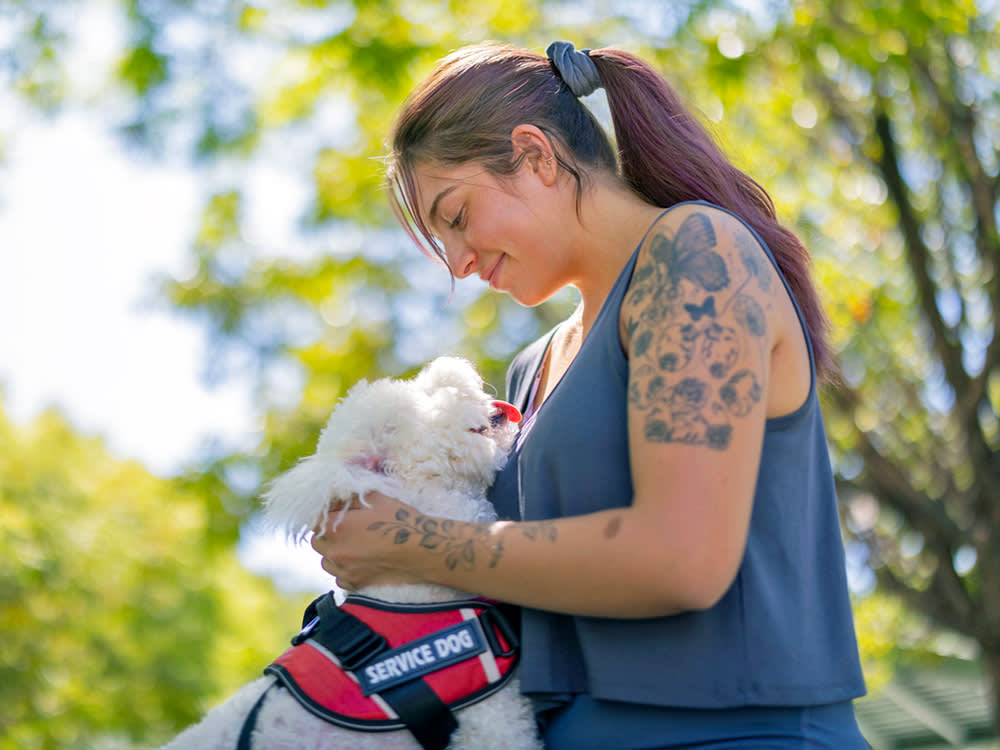
Somewhere between the door and the register, it happens. A manager crosses the floor with a look you have learned to read from twenty feet away, and asks you something you do not owe them.
Here is the thing most handlers never get told plainly: under the Americans with Disabilities Act, a stranger at a business gets two questions. Not a conversation, not a file, not a demonstration. Two. And the answer to both of them fits in about a dozen words.
The gap between what the law allows and what handlers actually end up explaining is where most of the friction lives. So let’s close it.
The script
When it is not obvious what your dog does, staff at a business, a government office, or a nonprofit open to the public may ask exactly these two things:
- Is the dog a service animal required because of a disability?
- What work or task has the dog been trained to perform?
That is the whole permitted inventory. A complete, legally sufficient answer sounds like this:
“Yes, she’s a service dog. She’s trained to alert me before a seizure.”
Or: “He’s trained to remind me to take my medication.” Or: “She retrieves items I can’t bend to pick up.”
Then you stop talking. The instinct to keep going, to explain the diagnosis, to justify yourself, is human and completely unnecessary. Naming the task is the entire requirement.
What nobody gets to ask
Staff may not:
- Ask what your disability is, or what your diagnosis is.
- Require medical documentation.
- Require a special ID card, certificate, or “service dog registration.”
- Ask the dog to demonstrate the task.
- Charge you a pet fee or a deposit for the dog.
- Refuse you access to any area the public may go.
If you hear “we need to see the paperwork,” you are being asked for something that does not exist, and you can say so.
The registration scam runs on that assumption
Search “register my service dog” and you will find sites that look official, take your money, and mail you a certificate and a laminated card. What you have bought is a novelty item. There is no federal database or registry of service dogs. No agency issues a license. Under the ADA, only dogs qualify as service animals in the first place, no matter what species a website is willing to “register.”
The scam only works because people, on both sides of the counter, assume there must be a list somewhere. There isn’t. A service dog is proven by what it does and how it behaves in public.
If you want your dog assessed against a real standard, the Public Access Test is the unofficial benchmark: the dog must stay calm and focused across situations, sitting on cue, unloading calmly from a vehicle, heeling through a building. A professional trainer can prepare a dog for it, and so can a well-informed handler working on their own.
What the law asks of you and your dog
The access right is not unconditional, and knowing the limits is part of holding the line confidently.
Your dog must be under your control at all times, generally via harness, leash, or tether, unless your disability makes those devices impossible, in which case voice, signal, or other effective control substitutes.
A business may lawfully ask you to remove the dog in only two circumstances: the dog is out of control and you are not taking effective action, or the dog is not housebroken. Even then, the ADA requires staff to offer you the opportunity to get the goods or services without the dog present. “Get out” is not a legal option. “We’ll bring your order to you outside” is.
Where the rules actually change: the airport
This is the exception that trips up handlers who assumed the ADA travels with them. Air travel runs on the Air Carrier Access Act, not the ADA, and it works differently.
Under DOT rules in effect since 2021, a service animal is a dog, of any breed or type, individually trained to do work or perform tasks for a person with a physical, sensory, psychiatric, intellectual, or other mental disability. Psychiatric service dogs are explicitly covered, and are treated the same as any other service dog.
But airlines may require paperwork, and they do:
- The DOT Service Animal Air Transportation Form. Every U.S. airline requires it. It is the only document you need to submit, and no certificate or registration is a substitute for it.
- A Service Animal Relief Attestation if any single flight on your itinerary runs more than eight hours, attesting that the dog will not need to relieve itself in flight, or can do so in a way that does not create a health or sanitation problem.
Submit those in advance, usually 48 hours before departure, and you are done. Airline staff can still ask about the dog’s trained tasks. They cannot interrogate you about your disability, and they cannot demand the dog perform on the jet bridge.
Emotional support animals are a different category, not a lesser one
An emotional support animal provides comfort by existing. That is real, and it is also not a trained task. That single gap is why the ADA treats an ESA as something other than a service animal, and why it carries no public-access right. Airlines stopped counting them as service animals too.
Where ESAs do have teeth is housing. Under the Fair Housing Act, a landlord generally cannot refuse a tenant with a disability who needs an assistance animal, and may not charge a pet fee for one. A landlord is permitted to ask for a letter from a licensed mental health professional confirming the need.
Handlers of psychiatric service dogs do not need such a letter, though they can request one if it makes a housing conversation smoother.
“The line people miss is that a psychiatric service dog performs tasks, it does not simply soothe,” says Dr. Amara Solis. “Applying deep pressure to interrupt a panic spiral, or blocking space so a crowd cannot close in, is trained work. That is the whole distinction, and it is why the dog gets to come with you.”
What’s new since this was written
The federal core has held steady: the two-question rule and the no-registry rule are unchanged, and the sites selling certificates are as legally meaningless in 2026 as they were a decade ago.
What has shifted is the airline layer. The 2021 DOT rules that ended the emotional-support-animal era are now fully bedded in, and the service animal form is a routine, non-negotiable part of booking rather than a novelty. If you have not flown with your dog in a few years, that form is the thing that changed, and forgetting it at the gate is now the most common way a legitimate handler gets stuck.
The practical upshot for everyday access is unchanged, and worth repeating: you owe strangers two answers, you owe them nothing else, and the paperwork they think they are entitled to has never existed.
References
- U.S. Department of Justice, Civil Rights Division. “ADA Requirements: Service Animals.” https://www.ada.gov/resources/service-animals-2010-requirements/
- U.S. Department of Justice. “Frequently Asked Questions about Service Animals and the ADA.” https://www.ada.gov/resources/service-animals-faqs/
- U.S. Department of Transportation. “Service Animals.” Aviation Consumer Protection. https://www.transportation.gov/individuals/aviation-consumer-protection/service-animals
- ADA National Network. “Service Animals and Emotional Support Animals.” https://adata.org/guide/service-animals-and-emotional-support-animals
- U.S. Department of Housing and Urban Development. “Assessing a Person’s Request to Have an Animal as a Reasonable Accommodation Under the Fair Housing Act.” FHEO-2020-01. https://www.hud.gov/sites/dfiles/PA/documents/HUDAsstAnimalNC1-28-2020.pdf
Common questions
How many questions can a business ask about my service dog?
Two. Whether the dog is a service animal required because of a disability, and what work or task the dog has been trained to perform. Staff cannot ask about your disability, demand documentation, or ask the dog to demonstrate the task.
Do I need to register or certify my service dog?
No. There is no official U.S. registry or license for service dogs. Websites selling registration, certificates, or ID cards are selling paperwork with no legal weight. Training and behavior are what make a dog a service dog.
Is an emotional support animal a service animal?
Not under the ADA. ESAs are not individually trained to perform a task, so they do not carry the same public-access rights. They do have protections under the Fair Housing Act, where a landlord may request a letter from a mental health professional.
Can a service dog ever be asked to leave?
Yes, in two situations: if the dog is out of control and the handler does not take effective action, or if the dog is not housebroken. Even then, staff must offer you the goods or services without the dog present.
Leila Torres leads our Living coverage, from home life and travel to the products and rescue stories that come with sharing a life with animals. She edits and writes across the section, with a soft spot for pieces about the bond between people and their pets.
Meet our experts ↗Keep reading
 LivingYour Dog Is Not Lying by the Door Missing YouJordan Ellis · 7 min
 LivingChicago Treats Dogs Better Than It Treats TouristsJordan Ellis · 12 min
 LivingYes, Your Dog Can Go to a Major League Game. Here's How It Actually Works.Marcus Webb · 7 min
 LivingInside the 'Soho House for Dogs,' Where a Dog Park Costs $1,400 a YearSasha Ford · 6 min
 LivingSF Is a Dog's City. The Leash Line Moves Every Few Hundred Feet.Jordan Ellis · 12 min
 LivingA Nightlife Guy, a Stubby Bulldog Mix, and 7-Minute Trail MilesMarcus Webb · 6 min