


Why Boston's Airport Put a Schnauzer, a Westie, and a Frenchie on the Floor
Logan Airport's new BOS PAWS therapy dog program is charming, but the reason it works is measurable: a few minutes with a dog measurably lowers the stress hormones that airports crank up.

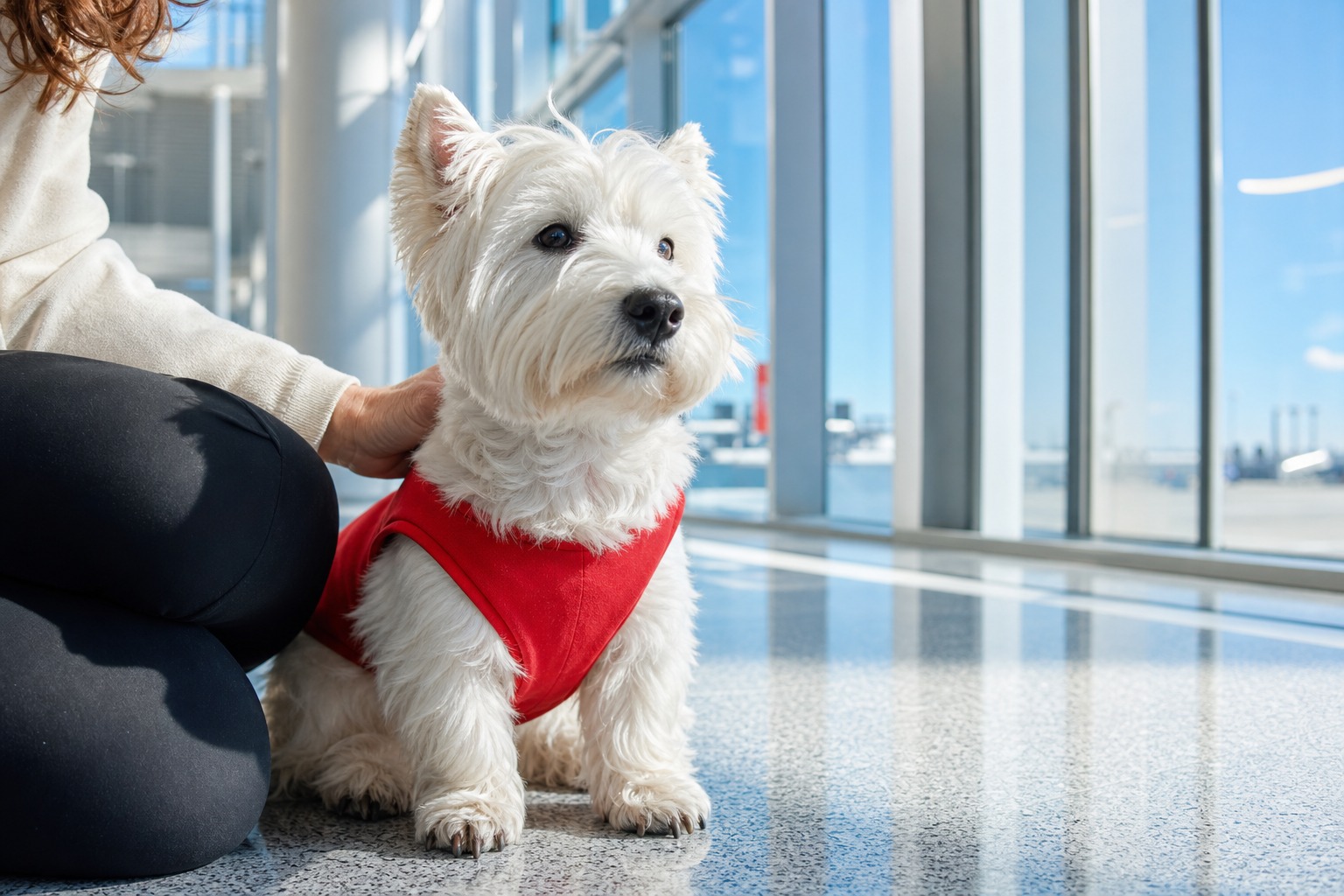
An airport is, by design, a stress machine. Delays you cannot control, a security line that moves like cold honey, a gate that changes without warning, and a seat built for someone half your size. Boston’s Logan Airport has decided the most effective amenity it can offer against all of that is not faster Wi-Fi or a renovated restroom. It is a French Bulldog named Waffles. And the reason that is not as silly as it sounds is that the calm a therapy dog delivers is not a vibe. It shows up in bloodwork.
The science the program is quietly betting on
Start with why this works, because it is the part the press release glosses. Spending even a few minutes petting a dog produces a real, measurable drop in cortisol, the body’s main stress hormone, along with lower blood pressure. This is not folklore. In a controlled study of roughly 200 university students, researchers at Washington State University found that just 10 minutes of hands-on contact with a dog or cat significantly lowered participants’ cortisol, and notably, the benefit came from actually petting the animal, not from merely watching it across the room. That distinction is the whole design of an airport program. The dogs are not behind glass. They are at hand level, vested and available, because the touch is the active ingredient.
That is also why you find therapy dogs stationed in hospitals, schools, and disaster sites, the places where stress runs hottest. An airport terminal, with its captive, anxious, time-pressured crowd, is a natural fit that simply took a while to catch on.
Meet the crew
Logan’s program, BOS PAWS, is a partnership between the Massachusetts Port Authority and the Alliance of Therapy Dogs, and the inaugural roster leans into variety. There is Remington, a Giant Schnauzer with the presence of a small pony. Buster, a West Highland Terrier built for laps. And Waffles, the French Bulldog, whose face does half the work before anyone touches him. Each wears a small vest that reads “pet me,” which doubles as both invitation and instruction, and each walks the terminals alongside a handler.
“At Boston Logan, we are very focused on creating a seamless and stress-free experience for travelers from the minute they walk into our terminals,” Massport CEO Rich Davey said in a statement. “Spend a few minutes with Waffles or Buster before your flight, you’ll love it.” Massachusetts Governor Maura Healey framed it as a mental-health signal: “We want everyone who travels through Logan to know that we prioritize mental health here in Massachusetts.” Logan is not the first U.S. airport to deploy therapy dogs, but it is the first in Massachusetts to do so.
The part that makes it work: these are working professionals
It is easy to picture this as cute and miss what it actually demands of the dogs. A terminal is one of the most overstimulating environments a dog can be asked to work in: booming announcements, rolling luggage, crowds, sudden noise. Remington, Buster, and Waffles are all certified therapy dogs, specifically prepared to stay calm in exactly that chaos, and their handlers bring experience guiding them through comparable settings.
That experience is the unglamorous backbone of the whole thing. Buster’s handler, Carl Kaplan, told the Boston Globe that he regularly volunteers Buster’s time at hospitals and schools, and bristled at any suggestion of payment. “He’s done almost 600 visits,” Kaplan said, “and when I think of all the great experiences I’ve had, I just couldn’t conceive of taking money for that.” Waffles’ handler, Karen Oemler, put the purpose plainly in the same coverage: “The whole idea of a therapy dog is to bring joy. What’s better than helping someone who’s having travel anxiety, or maybe flying to a funeral, or going to see a sick relative.”
If you meet one before your flight
A few small courtesies make the encounter work for everyone. Ask the handler before you reach for the dog, even when the vest says “pet me,” because the handler is reading the dog’s energy and pacing its day. Let the dog come to you rather than looming over it. Keep it brief if a line is forming behind you; the cortisol benefit lands fast, and the next anxious traveler is waiting. And resist the urge to feed a working dog a snack from your bag, however well-intentioned, since handlers manage their dogs’ diets carefully on the job. Then go catch your flight a little lighter than you arrived.
References
- Massport Newsroom, “Massport Brings a Little Joy and Therapy Dogs to Boston Logan Travelers.”
- The Boston Globe, “Therapy Dogs at Logan Airport Calm Passengers.”
- Pendry, P. and Vandagriff, J.L., “Animal Visitation Program (AVP) Reduces Cortisol Levels of University Students: A Randomized Controlled Trial,” AERA Open, 2019.
- Washington State University Insider, “Study Demonstrates Stress Reduction Benefits From Petting Dogs, Cats.”
Nina Vasquez writes about life at home with pets and the relationships at the heart of it. Her work covers day-to-day living, people-and-pet stories, and the products that fit into a real household, with a warm, grounded take on everyday pet ownership.
Meet our experts ↗Keep reading
 LivingSF Is a Dog's City. The Leash Line Moves Every Few Hundred Feet.Jordan Ellis · 12 min
 LivingStrangers Get Exactly Two Questions About Your Service Dog. Here's Your Script.Leila Torres · 6 min
 LivingThe Airport Therapy Dog's Real Job Is Getting Strangers to TalkClaire Sutton · 6 min
 LivingInside the 'Soho House for Dogs,' Where a Dog Park Costs $1,400 a YearSasha Ford · 6 min
 LivingA Nightlife Guy, a Stubby Bulldog Mix, and 7-Minute Trail MilesMarcus Webb · 6 min
 LivingFor Andrew Knapp, the Dogs Are the Whole MapClaire Sutton · 7 min