


For Andrew Knapp, the Dogs Are the Whole Map
The Find Momo photographer's life on the road gets sold as freedom. Talk to him and it's really a story about grief, lineage, and the three dogs who hold the scaffolding together.

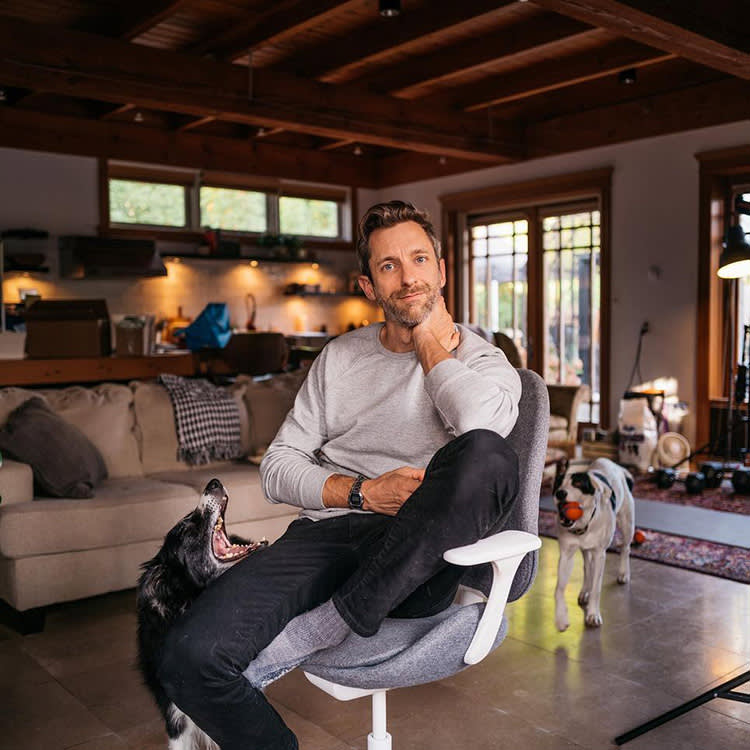
The version of Andrew Knapp’s life that travels well on the internet is the freedom one: a van, an open road, a beautiful dog poking his head out from behind a rock somewhere in the frame. It is the picture that built a book series and an enormous following, and it is real enough. But it is not the part Knapp himself leads with. Ask him what a normal day is like and the first thing he says is, “Often I feel like I’m just trying to keep the scaffolding of my life from falling apart.” The dogs, it turns out, are not the decoration on the freedom. They are the scaffolding.
Knapp has spent about half of his time on the road since roughly 2010. He is careful to puncture the fantasy that the lifestyle is one long exhale. “Of course being ‘out there’ always seems more appealing than staying still or having an apartment,” he says, though lately the van is as much necessity as romance, with decent housing harder and harder to come by. He counts the freedom as a privilege while being clear that it sends its own invoices. The road, in other words, is partly a choice and partly the hand he has been dealt. What has stayed constant through it is the company.
The game that made the work, and the dog who invented it
The photography people know him for, Momo half-hidden in a sweeping landscape, was not an art-school concept. It was a Border Collie’s idea. The hide-and-seek game was Momo’s invention, sprung on their daily trail walks when the collie started tucking himself away among the trees and waiting. “I brought the camera and the capitalist agenda,” Knapp says. That instinct of Momo’s, to tuck himself into a scene and wait to be found, became a whole visual language, a high-art and much cuter spin on Where’s Waldo, and grew into the Find Momo book series and a following in the hundreds of thousands.
What made the images linger, Knapp thinks, was less the dog than what the search did to the viewer. What he loved, he says, was how the search slowed people down: viewers lingered inside the frame, hunting, and ended up genuinely meeting the landscape instead of scrolling past it. He grew up in Northern Ontario, “where the trees are small, the rocks are black, and the land is vast,” a landscape that forced him to find beauty in places that did not hand it over easily. He quotes Brian Eno, who said “beautiful things grow out of sh*t,” and the line lands as something closer to a working philosophy than a bit.
Momo was, by Knapp’s account, an unusual Border Collie. The breed runs hyperactive and relentlessly busy; Momo did not. “He was chill, with all the smarts. I loved him.” He died the summer before this conversation, and his absence is the quiet center of everything Knapp is doing now.
Three dogs, one lineage
This is where the freedom story gives way to something more tender. Knapp’s dogs are not interchangeable travel buddies; they are a line, each one tethered to the last. He found Momo on Craigslist in 2008, “I had just bought my own house, so it was a good time to get a dog,” and Momo, he says flatly, changed his life. In 2019 he adopted Boo from a Texas rescue. And Yaya arrived soon after Momo died, by a coincidence that did not feel like one: Yaya turned out to be Momo’s nephew. “He had to be part of my family.”
He describes them like family too, with the affectionate exasperation that implies. “Boo is a bodybuilder and sneaks out while I’m sleeping to go to the dog gym and trains with dog weights. I love him.” And Yaya: “Momo’s bratty little nephew. I lovingly tell people he’s the worst dog I’ve ever had. I can equally say he’s my third-best dog. He’s been the hardest to train by far, but I love him so dearly and we’ve come a long way. He really completes my little family.” The hiding game survives Momo through them. Knapp still photographs Boo and Yaya tucked into scenes when the spot is safe and the moment is right.
That continuity is the thread running into his next projects. He is working on at least two more books: a children’s book starring Yaya and Boo in the hide-and-seek spirit of the others, and, more strikingly, a children’s book about grief that he is illustrating himself. “That’ll be cathartic,” he says. It is hard to read that plan as anything but Momo’s, processed into something he can hand to a child.
What the road actually asks of a dog (and of you)
For all the romance, Knapp is unsentimental about logistics, and this is the most useful part for anyone fantasizing about doing the same. Adding a dog to a moving household is not friction-free, and adding one to a moving household the size of a van is its own discipline.
His smoothest introduction, bringing Boo in while Momo was aging, happened precisely because he had stopped moving. “In 2019, I tried to stay still completely. With Momo getting older, it became too difficult for him to travel.” They were in a guesthouse on two acres where the dogs could be outside all day. “It was a dream, really.” The lesson buried in that is worth saying plainly: the hardest moment to introduce a new dog is the moment your life is least stable, and a little stillness can do what no amount of technique will.
The dogs adapted to the van in their own ways. Boo, helpfully and annoyingly, “tells me when I’m driving too much.” Yaya “sleeps the second the van starts moving,” a habit that started at nine weeks old on a stressful first road trip and never broke. And then there is the part nobody posts. “Sometimes there is nowhere to poop,” Knapp says. A stretch when Yaya caught a parasite and needed out every single hour produced, in his telling, the kind of messes a van has no square footage to forgive. The flip side is that the door is always two steps away, “my third-floor apartment would have been impossible.”
He does not pretend the tradeoffs are small. “Traveling with a dog is absolutely more challenging. For me, it’s worth it; my life revolves around them. For some people it would probably be too much.” You give up restaurants you wanted to try and places that will not take a dog or are too hot or cold to leave one in the van. That is the honest ledger, and Knapp keeps it open rather than selling the highlight reel.
A few hard-won notes for the dog-and-van fantasy
If Knapp’s story tempts you, the practical spine of it is worth lifting out:
- Pick your introduction window, not just your dog. The calmest time to add a second dog is when your living situation is most stable, even if that means pausing the travel for a stretch.
- Plan the lifestyle around the dog’s body, not the other way around. Bathroom access, temperature, and somewhere safe to roam in the morning dictate where you can actually go.
- Budget for the unglamorous days. Parasites, no-toilet stretches, and messes in a confined space are part of the deal, not exceptions to it.
- Let the dog set some of the agenda. Knapp’s best-known work exists because he followed his dog’s instinct instead of imposing a concept. The same openness tends to make daily life better, too.
In the end, the freedom narrative gets the order backwards. Knapp is not a free man who happens to have dogs. He is a man whose dogs are the through-line, Momo to Boo to Yaya, grief to continuity to the next book, and the road is just the place all of that happens to take place. As for where it goes next, he will likely spend the summer in Canada, and if a place to live does not materialize by fall, maybe Mexico, maybe Portugal. The destination, you get the sense, was never really the point.
Claire Sutton writes about life with pets, from the first days home to the small daily routines that make a household work. Her reporting spans people-and-pet relationships, training basics, and the practical side of bringing a new animal into the family.
Meet our experts ↗Keep reading
 LivingYes, Your Dog Can Go to a Major League Game. Here's How It Actually Works.Marcus Webb · 7 min
 LivingInside the 'Soho House for Dogs,' Where a Dog Park Costs $1,400 a YearSasha Ford · 6 min
 LivingSF Is a Dog's City. The Leash Line Moves Every Few Hundred Feet.Jordan Ellis · 12 min
 LivingA Nightlife Guy, a Stubby Bulldog Mix, and 7-Minute Trail MilesMarcus Webb · 6 min
 LivingBring the Dog: 11 NYC Date Spots Where Your Pup Is the Best WingmanSasha Ford · 5 min
 LivingStrangers Get Exactly Two Questions About Your Service Dog. Here's Your Script.Leila Torres · 6 min