


A Cat Just Picked You. Now Read It Correctly
The internet says the universe hands out cats to the people who need them. The kinder truth is that the best response to a stray who chooses you is not always to keep it. Here is how to tell.

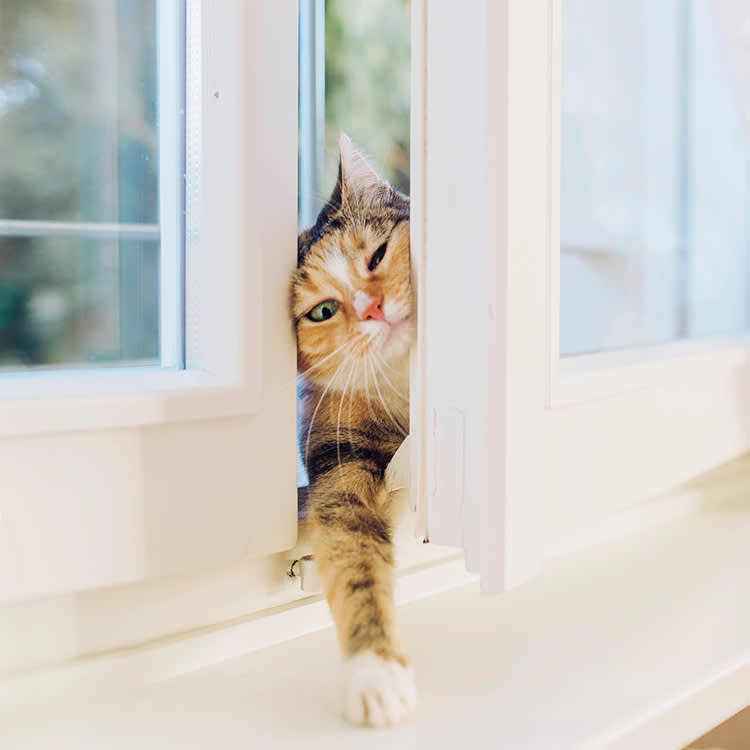
It always feels like fate. You are hauling groceries or standing on the porch with your coffee, and a cat trots straight over, winds around your ankles, and looks up like the two of you had an appointment. A voice in the back of your head says: well, I guess this is my cat now.
The internet has a name for that voice. People call it the cat distribution system, and the comments under every stray-adoption video are full of it, as if the universe filed paperwork and assigned you a pet. It is a lovely joke. But it quietly encourages the wrong first move, because the kindest response to a cat that picks you is not always to scoop it up and rename it. Sometimes it is to read the cat correctly and leave it exactly where it is. So before the fairy-tale instinct takes over, here is how to tell what you are actually looking at.
Read the cat before you fall in love
The single most useful skill in this moment is triage, not adoption. A cat that approaches you falls into roughly one of two groups, and they call for opposite responses.
The cat that does not need you. If the cat looks well-fed, has a glossy coat, moves with confidence, and seems unbothered, it very probably has a home already and is simply out patrolling its territory. Friendly does not mean homeless. Plenty of owned cats are social with strangers and roam a surprising distance. Female cats with kittens routinely leave the litter for stretches to go find food, so an “abandoned” nest under your deck is often nothing of the sort. Scooping up a thriving cat because it was affectionate is how people accidentally steal a neighbor’s pet.
The cat that does need you. If the cat is thin, has a dull or patchy coat, is limping or visibly injured, is coughing or has crusty eyes, or is a genuinely orphaned kitten with no mother returning, that is the animal worth stepping in for. This is the cat the meme should be about.
When you are not sure which one you are seeing, err toward observing before acting. Watch for a day if you can. A cat that has a home will usually drift back to it.
If it does need help, work the checklist
Deciding to help is not the same as deciding to keep. Your first obligation is to find out whether this cat already belongs to someone, and only then to think about adoption.
- Check for a collar and tag. The fastest possible reunion is a phone number on a tag.
- Get it scanned for a microchip. A vet clinic or shelter will scan for free, and a chip is often the only link back to a frantic owner across town.
- Post it locally. Clear photos in neighborhood apps and local lost-pet groups reunite more cats than anything else. Give it real time before you conclude no one is looking.
- Look into TNR. If the cat turns out to be a community or feral cat rather than a lost pet, supporting a trap-neuter-return program in your area does far more for your neighborhood’s cats than bringing one indoors. TNR addresses the source; a single rescue addresses one symptom.
If you have done all of that and the cat is truly unclaimed, then yes, you may well have found your cat. Just get it a vet check, test and vaccinate, and introduce it slowly to any resident pets.
The part the meme leaves out
Here is the arithmetic that makes the whole “distribution system” run, and it is less magical than the joke lets on. There is no reliable census of unowned cats in the United States, but estimates land in the tens of millions, commonly cited somewhere between 30 and 80 million community and free-roaming cats. Roughly 2.9 million cats entered shelters in a recent year, and that captures only a small fraction of the outdoor population.
The universe is not handing out cats. What is actually happening is that there are tens of millions of homeless cats out there, so eventually one crosses your path. The bond you feel when it does is completely real. The reason it happens so easily is the part nobody wants to put on a caption.
That reframing is not a downer, it is the point. Once you see the encounter as a symptom of overpopulation rather than destiny, your response gets sharper: help the cats who clearly need it, leave the thriving ones to their families, support the programs that shrink the problem, and stop waiting for a sign.
You do not have to be chosen
The best news about the cat distribution system is that you can opt out of waiting for it entirely. If you want a cat, you do not need the universe to deliver one. Shelters and rescues are full of cats who need homes right now, and online listings let you browse from the couch. Plenty of people walk in planning to adopt one and leave with two, which is its own distribution system, just one you actually control. A cat crossing your path is a nice story. Choosing one on purpose is a better plan.
References
- Gyles, Carlton. “Outdoor Cats or Community Cats?” The Canadian Veterinary Journal, vol. 60, no. 4, 2019, pp. 349–352. https://www.ncbi.nlm.nih.gov/pmc/articles/PMC6417603/
- “Pets by the Numbers.” Humane World for Animals (formerly the Humane Society of the United States). https://humanepro.org/page/pets-by-the-numbers
- “Pet Statistics: Shelter Intake and Surrender.” ASPCA. https://www.aspca.org/helping-people-pets/shelter-intake-and-surrender/pet-statistics
Common questions
A cat showed up at my door. Can I just keep it?
Not automatically. First read the cat. A well-fed, healthy, relaxed cat almost certainly has a home and is out on its rounds, so keeping it may mean taking someone's pet. A thin, injured, sick, or clearly abandoned cat, or an orphaned kitten, is the one that genuinely needs you. Either way, make a real effort to find an owner before you adopt.
How do I find the owner of a stray cat?
Check for a collar and tag, take the cat to a vet or shelter to scan for a microchip, and post clear photos in local lost-pet groups and neighborhood apps. Many outdoor cats roam widely but have families looking for them.
Is the cat distribution system real?
There is no cosmic matching service. What the meme actually captures is that there are tens of millions of unowned cats in the U.S., so sooner or later one is likely to cross your path. The bond you feel is real; the reason the encounters happen so often is an overpopulation problem, not fate.
Leila Torres leads our Living coverage, from home life and travel to the products and rescue stories that come with sharing a life with animals. She edits and writes across the section, with a soft spot for pieces about the bond between people and their pets.
Meet our experts ↗Keep reading
 LivingHe's Rehomed 40 Kittens. Behind the Cute Videos Is a SystemJames Okafor · 7 min
 Health & WellnessThe Wobbly Cat Looks Like a Tragedy. It's One of the Easiest Special Needs There Is.Dr. Lena Park · 8 min
 LivingA San Diego Judge Redefined 'Abandonment' for Cats. Shelters Everywhere Are Watching.Marcus Webb · 6 min
 Health & WellnessGetting Your Cat Fixed Can Cost $0 or $500Dr. Priya Nair · 6 min
 LivingKitten Season Never Ends Anymore. Blame the Vet Bill, Not the Weather.Leila Torres · 8 min
 LivingThe Cat That Matches Your Star Sign Isn't a Breed. It's a Personality Type.Nina Vasquez · 9 min