


Your Dog Guards Their Bowl Because They're Worried, Not Bossy
Food guarding gets misread as a dog being dominant, and the old 'show them who's boss' fix makes it worse. Here's what growling over a bowl actually means, and the simple training that teaches a dog your approach is the best part of dinner.

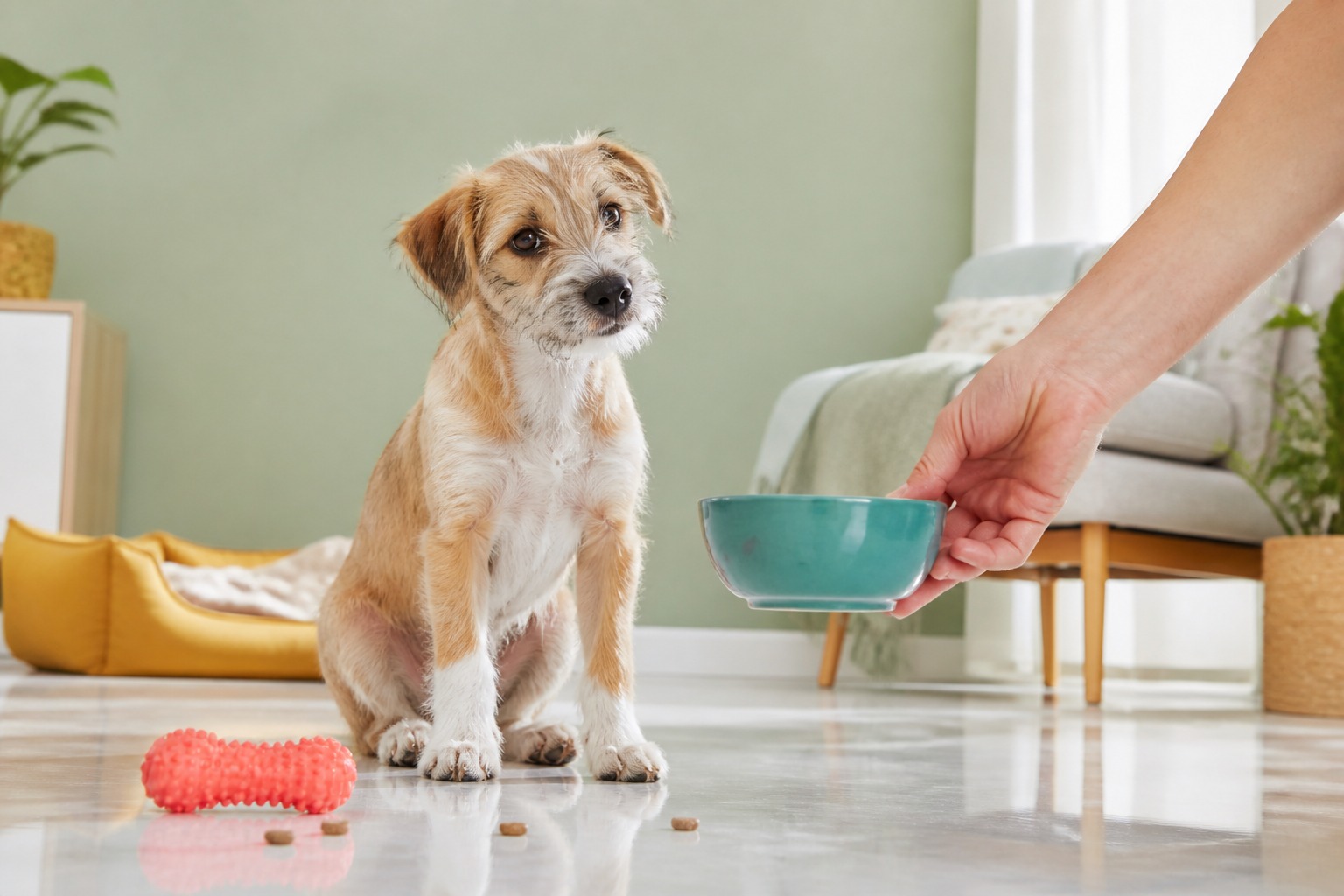
Some dogs turn into a different animal the moment a food bowl hits the floor. They stiffen, eat in a frantic hunch, glare sideways, and greet an approaching hand with a low growl that says, clearly, back off. It’s common, it’s unnerving, and it’s almost always misunderstood.
The popular read is that the dog is being dominant or “bossy,” trying to run the household from behind a bowl of kibble. That framing is not just wrong, it points you toward the exact response that makes the problem worse. So let’s start with what’s really going on, then fix it.
Guarding is about fear of loss, not a power grab
What you’re seeing is resource guarding, a catch-all for any behavior a dog uses to warn others off something it values. Around food, that shows up as growling, showing teeth, stiffening, bolting the food down, glaring, hovering over the bowl, snapping, barking, or biting. The usual targets are food, treats, bones, and chews.
Underneath all of it is a simple, insecure worry: this good thing is about to be taken from me. It’s not a status play. It’s anxiety about loss. That distinction matters enormously, because the old-school advice, take the bowl away mid-meal to prove you can, stick your hand in the food to assert control, does the precise opposite of reassuring a worried dog. It confirms the dog’s fear that people near the bowl are a threat, and teaches guarding rather than curing it. If your approach genuinely does sometimes make dinner disappear, a dog would be foolish not to guard it.
The whole fix flows from flipping that equation.
The goal: make you the best thing about dinner
You want your dog to feel great when you come near during a meal, and even when your hand comes toward the dish or lifts it away. A dog who’s genuinely happy to see you coming has no reason to growl, because your arrival never signals a loss. You build that feeling by pairing your approach with something even better than what’s already in the bowl.
The mechanism is straightforward. If you routinely walk past an eating dog and drop in a treat, the dog begins to expect a small reward every time you step toward the dish. Once your presence reliably predicts something good, the guarding motive evaporates. The steps in the how-to above build that association gradually, from a casual treat-toss on the walk-by all the way to lifting the bowl and handing it back better than you found it. Take it slow. Each step should look boring and relaxed before you move to the next, and the whole progression usually takes anywhere from a few days to several weeks.
One caution built into the method: don’t overdo the treat-tossing. Interrupting every few bites annoys a dog the way a waiter refilling your water after every sip annoys you. Once or twice a meal, and not every single meal, keeps your approach a welcome event instead of a nuisance.
Prevention beats treatment, so start with puppies
The best time to run this program is before there’s any problem at all. Puppies are clay. A young dog who learns from day one that human hands near the bowl mean bonus treats, not theft, may never develop guarding in the first place. If you have a new puppy, fold the treat-toss into mealtimes now, while it’s pure prevention and there’s zero tension to work around. It’s far easier than reversing an established habit later.
The same “trade up” logic works beyond the bowl. If your dog grabs something they shouldn’t, resist the instinct to chase and yank it away, which teaches them that you approaching means they lose their prize. Instead, offer something better in exchange. A dog who learns that giving things up leads to an upgrade becomes a dog who happily hands things over.
Know the warning signs, and when to stop
This training is for prevention and for mild, early guarding. It is not a do-it-yourself fix for a dog who is already behaving aggressively around food. If your dog is already snapping or biting over the bowl, or if at any point during this process you see signs of real tension, a stiff body, a low growl, food suddenly gulped faster, tight hovering over the dish, a snap, or a flash of teeth, stop and bring in a qualified professional.
The moment food guarding tips into a growl you can feel in the room, or teeth, that’s my line for calling a trainer or veterinary behaviorist, not YouTube. There’s no shame in it. Working with a guarding dog safely is a skill, and pushing a scared dog past its threshold is how people, and kids especially, get bitten. Early and mild, you can absolutely turn around at home. Once there’s bite risk, get a pro.
A certified professional dog trainer or a veterinary behaviorist can assess the specific dog and keep everyone safe, and they’ll often use a version of the same counter-conditioning you’ve read here, just with expert timing and management.
The payoff
Done patiently, the result is the sentence every trainer loves to hear: my dog no longer growls over food, because I taught them to be glad I show up at mealtime. You didn’t dominate the dog. You changed what your approach means, from a threat into a promise. That’s the difference between a dog who tolerates you near the bowl and one who’s delighted you showed up.
References
- Resource Guarding in Dogs (American Veterinary Society of Animal Behavior)
- Food Guarding (ASPCA Behavior Library)
This article covers prevention and mild cases. Food guarding that involves snapping or biting is a safety issue; work with a qualified trainer or a veterinary behaviorist rather than attempting to resolve it alone.
Dr. Kohl is a board-certified veterinary dentist with a particular interest in preventive oral care. She reviews all dental health content at The Pet Times and contributes practical guides on home dental routines, professional cleaning, and oral disease prevention.
Meet our experts ↗Keep reading
 TrainingYes, Dogs Get Tired of Barking. Waiting Them Out Still Won't Work.Dr. Nina Kohl · 6 min
 Training'Overprotective' Is Usually Fear Wearing a Nicer NameDr. Ravi Mehta · 8 min
 TrainingYour 'Dominant' Puppy Is Just a TeenagerDr. Nina Kohl · 5 min
 TrainingYour Dog Paws at You Because It Works. You're the One Who Taught ThemDr. Mara Chen · 6 min
 TrainingYour New TV Is Half the Reason Your Dog Won't Stop Barking at ItDr. Nina Kohl · 8 min
 TrainingYour Dog Isn't Being Bad. Leash-Biting Is Excitement With Nowhere to Go.Dr. Ravi Mehta · 5 min