


That $100 Sonic Scaler in Your Feed Sells a False Sense of a Clean Mouth
At-home sonic scalers promise a vet cleaning without the vet bill. The catch is that the part you can see was never the part that mattered. Here is what the ad leaves out, and the cheaper plan that actually works.

The ad is well-built. It opens on a dog’s grimy molar, runs a little electric wand along it, and reveals a gleaming white tooth, no vet, no anesthesia, no four-figure invoice, all for under a hundred dollars. It is satisfying to watch, and it is aimed straight at a real and reasonable fear: that your dog’s next dental cleaning will cost more than you planned and you will not see it coming until the invoice prints.
That fear is legitimate. The product’s answer to it is not. Because the thing the wand cleans, the shiny enamel you can see, was never the part that threatens your dog. The disease that costs dogs their teeth lives somewhere the camera never points, and somewhere the scaler can never reach. So before you add one to your cart, here is what the demo leaves out, why three different lines of veterinary expertise land in the same place, and the genuinely cheaper plan that actually protects your dog.
What the ad is actually showing you
A sonic or ultrasonic scaler removes tartar, the hardened mineral crust on a tooth, from the surfaces you can see. In the video, that is the whole story: dirty becomes clean, money saved. But “the surfaces you can see” is doing enormous work in that sentence, because dental disease in dogs is overwhelmingly a below-the-gumline problem.
The before-and-after shot is real, and that is exactly why it is misleading. You can scrape a crown shiny and change nothing about the dog’s actual dental health, because the bacteria doing the damage are sitting in the pocket under the gum, where that wand can’t see or reach. The ad shows you the one part of the mouth that was least likely to hurt your dog.
Periodontal disease, the bacterial destruction of the tissues that anchor the teeth, affects an estimated 80% of dogs by the age of two. It begins as plaque bacteria on the tooth and progresses under the gum line, in an oxygen-poor pocket that no visual inspection and no at-home scaler can access. Cosmetic improvement on top, progressive disease underneath: that is the documented pattern with surface-only cleaning, and it is the whole reason the gadget fails the dog even when it “works” on camera.
Why a real cleaning costs what it costs
It helps to understand what you are actually paying for at the vet, because it is not the same task with a markup. Under anesthesia, your veterinarian does four things the scaler cannot:
- A full oral exam of every tooth and the soft tissue, with the dog still and pain-free.
- Dental X-rays, which reveal the disease, bone loss, root infection, fractured roots, hiding below the gum line, invisible to the eye.
- Scaling above and below the gum margin, clearing the subgingival pockets where periodontal disease actually lives.
- Polishing, which smooths the micro-scratches that scaling leaves so plaque has less to cling to.
The X-rays and the subgingival cleaning are the entire point, and they are precisely the two things an awake-dog gadget cannot deliver. Anesthesia is not an upsell; it is what makes the X-rays and deep cleaning possible without traumatizing the dog. The American Veterinary Dental College has held a formal position against scaling companion-animal teeth without anesthesia since 2004, for exactly these reasons.
The two ways the gadget actively backfires
It would be one thing if these tools were merely useless. They can also do harm.
They manufacture false security. A mouth that looks clean reads as a mouth that is clean, so an owner relaxes and skips or delays the professional care that would have caught real disease early.
The dangerous part of the marketing is the implication that this replaces an anesthetized cleaning, which it can’t. I worry less about the dog whose owner does nothing and more about the dog whose owner thinks the home gadget has it handled. By the time we see that mouth, the disease under the gum has had a long, quiet head start.
They can injure an awake dog. These tips were engineered for a patient lying perfectly still under anesthesia. On a wiggling, awake dog, a pointed scaler near the gums is a recipe for cut tissue.
“You can genuinely nick the gums, the tongue, or other soft tissue, and you risk stirring up enough pain and fear that the dog resists any kind of mouth care from then on,” Dr. Nair says. “And a scaler that sprays water without a protected airway adds an aspiration risk, fluid and debris going where it shouldn’t. We can barely get most owners to brush regularly; handing them a power tool for the gum line is the wrong direction.”
That last point is the quiet tragedy of these gadgets: a frightening experience with a buzzing tool can sour a dog on toothbrushing forever, costing you the one home habit that genuinely helps.
The cheaper plan that actually works
Here is the part the ad really does not want you to sit with: the honest budget alternative to an expensive cleaning is not a cheaper gadget. It is a nearly free daily habit. Brushing does not remove existing tartar, but it slows the plaque that becomes tartar, which stretches the time between professional cleanings and keeps each one simpler and less expensive.
Start with the vet, not the brush. If your dog already has painful dental disease, brushing a sore mouth can make them dread home care. Unless your dog is very young or just had a cleaning, get a quick exam first so any existing disease is treated. On average, dogs benefit from a dental check starting around age three, but the right schedule is individual.
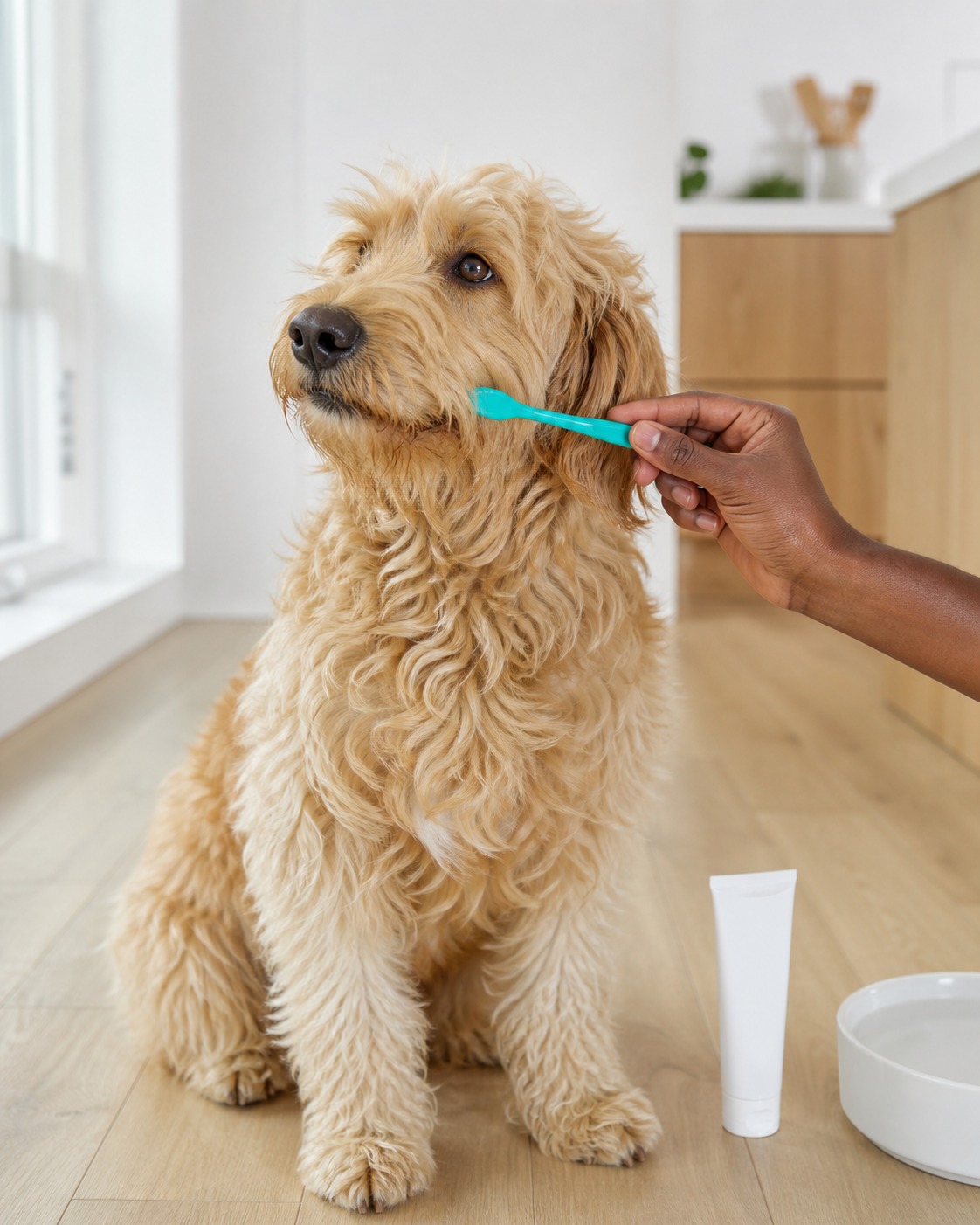
Then brush, and brush often. Once a week is not enough; aim for at least four times weekly, ideally daily. The basics:
- Use a soft-bristled brush and a fluoride-free pet toothpaste, preferably one accepted by the Veterinary Oral Health Council (VOHC).
- Put a little paste on your finger and let your dog taste it. If they like it, use it; if not, the brush alone still helps.
- Focus on the outer (cheek-side) surfaces, bristles toward the gum line, held at about a 45-degree angle.
- Work in small circles, concentrating on the canines and the big teeth toward the back.
- Spend roughly 30 seconds per side.
Use tools that are actually vetted. Look for the VOHC seal on chews, pastes, and rinses; it means the product passed a defined testing protocol. And skip the things that crack teeth: antlers, nylon bones, cow hooves, and “real” bones are hard enough to fracture the large carnassial teeth, and even tennis balls are notorious for grinding down enamel over time.
Once tartar has formed, only a professional cleaning under anesthesia can remove it; everything you do at home is about delaying that point, not replacing it. That is the honest version of the promise the gadget makes dishonestly.
The bottom line
The sonic scaler in your feed sells a clean-looking crown and calls it dental care. It is not the same thing. The disease that matters is under the gum, where the tool cannot reach, the camera cannot see, and only an anesthetized cleaning with X-rays can find it, and on an awake dog the gadget adds real risk of injury, aspiration, and a lifelong aversion to mouth handling. If the appeal was saving money, the move that genuinely saves it is the boring one: brush most days, use VOHC-accepted products, and keep up the annual checks. A couple of unglamorous minutes a day beats a hundred-dollar wand every time.
References
- American Veterinary Dental College. “Companion Animal Dental Scaling Without Anesthesia.” AVDC Position Statements. https://avdc.org/avdc-position-statements/
- “Reasons Not to Choose Anesthesia-Free Pet Dentals.” Anesthesia-Free Pet Dental Cleanings — Know the Facts (AVDC). https://afd.avdc.org/reasons-not-to-choose-anethesia-free-pet-dentals/
- “Periodontal Disease in Dogs.” American Veterinary Dental College. https://afd.avdc.org/pet-periodontal-disease/
- “Accepted Products.” Veterinary Oral Health Council. https://vohc.org/accepted-products/
Common questions
Are sonic scalers safe to use on a dog at home?
They carry real risks. The tips were designed for use on a fully still, anesthetized patient, so on an awake dog they can injure the gums, tongue, and soft tissue if the dog moves. The spray also poses an aspiration risk without a protected airway, and the stress can make a dog more resistant to all future mouth handling.
Why does a vet cleaning cost so much more?
Because it is a different procedure. Under anesthesia, the vet does a full oral exam, takes dental X-rays to see below the gumline, scales above and below the gum margin, and polishes the teeth. The X-rays and subgingival cleaning are exactly what an at-home scaler cannot do, and they are where dental disease is actually found and treated.
What is the cheapest thing that genuinely protects my dog's teeth?
Daily brushing with a soft brush and pet toothpaste, ideally backed by VOHC-accepted products and an annual vet check starting around age three. It is unglamorous and nearly free, and it does more for your dog's mouth than any gadget, because it slows plaque before it hardens into tartar that only a professional cleaning can remove.
Not a substitute for your vet. Our guidance is educational. For urgent symptoms, contact a vet or emergency clinic right away. Editorial standards
Dr. Nair is a veterinarian focused on diet and feeding. She covers everyday nutrition, treats, and the many "can they eat this?" questions owners ask, grounding each answer in what is actually safe and sensible for dogs and cats.
Meet our experts ↗Keep reading
 Health & WellnessYour Dog's Teeth Are Chattering. The Trigger Tells You If It's Nothing or an Emergency.Dr. Mara Chen · 6 min
 Health & WellnessEvery Dog Bone Fails in One of Two Ways. Learn Both and You'll Never Buy Wrong Again.Dr. Ravi Mehta · 7 min
 Health & WellnessAn AI Can Now Grade Your Dog's Teeth From a Phone Photo. The Catch Is What It Can't DoDr. Amara Solis · 5 min
 Health & WellnessThat Crunching Sound Isn't a Quirk. It's a Symptom.Dr. Lena Park · 5 min
 Health & WellnessYour Dog's Gum Disease Has One Reversible Stage. Miss It and There's No Undo.Dr. Ravi Mehta · 5 min
 Health & WellnessBrush the Ones You Want to Keep: The Dog Dental Rule Nobody Says Out LoudDr. Nina Kohl · 6 min