


Snow Zoomies Come With a Countdown. Almost Nobody Starts the Clock.
Your dog losing their mind in fresh snow is real joy, and it is also a timer you are not watching. Here is what actually makes snow so intoxicating, and the temperature numbers that tell you when to call it.

Affiliate disclosure. This article contains affiliate links. We may earn a small commission if you buy through a link, at no extra cost to you. How we handle recommendations.
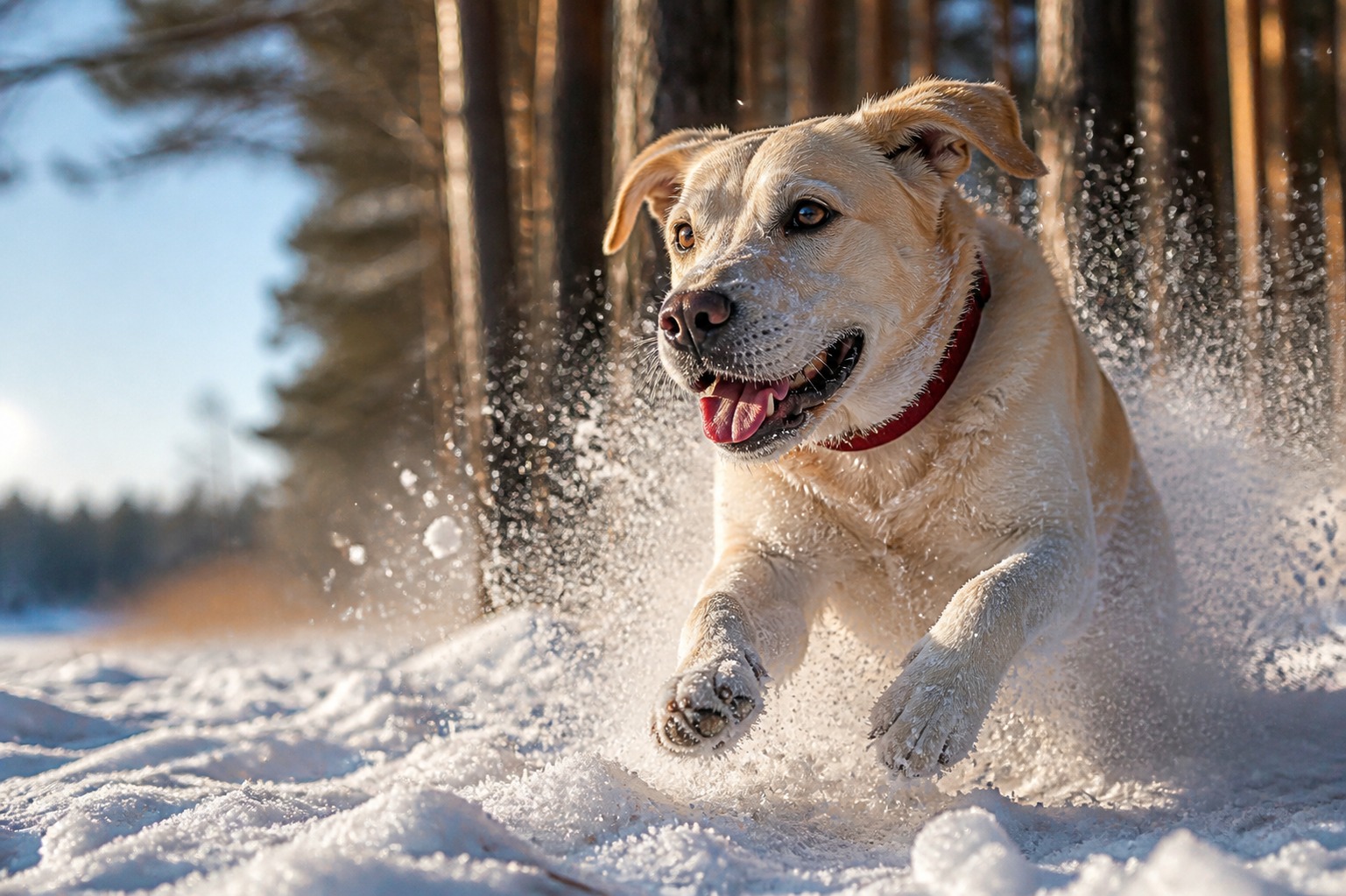
The first real snowfall of the year turns some dogs into a completely different animal. Ears up, nose down, a hard sprint through the drifts, then a full-body plow into the deepest pile they can find. It is one of the great free joys of dog ownership.
It is also the fastest way to lose track of time in the cold.
Here is the thing almost nobody tells you: the dog is a terrible judge of when to stop. A snow-drunk dog will keep going long past the point where their body has started to lose the argument with the weather, and the excitement itself masks the early warning signs. So the joy is yours to enjoy, but the clock is yours to keep. This piece is about both halves: why the snow hits them like that, and the numbers that tell you when the fun has a hard edge on it.
Why snow scrambles a dog’s brain in the best way
It is the novelty, physically. Most of what a dog experiences is a rerun. The same yard, the same block, the same three surfaces underfoot. Snow changes the texture, the sound, the temperature, and the light all at once. Some dogs stomp and dig purely to make the crunch happen again, because the feedback is that satisfying.
Cold is a stimulant for a lot of dogs. Think about how your dog moves on a hot, sticky August afternoon compared to a crisp 35-degree morning. The energy that heat drains out of them, cold hands back. That surplus has to go somewhere, and it usually goes into zoomies, digging, and vertical leaps.
The footing is different. Fresh powder gives underfoot, and a dog bounding through it gets a little lift they do not get on pavement. That bunny-hop gait you see is not just enthusiasm. It is easier.
The smells go through a whole cycle. This one is underrated. Fresh snow temporarily caps the scent trails already on the ground, so a dog arrives to a page that has been partially wiped. Then, as the snow is disturbed, packed, and melted, those smells come back up in fresh layers. Working out what is buried under there is a genuinely rewarding puzzle for a nose built to solve it.
Snow is one of the only times a dog’s whole familiar world gets rewritten overnight. The zoomies are the sound of a dog realizing every square foot of the yard is worth checking again.
The breed part is real, but it is not the whole story
An eight-pound Chihuahua stepping into a drift and immediately shaking is not being dramatic. Cold tolerance is substantially built in.
The Alaskan Malamute, the Bernese Mountain Dog, and the Siberian Husky are built for this weather, with working histories that ran through sledding, hunting, and search-and-rescue in cold country. What they carry is a double coat: a dense, insulating layer sitting against the skin, with a weather-resistant outer layer over the top of it. That is a thermal system most of these dogs are already wearing. They generally do not need a sweater on top of it. Sporting and working breeds often love snow for a different reason: it is a fresh, complicated environment to explore, which is exactly the job they were bred to want.
But breed only sets a range. Inside that range, personality decides. Some dogs are curious and playful, and snow amplifies that. Others are cautious, hate being wet, or simply prefer their world predictable, and no amount of Husky in the mix will make them love it. A dog who goes on walk strike in a snowstorm is not broken.
The numbers you should actually be tracking
This is the part the snow-day photo never shows you. Cold injury in dogs is a function of temperature, wind, wetness, coat, body size, age, and health, and the thresholds are lower than most owners assume.
Veterinary guidance converges on a rough ladder:
- Around and just below freezing (32°F): the zone where older, smaller, thinner-coated, and unwell dogs start to show early cold stress. Most healthy, well-coated adult dogs are fine for a normal walk.
- Below about 20°F: genuinely hazardous for small and medium dogs, and frostbite risk climbs for everyone. Frostbite goes after the parts that stick out and stay wet: paw pads, ear tips, tail, nose.
- Below 0°F: potentially life-threatening for many dogs within minutes, and wind or wet gear collapses that window further.
For a thin-coated dog, the working limit in freezing weather is often just ten to fifteen minutes of exposure without a warm place to retreat to. That is barely a lap of the block.
Hypothermia is not a single state, either. Vets stage it by core temperature: mild at roughly 90 to 99°F, moderate at 82 to 90°F, and severe below 82°F. Untreated, it moves toward cardiac and respiratory failure. You will not be taking a temperature in the yard, so watch the dog instead:
- Shivering that will not stop, or shivering that suddenly stops in a cold dog (a bad sign, not a good one)
- Slowing down, stumbling, or acting confused
- Pale or bluish gums and skin
- Skin that feels genuinely cold to the touch
- Holding one paw up mid-stride, which usually means the pads hurt
That last one is your cue to end the walk. Not to negotiate. To go inside.
The stuff on the sidewalk is a separate problem
Snow itself is mostly benign. What we put on top of it is not.
Sidewalk salt and chemical ice melt can burn paw pads on contact and cause real illness if a dog licks it off, which every dog will try to do. The combination of freezing snow and de-icer is what produces those cracked, raw, sore pads in February.
Two fixes, in order of how much your dog will tolerate:
- Booties, if your dog will wear them. Nothing beats a physical barrier.
- Wipe or rinse the paws the second you get in the door, every time, no exceptions. This is the one that actually gets done.
- A protective balm or paw wax applied before you go out, like Musher’s Secret, gives the pads a barrier and helps them recover afterward. Plain coconut oil is a reasonable stand-in for the recovery half.
Two things the cold quietly changes about food and water
They still need water, maybe more. Winter air is dry, and dogs still work hard on a snowy walk. Cold weather does not lower the water requirement, it just hides the thirst. Keep the bowl full and topped up after exercise.
They may need to eat more. Holding core temperature in the cold burns calories, and a dog spending real time outside in winter is running a bigger furnace than they were in July. For active outdoor dogs in a hard winter, a modest bump in food is reasonable. Ask your vet before you change amounts, especially if your dog is already carrying extra weight.
What newer research adds
The temperature ladder above reflects where veterinary guidance has landed recently, and it is stricter than the folk wisdom most of us grew up with. Washington State University’s veterinary teaching hospital and the American Animal Hospital Association both now put the practical limit for thin-coated dogs and cats at roughly ten to fifteen minutes of freezing exposure without a warm space to go back to, rather than the vague “watch them and see” advice of a decade ago.
The other shift is that the guidance now weights wind and wetness as heavily as the thermometer reading. A wet dog at 25°F is losing heat far faster than a dry dog at 15°F. If your dog has been swimming, plowing through slush, or rolling, treat the day as much colder than it says on your phone.
Nothing here is a reason to skip the snow day. It is a reason to end it while it is still fun.
The bottom line
The excitement is genuine, the breed differences are real, and the scent puzzle under the snow is the best enrichment your dog will get all winter. Take them out. Let them lose their mind for a bit.
Then be the one who watches the clock, checks the paws, and calls it early, because your dog absolutely will not.
References
- American Animal Hospital Association. “Cold Weather Pet Safety Tips for Dogs and Cats.” aaha.org
- Washington State University Veterinary Teaching Hospital. “When Is It Too Cold for Your Pet?” January 6, 2025. hospital.vetmed.wsu.edu
- American Kennel Club. “Hypothermia in Dogs: How Cold Is Too Cold?” akc.org
Common questions
How long can my dog safely stay out in the snow?
It depends on the temperature, the coat, and the dog. A rough working rule: above freezing, most healthy adult dogs are fine for a normal walk. Between 32°F and 20°F, small, thin-coated, senior, and sick dogs should be limited to short outings, often ten to fifteen minutes. Below 20°F, small and medium dogs face real frostbite risk. Below 0°F, wind and wet can make it dangerous for many dogs within minutes.
Why does my dog go wild in snow but ignore the yard the rest of the year?
Snow rewrites the scent landscape. Fresh snowfall temporarily caps existing odor trails, and as it packs, melts, and gets churned up, it releases those smells again in new layers. To a nose that good, a snowed-over yard is a brand-new place. Add the novel texture, the cold-driven energy bump, and the springy footing, and the yard becomes worth investigating all over again.
Is snow itself dangerous for my dog to eat?
Clean snow in small amounts is not a problem, but snow near roads and sidewalks is often loaded with de-icing salt and chemical melt, which can burn the mouth and cause vomiting or worse if swallowed. Steer your dog away from plowed piles and slush, and rinse or wipe the paws when you get in.
Do double-coated dogs need a coat in the snow?
Usually not. A dog with a true double coat, meaning an insulating undercoat plus a protective topcoat, carries their own thermal layer. Coats matter far more for single-coated, thin-coated, short-legged, very small, very old, very young, and unwell dogs, whose bodies lose heat much faster.
Not a substitute for your vet. Our guidance is educational. For urgent symptoms, contact a vet or emergency clinic right away. Editorial standards
Dr. Chen is a small-animal veterinarian who leads health and safety coverage at The Pet Times. She writes and reviews the bulk of our illness, condition, and safety content, translating clinical guidance into clear, practical advice owners can act on at home.
Meet our experts ↗Keep reading
 TrainingThe Dog That Bites Your Kid Isn't the One on the SidewalkDr. Mara Chen · 8 min
 TrainingYour Dog Rolling in Poop Isn't Camouflage. That Theory Barely Holds Up.Dr. Nina Kohl · 7 min
 TrainingYour Dog's Joy Sends 86,000 People to the ER Every YearDr. Nina Kohl · 8 min
 Health & WellnessDog Saliva Doesn't Heal Wounds. It Delivers Bacteria.Dr. Priya Nair · 8 min
 LivingA Wolfdog Is Not a Fluffier Husky. Nobody Can Tell You What You Actually Own.Dr. Ravi Mehta · 8 min
 Health & WellnessA Loose Dog Is Charging You. Your Instincts Are Wrong.Dr. Nina Kohl · 6 min