


Renaming Your Rescue Won't Confuse Her. Keeping a Poisoned Name Might.
A name is not an identity to a dog. It is a cue, and cues can be broken. Why changing a shelter dog's name is usually a favor to her, when to keep it, and the two-week protocol that makes it stick.

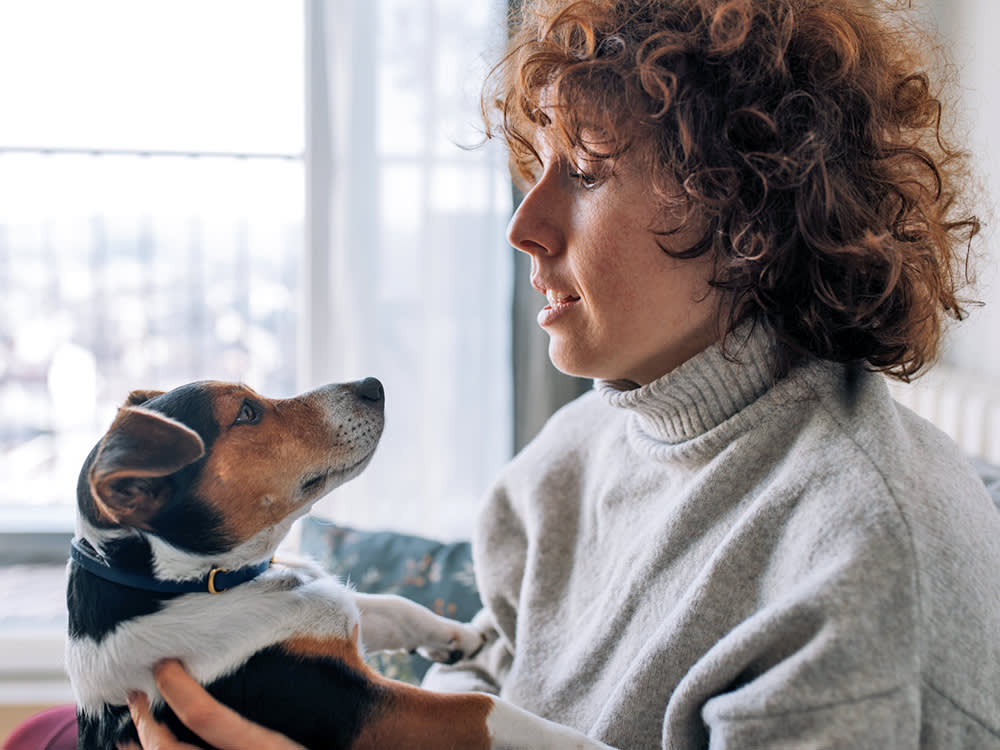
The night you bring a rescue dog home, you find yourself holding a piece of paperwork with a name on it that somebody else picked. Maybe a volunteer named her after a snack. Maybe an entire litter got themed. Maybe the name is fine and just is not yours.
And then the worry starts: if I change it, will she be confused? Will I be taking something away from a dog who has already lost everything?
No. In most cases you will be doing her a favor, and the reason why is more interesting than “dogs don’t care.”
A name is a cue, not an identity
Your dog does not experience her name as a self. She experiences it as a sound that reliably predicts something. If the sound has been paired with food, praise, and attention, it predicts good things and she turns toward it. If it has been paired with nothing, it predicts nothing and she ignores it. If it has been paired with being grabbed, crated, or yelled at, it predicts bad things, and she has learned to check out when she hears it.
Trainers call that last one a poisoned cue. It is the single best argument for renaming an adopted dog, and it is the one nobody mentions. A dog whose old name was mostly used to interrupt, scold, or capture her does not have a precious identity you are erasing. She has a word that means “something unpleasant is about to happen,” and you are offering to take it away from her.
For most shelter dogs the history attached to the existing name is short, sometimes just a couple of weeks in a kennel. Unless someone deliberately trained her to respond to it, she may not really know it at all.
People agonize over the name and then use it forty times a day to mean ‘stop that.’ The name is not the problem. What the name has come to predict is the problem, and a fresh one is a clean slate.
Naming is also, unavoidably, for you. It is one of the first real acts of relationship, and choosing a name that fits how you see this dog is part of how a stranger becomes yours. That is not a frivolous reason. It is most of the reason people do it.
When to keep the old name
There is one situation where the calculus flips.
If you are adopting a senior dog who spent years in a loving home, that name has been reinforced thousands of times in good contexts. It genuinely does function as something like a marker of self, and stripping it out during an already disorienting transition is an unnecessary cost. Keep it.
You can still make the relationship yours without a legal name change. Add a nickname. Dogs learn additional words for themselves easily, and a nickname that only you use becomes a private channel between the two of you. It does not interfere with the original name; it sits alongside it. Plenty of dogs respond to a silly nickname exactly the way they respond to their formal name, because both have been loaded with the same good associations.
The same logic applies to a dog who is already deeply bonded to a foster and clearly knows her name well. You are not obligated to change it. You are simply allowed to.
The mistake that ruins new names
Here is what people actually do wrong, and it has nothing to do with which name they picked.
They repeat it.
“Luna. Luna. Luna! LUNA.” Each unanswered repetition makes the word weaker. You are teaching your dog, very efficiently, that this sound does not require a response, because four times out of five it did not lead to anything. The word gets diluted until it is background noise, and then people conclude the dog “doesn’t know her name.”
Say it once. If she looks, pay her immediately and generously. If she does not look, say nothing, wait, and come back later with better food or a quieter room. A name that always gets answered is a name that is worth answering.
Some dogs pick this up in a couple of minutes. Others take a couple of weeks. If you are stuck, an hour with a good trainer is usually enough to fix the mechanics, which are almost always the issue.
Two weeks, ten seconds at a time
The protocol is short enough to run while the kettle boils.
Days 1 to 3. Quiet room, no distractions, excellent treats. Say the new name once, mark and pay any head turn. Five to ten reps a day, ten seconds each. If she knew her old name well, say the old name, then the new one, then pay. You are building a bridge.
Days 4 to 7. Drop the old name entirely. Add mild distraction: another room in the house, then the hallway, then the backyard.
Days 8 to 14. Take it outside. Say it once on a walk when she is mildly interested in something else, and pay heavily when she turns. This is where the name becomes real, because a name that only works in a silent kitchen is not a name, it is a parlor trick.
Forever. Never use it as a reprimand. If you need to interrupt a behavior, use a different word. The name means “look at me, something good is happening.” Keep it clean, and you will still have a working recall in five years.
What newer research adds
The old assumption was that a dog’s name is basically a Pavlovian noise, an attention beep with no content behind it. That has gotten more interesting.
In a 2024 study published in Current Biology, researchers at Eötvös Loránd University in Budapest, led by Marianna Boros, used non-invasive EEG to record dogs’ brain activity while owners said familiar words alongside objects. When the word matched the object shown, the brain’s response differed measurably from when it did not. In other words, hearing a word activated a mental representation of the thing the word refers to.
The finding that matters most for you: this was not limited to the celebrated “genius” dogs who know a hundred toy names. The effect showed up broadly, suggesting it is a general canine capacity rather than a rare talent. Related work has found that dogs who do learn object labels hold onto them for at least two years.
The takeaway is not that your dog thinks of herself as “Luna.” It is that words, for dogs, are real associative structures that get built through pairing and stay built. Which means a new name is not a deletion. It is a new association, laid down the same way the old one was, only this time with you doing the paying.
References
- Boros, M., et al. “Dogs Build Semantic Expectations Between Spoken Words and Objects.” Current Biology, 2024. cell.com/current-biology/fulltext/S0960-9822(24)00385-3
- “Dogs With a Vocabulary of Object Labels Retain Them for at Least 2 Years.” Biology Letters, Royal Society, 2024. royalsocietypublishing.org/rsbl/article/20/9/20240208/63657/
- Fugazza, C., et al. “Acquisition and Long-Term Memory of Object Names in a Sample of Gifted Word Learner Dogs.” Royal Society Open Science, vol. 8, no. 10, 2021. royalsocietypublishing.org/rsos/article/8/10/210976/
- American Veterinary Society of Animal Behavior. “What Are Reward-Based Training Methods for Dogs (and Cats)?” avsab.org/what-are-reward-based-training-methods-for-dogs-and-cats/
Dr. Solis is a board-certified veterinary dermatologist with over twelve years of clinical experience. She advises on skin conditions, allergies, and grooming practices that affect coat and skin health. All dermatology and allergy content at The Pet Times is reviewed by her team before publication.
Meet our experts ↗Keep reading
 TrainingYes, Your Dog Can Learn to Skateboard. It's Just Shaping in Disguise.Claire Sutton · 5 min
 LivingDon't Teach Your Dog to Swim. Teach Them to Get Out.Dr. Priya Nair · 8 min
 Health & WellnessA Man Shot a Dog for Running at Him. He Was Never Charged.Marcus Webb · 8 min
 LivingThe 'Trainer' Who Starved 133 Dogs Is Finally Going to Prison for 15 YearsNina Vasquez · 5 min
 Training8 Ways to Be the Dog Owner Your Building Doesn't Complain AboutMarcus Webb · 8 min
 Training'Gentle Parenting' Your Dog Isn't Permissive. That's the Part People Get Wrong.Dr. Nina Kohl · 9 min