


Rawhide Is a Tannery Byproduct. Whether It Hurts Your Dog Is Up to You.
The rawhide debate isn't really about rawhide. It's about two things nobody prints on the bag: how your dog chews, and how honestly the chew was made. Here's the full risk picture, who should skip it entirely, and how to buy the safer stuff.

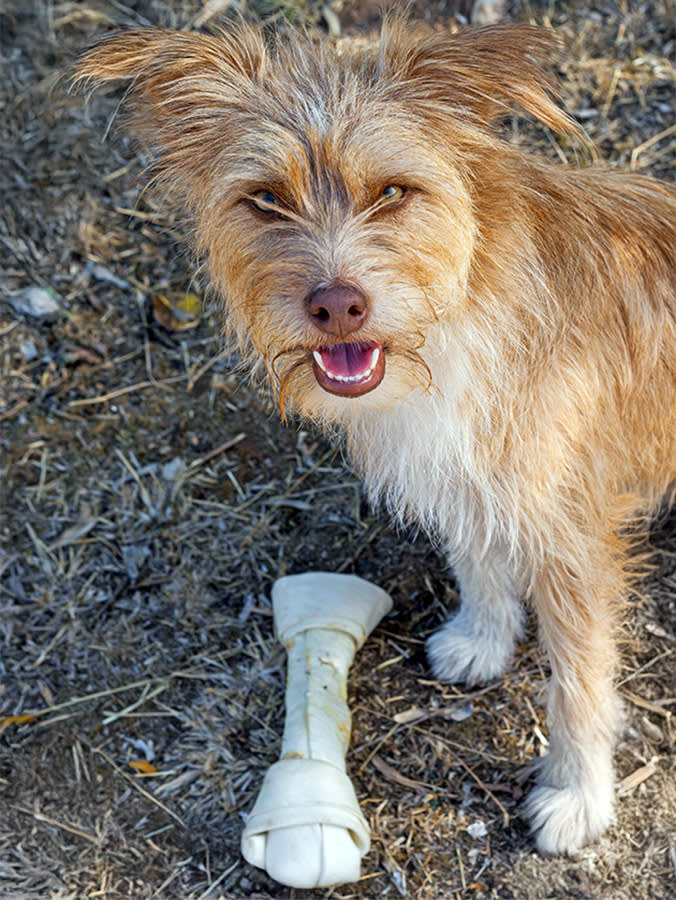
Walk down any pet-store aisle and rawhide is everywhere, which makes it feel like a settled, safe default. It isn’t settled at all. Ask ten vets and you’ll get mixed answers, and that’s because “is rawhide bad for dogs” is the wrong question. Rawhide isn’t one product with one risk profile. The same word covers a clean, single-ingredient chew made under U.S. regulation and a chemical-soaked leftover from an overseas tannery. And the same chew is nearly harmless in the mouth of a patient gnawer and genuinely dangerous in the jaws of a gulper. So whether rawhide is “bad” comes down to two things the packaging rarely makes clear: how your dog chews, and how the thing was actually made. Sort those out and you can make a real decision instead of a superstitious one.
What you’re actually handing your dog
Rawhide comes from the inner layer of cattle or horse hides. The outer layer becomes leather goods; what’s left underneath, cleaned up, becomes the chew. It’s prized for a tough, chewy texture that keeps dogs happily occupied for a long time, and it comes in every shape and size, frequently coated in peanut-butter, beef, or chicken flavor to boost the appeal.
That “natural product” label on the front is doing a lot of work, though, because how a hide gets from animal to aisle varies enormously. The basic process: strip the outer layer, clean the inner one chemically or mechanically to pull off fat and hair, preserve it against rot, then cut, knot or roll, and dry it into that hard chew. The details are where it gets uncomfortable. Hair is frequently stripped using sodium sulfide liming, and much of the raw material arrives as a byproduct from leather tanneries, an industry that features heavily among the country’s Superfund cleanup sites. To fight decay and the resulting stench, hides get washed and whitened with hydrogen peroxide, and some are coated with titanium oxide to look cleaner and whiter. Residues that have turned up in rawhide over the years include lead, arsenic, mercury, and formaldehyde. None of that appears on the bag.
There’s a regulatory blind spot underneath all this. Because these chews are consumable, the FDA treats them as “food,” yet so long as the label avoids any nutritional claim like “high protein,” a maker can sidestep the pet-food standards set by the Association of American Feed Control Officials. In practice, the FDA’s veterinary arm tends to investigate additives only after a pile of complaints about a specific chemical. The oversight is reactive, not preventive.
This isn’t just theory. In 2017, a major supplier recalled multiple rawhide brands, including American Beefhide, Digest-eeze, and Healthy Hide, after discovering that facilities in Mexico, Colombia, and Brazil had used a quaternary ammonium compound, an antimicrobial cleared for cleaning food equipment but not approved as a rawhide processing aid, in production. Dogs that got the affected chews turned up with vomiting, diarrhea, and reduced appetite. It’s the cleanest illustration you’ll find of why where and how a rawhide is made is not a trivia question.
The physical risks: mostly about how your dog chews
Set the chemistry aside for a second, because the most common ways rawhide sends a dog to the vet are mechanical, and they track closely with chewing style.
The big one is obstruction. Rawhide is engineered to be tough and durable, and “consumable” does not mean “digestible.” A dog softens and gnaws off chunks, but those chunks don’t break down. Swallowed whole, rawhide can actually swell in the stomach, and a large piece can lodge anywhere along the digestive tract, from the esophagus to the intestines. At best that’s a stomachache; at worst it’s a life-threatening blockage that shows up as vomiting, appetite loss, abdominal pain, or constipation and can end in emergency surgery. The dogs hit hardest by blockages are the little ones, the powerful chewers, and the food-inhalers.
Almost every rawhide emergency I’ve treated came down to a dog swallowing a piece too large to move through the gut, and it lodges somewhere it shouldn’t. The dogs at highest risk are the enthusiastic gulpers, the ones so eager to get the treat down that they’ll try to swallow something clearly too big. If that’s your dog, no amount of supervision fully fixes it, and I’d steer you to a safer chew.
Choking is the fast version of the same problem: a chunk bitten off too big to swallow can wedge in the throat, and it can happen even to a dog who usually chews politely. Then there are teeth. Gnawing on anything hard is a leading cause of fractured teeth in dogs, and puppies and hard chewers are especially prone because they don’t hold back. A cracked tooth isn’t just painful; it opens the door to infection that can travel elsewhere in the body.
The product risks: mostly about where it came from
The other cluster of risks is about the chew itself, and it’s why sourcing matters so much. Beyond the processing residues above, the flavorings deserve a hard look: the past decade brought an explosion of flavored rawhides, and more flavor can mean more to worry about. One bubble-gum coating, for instance, listed the dye FD&C Red 40, a suspected carcinogen, plus preservatives like sodium benzoate. The more a dog licks and chews and swallows, the more of whatever’s in there they absorb, and slow, low-dose exposure is nearly impossible to trace back to a cause.
Origin compounds the uncertainty. Rawhide produced overseas can be difficult to trace, and a grim historical note underlines the point: a Humane Society International fur-trade investigation in the late 1990s documented dog skins in Asia being mixed into rawhide chews exported to U.S. stores. Modern U.S.-made rawhide under stricter regulation is a far cry from that, which is exactly why country of origin belongs at the top of your checklist.
Who should just skip rawhide
Honestly, plenty of vets think most dogs are better off without it, and for some dogs that’s not a close call. If your dog chews aggressively, gulps large pieces, or has any history of digestive trouble, the simplest safe choice is to skip rawhide entirely and pick something else. Puppies, especially under six months, shouldn’t have it either, mostly because of the choking risk. There’s no chewing benefit rawhide offers that a safer chew can’t.
To be fair to the other side, rawhide does have upsides when it goes well: gnawing can scrape off some tartar (though it’s no substitute for a real dental cleaning), it’s genuine mental enrichment for a bored dog, it can redirect a chewer away from your furniture, and it keeps high-energy or anxious dogs busy for a good while. Those benefits are real. They’re just also available from chews that don’t carry the same risks.
If you’re going to do it, buy right and serve right
Decide to keep rawhide in rotation? Then treat both the buying and the giving as safety steps.
When you shop, favor size and thickness matched to your dog’s power, avoid obviously chemically processed hides, and choose products made in the USA where the rules are tighter. Rolled or compressed rawhides resist being torn into dangerous chunks and last longer, so skip thin sheets. Look for single-ingredient chews free of artificial preservatives, colors, and flavors, and if your dog has a sensitive stomach, seek out ones specifically labeled more digestible.
When you serve it, the rules are simple and non-negotiable: supervise the entire time, offer a piece too big to swallow whole, cap the session around 15 to 20 minutes so your dog doesn’t soften and ingest too much, pull any small or heavily chewed-down nub, and watch for coughing, gagging, vomiting, or off bowel movements. If your dog has GI history, clear it with your vet before you start. Do all of that and you meaningfully shrink the risk, though you never quite erase it.
Safer ways to satisfy the chew
The urge to chew is real and worth honoring, so if you’d rather sidestep rawhide, there’s a deep bench of alternatives: a fresh or frozen carrot, a stuffed and frozen rubber toy, bully sticks (still watch for swallowing), Himalayan yak-cheese chews, single-ingredient dehydrated meat chews like tendons or ears, sweet-potato chews, and dental sticks. For the dental angle specifically, chews carrying the Veterinary Oral Health Council (VOHC) seal are the evidence-backed pick. Match whatever you choose to your dog’s size and chewing style, and, rawhide or not, always supervise chew time.
What newer research adds
The research keeps pointing in the same practical direction. In-lab digestibility work has shown that traditional rawhide breaks down poorly compared with alternatives, which is the science behind that swelling-and-obstruction risk, and it’s pushed the market toward “digestible” rawhide-style chews and clearly labeled single-ingredient options. On the dental side, the smarter move than hoping a chew scrapes teeth clean is to look for the VOHC seal, which means a product has actually been tested to reduce plaque or tartar rather than just claiming to. The throughline: you have more genuinely good options than the pet-store rawhide wall suggests, and the safest chew is almost always the one matched to how your particular dog chews.
References
- Hooda, S., et al. “In Vitro Digestibility of Expanded Pork Skin and Rawhide Chews, and Digestion and Metabolic Characteristics of Expanded Pork Skin Chews in Healthy Adult Dogs.” Journal of Animal Science (2012).
- U.S. Food and Drug Administration. “United Pet Group Voluntarily Recalls Multiple Brands of Rawhide Chew Products for Dogs Due to Possible Chemical Contamination.” FDA recall notice, 2017.
- Arhant, Christine, et al. “Chewing Behaviour in Dogs — a Survey-Based Exploratory Study.” Applied Animal Behaviour Science, vol. 241, 2021, p. 105372.
- Veterinary Oral Health Council. “VOHC Accepted Products for Dogs.” vohc.org.
Common questions
Is rawhide actually bad for dogs?
It depends. The real risks come from poor-quality or chemically treated hides, dogs who gulp or chew aggressively, and chewing without supervision. Choose a high-quality chew, watch your dog, and keep sessions short, and many dogs handle rawhide fine.
What kinds of rawhide are safest?
Single-ingredient rawhides with no added chemicals, colors, or preservatives; thick and dense rather than thin sheets; ideally labeled digestible; made in the USA, where processing is more tightly regulated; and rolled into sticks rather than flat sheets.
What's the safest chew overall?
Rubber toys like KONGs, dental chews carrying the Veterinary Oral Health Council (VOHC) seal, bully sticks (watch for swallowing), and single-ingredient dehydrated meat chews like tendons or ears. Supervise no matter what you choose.
Not a substitute for your vet. Our guidance is educational. For urgent symptoms, contact a vet or emergency clinic right away. Editorial standards
Dr. Solis is a board-certified veterinary dermatologist with over twelve years of clinical experience. She advises on skin conditions, allergies, and grooming practices that affect coat and skin health. All dermatology and allergy content at The Pet Times is reviewed by her team before publication.
Meet our experts ↗Keep reading
 Product PicksYou Didn't Fail at Brushing Your Dog's Teeth. You Started at the Wrong End.Dr. Mara Chen · 7 min
 Health & WellnessMost Dog "Longevity" Supplements Are Guesswork. 9 That Aren't.Dr. Priya Nair · 11 min
 Health & WellnessYour Dog Doesn't Need Straight Teeth. It Needs a Bite That Doesn't HurtDr. Mara Chen · 8 min
 Health & WellnessAt-Home Grooming Is a Monthly Health Exam That Happens to Leave Your Dog CleanClaire Sutton · 8 min
 Health & WellnessYour Dog's Bad Breath Is a Medical Report, Not a Personality TraitDr. Priya Nair · 6 min
 Health & WellnessYour Dog's Gum Disease Has One Reversible Stage. Miss It and There's No Undo.Dr. Ravi Mehta · 5 min