


You Didn't Fail at Brushing Your Dog's Teeth. You Started at the Wrong End.
Everyone begins with the toothbrush, which is exactly why everyone quits. The one thing that decides whether your dog tolerates this is what the paste tastes like, and almost nobody treats that as the main event.

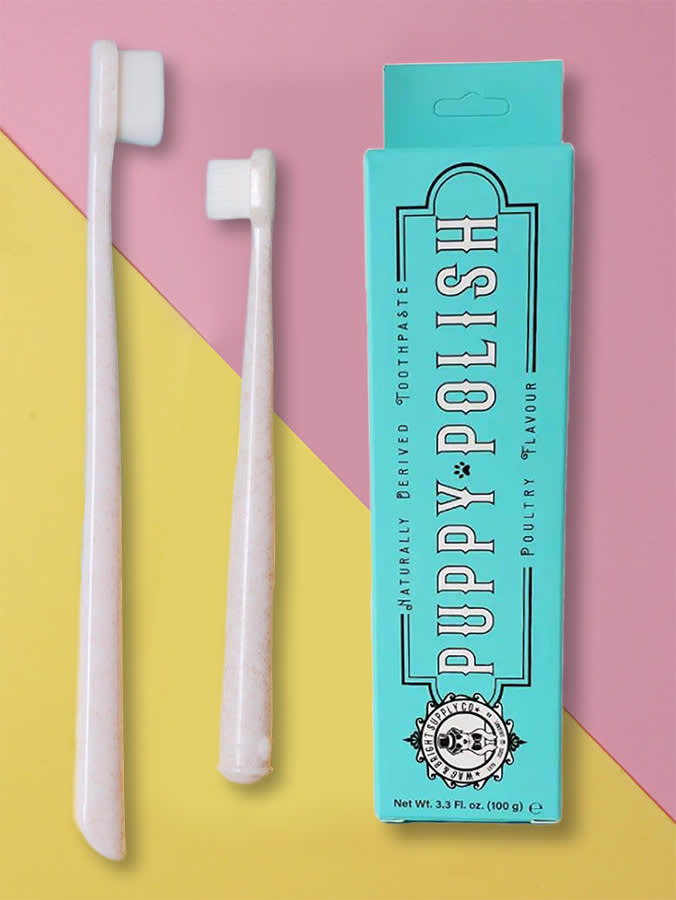
Here is how it goes for almost everyone. You buy the dog toothbrush. You read that you are supposed to brush your dog’s teeth, ideally every day, and you feel a small pulse of guilt. You corner the dog. There is a wrestling match. Somebody, possibly both of you, ends up unhappy on the bathroom floor.
Then you buy dental treats, tell yourself they are basically the same thing, and never speak of it again.
The problem is that you started with the toothbrush. The toothbrush is the last thing that matters. The thing that decides whether this becomes a two-minute daily habit or a fight you eventually lose is much dumber and much more powerful: does your dog want to eat the toothpaste?
The flavor is not a gimmick. It is the whole mechanism.
Think about what you are actually asking a dog to do. You want to put a foreign object into their mouth, move it around their gums, and have them hold still and cooperate. Nothing in a dog’s evolutionary history recommends this.
The only lever you have is making the thing in their mouth good. Not tolerable. Good. Good enough that they lean in.
That is why the paste is the product and the brush is the accessory, and it is why the newer wave of dog toothpastes has spent its effort on palatability. A poultry-flavored paste sweetened with stevia is not there to be cute. It is there to convert an unpleasant procedure into a food-delivery event, which is the only frame in which a dog will voluntarily let you touch their molars.
Get that right and the resistance mostly evaporates. Get it wrong and no technique in the world will save you.
The product: Puppy Polish, about $18
The one that made this argument concrete for us is Wag & Bright’s Puppy Polish, a dog toothpaste that arrives in a Tiffany-blue tube with a vintage French-pharmacy look, packaged with more care than most human toothpaste.
The aesthetic is doing a job, and it is worth naming honestly: a tube you are not embarrassed to leave on the counter is a tube you will actually reach for. Dental care fails on adherence, not on chemistry.
But the reason it works is the formula. It is poultry flavored, and it uses stevia, a natural sweetener, to make it appealing. Paired with the brand’s very soft-bristled brush, the sequence that usually plays out is not a wrestling match. It is: dog licks the paste, dog decides the paste is food, dog permits the brush, dog is confused about why this is over so quickly.
For a dog who has previously fought every attempt at brushing, that first lick is the entire hinge of the thing. Two minutes, no drama, is a realistic outcome, and two minutes with no drama is a habit that survives.
Who it is right for: dogs who have refused brushing before, and people who have given up and defaulted to dental treats. Who it is wrong for: nobody, really, except that $18 is more than a basic enzymatic paste costs. If your dog already lets you brush without complaint, a cheaper tube does the same job. One note: the very soft bristles are a feature, not a compromise. Gum tissue is where periodontal disease starts, and a stiff brush on an inflamed gumline is how you teach a dog that this hurts.
Shop Puppy Polish at Dog & Co.
The brand is also unusually transparent about its formulas and how they are tested, and is working toward becoming a sustainable, carbon-neutral company. That is a nice-to-have rather than a reason to buy, but it is a real one.
Why any of this is worth the trouble
It is easy to file dental care under vanity, somewhere near breath freshening. It is not.
Periodontal disease is the most common clinical condition in adult dogs, and the majority show evidence of it by the age of three. It is not a cosmetic problem. It is a chronic bacterial infection of the tissue holding the teeth in the jaw, and it is painful long before it is obvious, because dogs are extremely good at not showing you.
The progression is boring and relentless. Plaque forms. Within roughly a day to three days, it mineralizes into tartar. Once it is tartar, a brush cannot remove it, and only a professional cleaning under anesthesia will. Under the tartar line, the gum recedes, the bone resorbs, and the tooth loosens.
Which means brushing is entirely a prevention activity, operating inside a 24-to-72-hour window. That is the real reason frequency matters more than intensity. A perfect brushing once a month accomplishes almost nothing. A mediocre brushing most days accomplishes a great deal.
People think they are cleaning their dog’s teeth. They are not. They are interrupting a clock. Plaque turns into tartar in a day or two, and once that happens, you have lost that round and only a cleaning under anesthesia will win it back. The brushing you do today protects the teeth you still have.
The one hard rule: never human toothpaste
This is the part to read twice.
Human toothpaste frequently contains xylitol, which is seriously toxic to dogs. It can cause a rapid, dangerous drop in blood sugar and, at higher exposures, liver failure. Human paste also contains fluoride, which is formulated on the assumption that you will spit it out.
Your dog cannot spit. Every gram of what you put on that brush is being swallowed.
Use a toothpaste made for dogs. This is not a preference. It is the difference between a health routine and a poisoning.
The routine that actually holds
The reason people fail is that they attempt the finished behavior on day one. Build it instead.
- Let them lick the paste off your finger. Just that. For a couple of days. You are teaching one thing: this stuff is delicious.
- Finger on the gums. Paste on your finger, run it once along the outside of the teeth, and stop while they still want more.
- Introduce the brush, loaded. Let them lick it off the bristles like a spoon.
- Brush the outer surfaces only. This is where the plaque is and where the disease starts. Do not fight for the inner surfaces; the tongue does meaningful work there and the fight is not worth the marginal gain.
- Keep it under two minutes and end early. Stop before your dog wants you to. That is what makes tomorrow easy.
If you are shopping for other dental products alongside the brushing, look for the Veterinary Oral Health Council (VOHC) seal. The VOHC awards its seal only to products that have submitted data showing they actually reduce plaque or tartar. Most of the dental chew aisle has not. The seal is the closest thing to a filter that exists.
What’s new since this was written
Two updates worth knowing.
First, the evidence continues to favor the boring conclusion: mechanical brushing beats everything else. Dental chews, water additives, and dental diets can help at the margins, and the VOHC-accepted ones genuinely do something. But nothing has been shown to substitute for physically disrupting plaque with a brush. If you were hoping a treat could replace this, the research has consistently declined to grant that wish.
Second, veterinary dentistry has grown firmer about what “cleaning” means. A cleaning without anesthesia, sometimes marketed as a gentler or cheaper option, cannot address the part of the tooth that matters, which is the part below the gumline, and it cannot include dental X-rays. The American Veterinary Medical Association and the veterinary dental specialty organizations do not consider anesthesia-free cleaning an acceptable substitute for professional treatment. If a groomer offers to scale your dog’s teeth while they are awake, understand that you are buying an appearance, not a treatment.
Which loops back to the tube on your counter. The thing that keeps your dog out of that chair is the two minutes you can actually get away with, most days, because the paste tastes good.
References
- American Veterinary Medical Association. “Pet Dental Care.” https://www.avma.org/resources/pet-owners/petcare/pet-dental-care
- American Veterinary Dental College. “Periodontal Disease” and “Companion Animal Dental Scaling Without Anesthesia.” https://avdc.org/avdc-position-statements/
- Veterinary Oral Health Council. “VOHC Accepted Products for Dogs.” https://vohc.org/accepted-products/
- U.S. Food and Drug Administration. “Paws Off Xylitol; It’s Dangerous for Dogs.” https://www.fda.gov/consumers/consumer-updates/paws-xylitol-its-dangerous-dogs
- American Animal Hospital Association. “AAHA Dental Care Guidelines for Dogs and Cats.” https://www.aaha.org/education/guidelines/dental-care-guidelines/
Common questions
How often does my dog actually need their teeth brushed?
Daily is the gold standard, because plaque begins mineralizing into tartar within about 24 to 72 hours, and once it is tartar, a brush will not touch it. Three times a week is the realistic floor that still does meaningful good. Once a month is essentially decorative.
My dog already has tartar. Will brushing remove it?
No. Brushing prevents tartar; it does not remove it. Hardened tartar comes off with a professional cleaning under anesthesia. Starting to brush now is still worth it, because it protects the teeth you have not lost yet, but it will not undo what is already there.
Dr. Chen is a small-animal veterinarian who leads health and safety coverage at The Pet Times. She writes and reviews the bulk of our illness, condition, and safety content, translating clinical guidance into clear, practical advice owners can act on at home.
Meet our experts ↗Keep reading
 Health & WellnessYour Dog's Bad Breath Is a Medical Report, Not a Personality TraitDr. Priya Nair · 6 min
 Health & WellnessBad Dog Breath Isn't Cute. It's the First Sign of Disease.Dr. Mara Chen · 6 min
 Health & WellnessYour Dog's Gum Disease Has One Reversible Stage. Miss It and There's No Undo.Dr. Ravi Mehta · 5 min
 Health & WellnessHomemade Dog Toothpaste Is Solving the Wrong ProblemDr. Lena Park · 8 min
 Health & WellnessYou Can't Brush Off Tartar. You Have 72 Hours to Beat It.Dr. Mara Chen · 9 min
 Health & WellnessBrush the Ones You Want to Keep: The Dog Dental Rule Nobody Says Out LoudDr. Nina Kohl · 6 min