


Your Dog Doesn't Need Straight Teeth. It Needs a Bite That Doesn't Hurt
Dog braces sound like vanity, but the real decision is extraction versus correction. For a painful misaligned bite, orthodontics often costs about the same as pulling teeth and keeps the ones your dog actually uses. Here is how to weigh it.

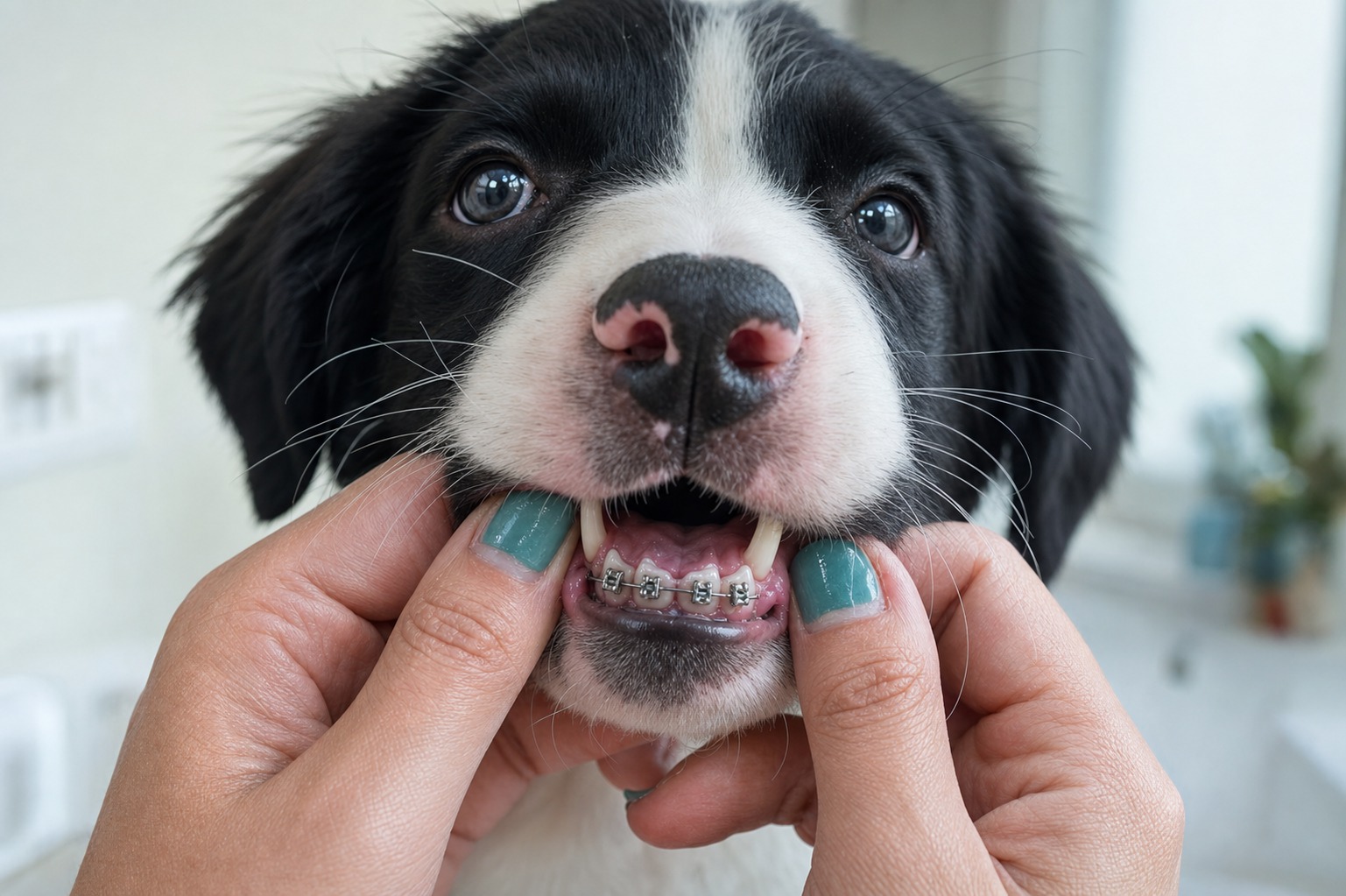
The scenario that lands a dog at a veterinary orthodontist is almost never “the owner wanted a prettier smile.” It is a vet looking into a puppy’s mouth and finding teeth that are about to start doing damage. That reframes the whole thing. The real question is not “should my dog get braces?” It is “when the choice is pulling teeth versus moving them, which one leaves my dog with a comfortable, functional mouth?” More often than owners expect, the answer is to move them, and the price is not the obstacle people assume.
What actually goes wrong: malocclusion, in plain terms
Malocclusion just means the upper and lower teeth do not line up the way they should. It is a problem not because it looks off but because misaligned teeth can jab into the palate, prevent a dog from closing its mouth, and cause chronic pain. Some malocclusions are skeletal (one jaw grows longer than the other) and some are dental (a single tooth erupts at the wrong angle). Both can hurt.
Take a textbook case: a four-month-old Dachshund mix whose lower jaw came in noticeably shorter than his upper jaw, giving him an almost chinless, extra-pronounced smile. Cute, but his vet flagged a Type II, base-narrow malocclusion: the mandible much shorter than the maxilla, producing an overbite. In growing puppies the jaws sometimes catch up to each other, but his was too extreme for that. And it was more than cosmetic. His lower canines, which should angle outward in front of the upper canines, were sitting behind them and were linguoverted, angled inward toward his tongue. Because his adult teeth were still erupting, they had not yet done harm, but left alone, that misalignment could eventually stop him from closing his mouth and injure his palate.
The decision the owner never sees coming: why not just pull the teeth?
This is the fork in the road, and it is worth slowing down on. Extraction sounds simpler and cheaper. It is often neither.
Canine teeth do real work. Their roots are roughly twice as long as their visible crowns, so removing one means genuine oral surgery and sometimes a bone graft. The lower canines in particular make up a good part of the chin, help hold the tongue in place, and are essential for grasping. Pulling a healthy canine is not a small thing, and a dog feels its absence. That is also why the veterinary field has been pushing toward saving teeth wherever possible: the American Veterinary Medical Association’s dental guidance now stresses earlier diagnosis and intervention precisely so that treatable problems get addressed before extraction becomes the only remaining choice.
So before extraction, a veterinary dentist weighs less destructive options:
Crown reduction (vital pulpotomy)
The dentist shortens an offending tooth, usually a lower canine. Because cutting the crown exposes the pulp, a small portion of pulp is removed and the top is reshaped and sealed. This vital pulpotomy is effective but not risk-free; it has to be monitored with annual dental X-rays to confirm the tooth stays healthy.
Ball therapy
In some dogs, gentle repeated pressure nudges a tooth into place. A correctly sized rubber ball, chewed about 15 minutes three times a day, can do it. The catch is cooperation: the dog has to actually want to chew the ball. Plenty of pups have zero interest, and the option evaporates.
Orthodontics (braces)
When the others do not fit, braces are frequently the gentlest route because they move teeth rather than remove them. And yes, dog braces really do use rubber bands, called elastic chains here. Under anesthesia, small buttons are cemented to the teeth (typically the lower canines and back molars), and elastic chains stretched between them apply steady pressure that gradually shifts the teeth into position. A specialist can often place the appliance in 90 minutes or less.
The four options at a glance
| Option | What it does | Best for | The catch |
|---|---|---|---|
| Orthodontics (braces) | Moves teeth into a healthy bite | A young, growing mouth where teeth can still be guided | Chains dislodge easily; several visits over 2 to 3 months |
| Crown reduction (vital pulpotomy) | Shortens the offending tooth and seals the pulp | A single tall tooth striking the palate | Needs annual X-ray monitoring for the life of the tooth |
| Ball therapy | Uses chewing pressure to nudge a tooth | A cooperative dog with a mild, tippable tooth | Only works if the dog actually chews the ball |
| Extraction | Removes the problem tooth entirely | Teeth too damaged or diseased to save | Loses grasping, jaw structure, and tongue support; real surgery |
The order matters. A veterinary dentist generally works down this list, reaching for the least destructive fix that will give your dog a comfortable, functional bite, and treats extraction as the last resort rather than the default.
What braces actually cost (the part most articles skip)
Here is the number that changes the decision. In the United States, canine orthodontic treatment generally runs about $1,500 to $5,000, with roughly $2,750 a common midpoint. On top of the base price, budget for diagnostic X-rays (about $75 to $150) and a series of adjustment visits (roughly $100 to $300 each). Crucially, extraction of the same teeth, with its surgery and possible bone graft, frequently lands in a comparable range, which is why families are so often surprised to learn that saving the teeth does not cost dramatically more than sacrificing them.
Two more financial realities to plan around. First, pet insurance almost never covers orthodontics, so assume you are paying out of pocket and ask for a full written estimate before you commit. Second, because treatment runs over several appointments, proximity to the dentist matters. For families who must travel far, some dogs can be fitted with an appliance the guardian tightens at home with a small wrench, and in other cases a mold is sent to a lab that fabricates a series of five or six progressive aligners you swap out at home, cutting the number of trips.
What treatment is like day to day
The biggest practical headache with elastic chains is simply keeping them intact. An active puppy can dislodge a chain almost daily while chewing on whatever he finds, and an owner quickly becomes an expert at reattaching them. One enterprising patient even popped off a button and needed a brief re-anesthetization to have it replaced. The good news: treatment is short, two to three months on average, and many dogs never need a retainer, because once the teeth are in place the dog’s own bite holds them there.
Cases vary. One Brittany Spaniel puppy arrived with an overbite so severe a vet initially suggested returning her to the breeder. Her family pursued treatment instead, with an appliance setup that added a palatal expander with acrylic splints to the usual buttons, chains, and composite extensions. Her teeth were saved at a price not meaningfully different from extraction, and she kept every component in place until she was done. Even a human dentist can be surprised at what is possible; one general dentist’s 10-month-old Wire Fox Terrier developed a malocclusion from a retained deciduous tooth, a baby tooth that never fell out, and was corrected in a relatively short stretch.
Owners hear ‘braces’ and picture something frivolous, but the conversation in my exam room is almost always about function and pain. A young, growing mouth responds to gentle correction far more readily than a mature one. When we catch a malocclusion while the adult teeth are still settling in, we can guide them into place before they ever cause trauma, and keep teeth the dog genuinely needs. Waiting rarely makes the case cheaper or easier.
A short decision guide for owners
If your vet flags a malocclusion, work through it in this order:
- Get it evaluated early. Older animals take longer to treat, and the window for the simplest correction is widest while the dog is young and the adult teeth are still settling. Ask for a referral to a board-certified veterinary dentist sooner rather than later.
- Ask which teeth are causing trauma and why. A bite that is merely unusual-looking but functional and pain-free may need nothing at all. A bite where teeth strike the palate or block the mouth from closing needs a plan.
- Compare correction and extraction on both cost and function. Ask for written estimates for each, and ask specifically what your dog loses by extraction (grasping ability, jaw structure, tongue support).
- Confirm it is function, not looks. A reputable dentist will tell you plainly that orthodontics is for comfort and to prevent damage, never cosmetic. The AKC’s ban on competing dogs with orthodontic work exists to keep it that way.
A bad bite is not a quirk of a cute face. Left alone it can cause real, lasting pain. But it is frequently fixable, often gently, often without sacrificing teeth your dog uses every day, and often for a price in the same neighborhood as pulling them. The costliest mistake is usually waiting.
References
- American Veterinary Dental College. “Malocclusions.”
- American Veterinary Medical Association. “New Guidelines Call for Earlier Diagnosis, Intervention in Dental Disease.”
- American Animal Hospital Association. “2019 AAHA Dental Care Guidelines for Dogs and Cats.”
- American Kennel Club. “Dog Dental Care: How to Keep Your Dog’s Teeth Clean.”
Common questions
Are dog braces just cosmetic?
No. Board-certified veterinary dentists perform orthodontics only to fix a painful or damaging bite, never for looks. In fact, the AKC bars dogs who have had orthodontic work on inherited teeth from conformation competition, precisely to keep it from becoming cosmetic.
How long does a dog wear braces?
Usually two to three months. Because a dog's normal bite acts as a natural retainer once teeth are in position, many dogs never need a retainer afterward, though some do.
What is the alternative to braces for a dog with a bad bite?
Depending on the case, options include crown reduction with a vital pulpotomy, ball therapy for teeth that need only gentle pressure, or extraction. Extraction removes teeth the dog uses for grasping and jaw structure, which is why dentists try to avoid it when a bite can be corrected instead.
Not a substitute for your vet. Our guidance is educational. For urgent symptoms, contact a vet or emergency clinic right away. Editorial standards
Dr. Chen is a small-animal veterinarian who leads health and safety coverage at The Pet Times. She writes and reviews the bulk of our illness, condition, and safety content, translating clinical guidance into clear, practical advice owners can act on at home.
Meet our experts ↗Keep reading
 Product PicksYou Didn't Fail at Brushing Your Dog's Teeth. You Started at the Wrong End.Dr. Mara Chen · 7 min
 Health & WellnessPuppy Breath Doesn't Go Bad. It Goes on Schedule.Dr. Mara Chen · 6 min
 Health & WellnessYour Dog's Bad Breath Is a Medical Report, Not a Personality TraitDr. Priya Nair · 6 min
 Health & WellnessYou Can't Brush Off Tartar. You Have 72 Hours to Beat It.Dr. Mara Chen · 9 min
 Health & WellnessAn AI Can Now Grade Your Dog's Teeth From a Phone Photo. The Catch Is What It Can't DoDr. Amara Solis · 5 min
 Health & Wellness'Dog Breath' Isn't Normal. It's the First Symptom of a Disease You Can PreventDr. Lena Park · 9 min