


The Dogs of the NYC Dyke March Were Making a Statement Too
At the 31st annual NYC Dyke March, the dogs walking 5th Avenue weren't a cute sidebar to the protest. For the people marching with them, bringing a pup was its own act of claiming space and chosen family. We met them on the route.
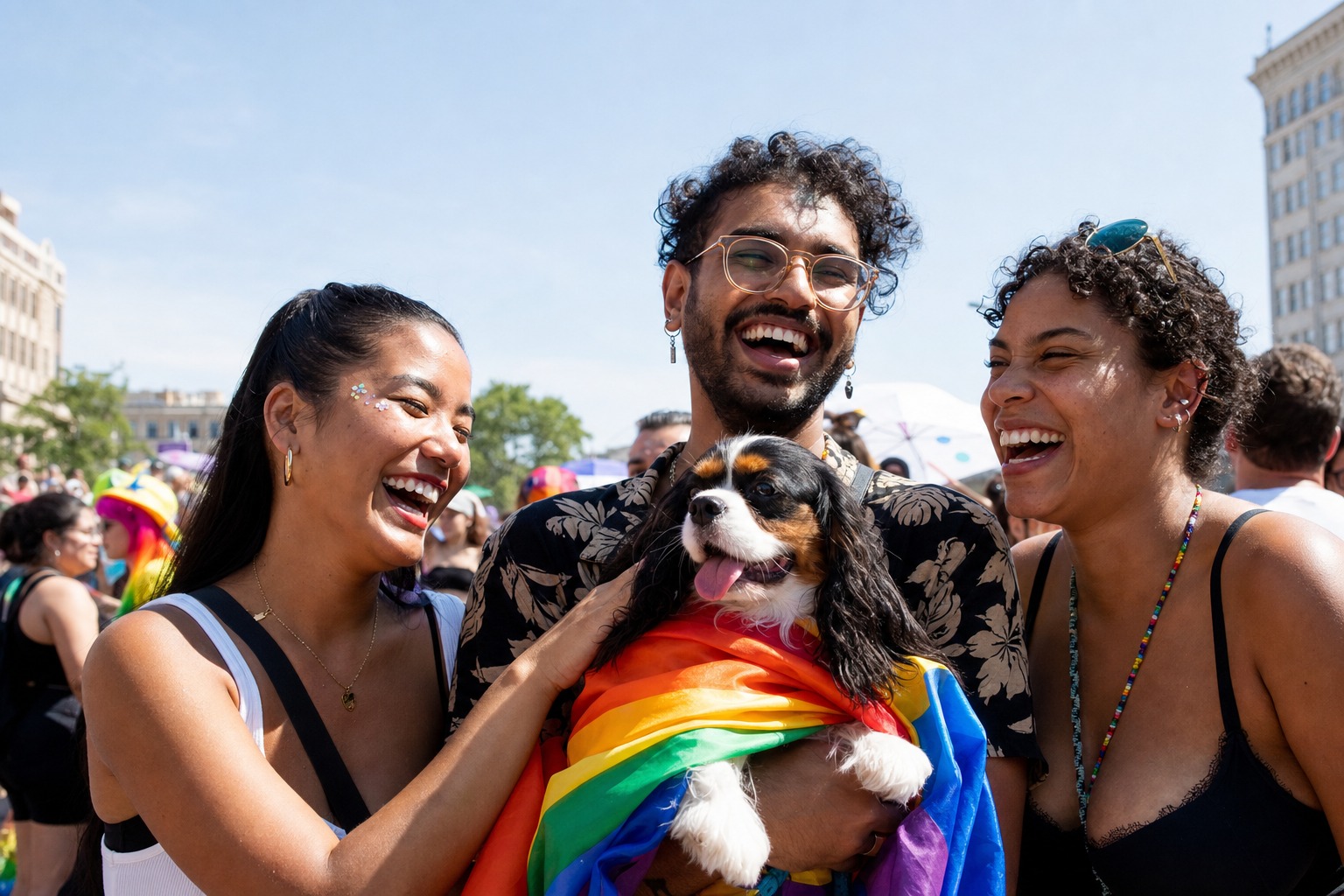
Spend enough time in New York and you learn that the Pride March is not the only show in town on the last weekend of June. It is the biggest and loudest, the one that makes headlines and books a queen like Christina Aguilera. But look past the floats and the rainbows and you will find the 31st annual Dyke March, and walking right down the middle of it, a lot of dogs. The dogs were not decoration. For the people marching with them, bringing a pup along was its own quiet statement about who gets to take up space, and about what family is allowed to look like.
The Dyke March, held in cities across the country throughout June, is by definition a protest rather than a parade. The NYC march’s website states, in part: “The March is a demonstration of our First Amendment right to protest and takes place without permits or sponsors. We recognize that we must organize among ourselves to fight for our rights, safety, and visibility.” In 2023, the march landed on the one-year anniversary of the Supreme Court overturning Roe v. Wade, and organizers answered the moment with the theme “Not Your Fcking Body, Not Your Fcking Business. Dykes for Bodily Autonomy.”
All the familiar staples were in place. Volunteer marshals linked hands along the route from Bryant Park to Washington Square Park, the Fogo Azul drumline kept a beat the whole way, the Queer Big Apple Corps played on, and the perennial “Lesbians Are Miracles” sign made its return, alongside a healthy dose of Barbie references including a personal favorite: “This Barbie is a dyke.” But the part we could not stop watching was the dogs. Here is who we met, grouped by what brought them out.
A quick word first: be extra careful any time you bring a dog to a gathering, especially a protest. Make sure they are genuinely comfortable in crowds, keep their paws protected from hot pavement and the elements, and always pack plenty of water. Skip any costume or accessory that could overheat your dog or that sits too tight or too loose. Many of the pups on the route were dressed in booties against the heat or rain jackets readied for a downpour that, in the end, never came.
The Veterans Who Have Marched for Years
Some of these pairs have been showing up together for so long that the march is part of their shared history.
Kate has been coming to the Dyke March for more than a decade, and Peaches, whom Kate affectionately calls a “fancy mutt” and a “ShihPomChiPoo” (Shih Tzu, Pomeranian, Chihuahua, and Poodle), has joined her for at least 10 of those years. “The first Dyke Marches I came to were before we had any sort of marriage rights,” she said. “Pride is a riot; I think it’s really important to show up and represent. There’s a massive backslide happening politically, and we have to show up in full force. And it’s great to be in spaces where you’re not only surrounded by likeminded folks, but you’re surrounded by like-minded activists.”
This family has marched together for three years, ever since Shay and Jamie brought home their Morkie, Archie. “I’m excited to see all the queers in one place and to march with them,” Jamie said. “We were standing here and seeing signs that make us laugh. Just people that get it. I don’t need to look far; they’re all around me right now.”
The First-Timers and the Rescues
For others, this was a debut, often for a brand-new rescue pup taking in the energy of a protest for the very first time.
It was Anya’s second year and the first for her three-month-old rescue puppy, Illyana, who is mostly Pit Bull and came from local NYC rescue org Waldo’s Rescue Pen. “She really likes meeting people,” Anya said. “She’s very food-motivated, which makes everything easier.” We caught up with Illyana again afterward, curled up between her mom’s legs in Washington Square Park. “This is my entire community,” Anya said. “My New York home is the queer scene. Whenever I ask my friends what they’re doing for pride, the only thing everyone is doing is going to the Dyke March.”
With rain in the forecast, two-year-old Navy turned up in a raincoat with a duck hood for her first Pride weekend. By the time we ran into her again, the skies had cleared and she had shed the layer. “I just think it’s a nice community event,” Kayla said. “Especially with all the laws that people are trying to pass lately, it’s more important than ever.” Why did it matter that Navy come along? “Navy’s a dyke.”
It was a first march for both Julia and Lulu, the four-month-old pup Julia rescued from True North Rescue Mission in Brooklyn. Lulu spent the lead-up cuddled close. “I’m a dyke,” Julia said. “I like to think my dog’s a dyke, too. I’m here to support the dyke mission.” And for Nicole’s first Dyke March, they pulled on some flannel, draped a little over their Pit Bull and Hound mix, Josie, and headed to 5th Avenue. “This is my first non-corporate pride event, and I didn’t realize how important that was until I just did more research after I got out of a really long, committed relationship,” Nicole said. “I had never really participated in many pride events, so I’m just learning more. It’s important.”
The Working Dog and the Borrowed One
Two pairs rounded out the day from opposite ends of the spectrum.
Arrebol is Chivita’s service dog. The two were matched about 18 months earlier through Heritage Service Dogs, a cross-disability organization that helps people raise and train their own service dogs. This was Arrebol’s first NYC Dyke March, and he came prepared with booties (“safety first,” Chivita said). “I’m here to bask in, like, dyke, gender-queer abundance and beauty and just take up space with my people, and my pup.”
And then there was Magic, a Cocker Spaniel who technically belongs to Luis’s boss. Junior and Luis heard about the march at the last minute and brought her along, though Magic is a veteran of the parade circuit, having also walked Brooklyn Pride and the Puerto Rican Day Parade. Junior called the march “diverse” and added: “That’s the meaning of the march, you know? Everybody can be the way they want to be.”
That line is as good a summary as any. The dogs of the Dyke March, the decade-long regulars and the four-month-old rescues alike, were all part of the same point their people were making by simply showing up: this is our community, this is our family, and we are taking up the space.
Leila Torres leads our Living coverage, from home life and travel to the products and rescue stories that come with sharing a life with animals. She edits and writes across the section, with a soft spot for pieces about the bond between people and their pets.
Meet our experts ↗Keep reading
 LivingMissouri Tops the 'Horrible Hundred' for a 14th Year. The 2026 Report Is Grim.Nina Vasquez · 6 min
 LivingSome States Once Banned Black Families From Owning Dogs. A Yale Scholar on Why That Still Echoes.Leila Torres · 6 min
 LivingA Comment on Instagram Got a Two-Legged Street Dog a Mercedes WheelchairJames Okafor · 5 min
 LivingThe Bigger Dog Always Loses in CourtDr. Mara Chen · 9 min
 LivingThe ADA Has No Breed List. Your Landlord's Insurance Does.Dr. Priya Nair · 6 min
 LivingHe's Fostered Almost 40 Pit Bulls. The Stigma Is the Only Thing He Can't Rehome.Leila Torres · 8 min