
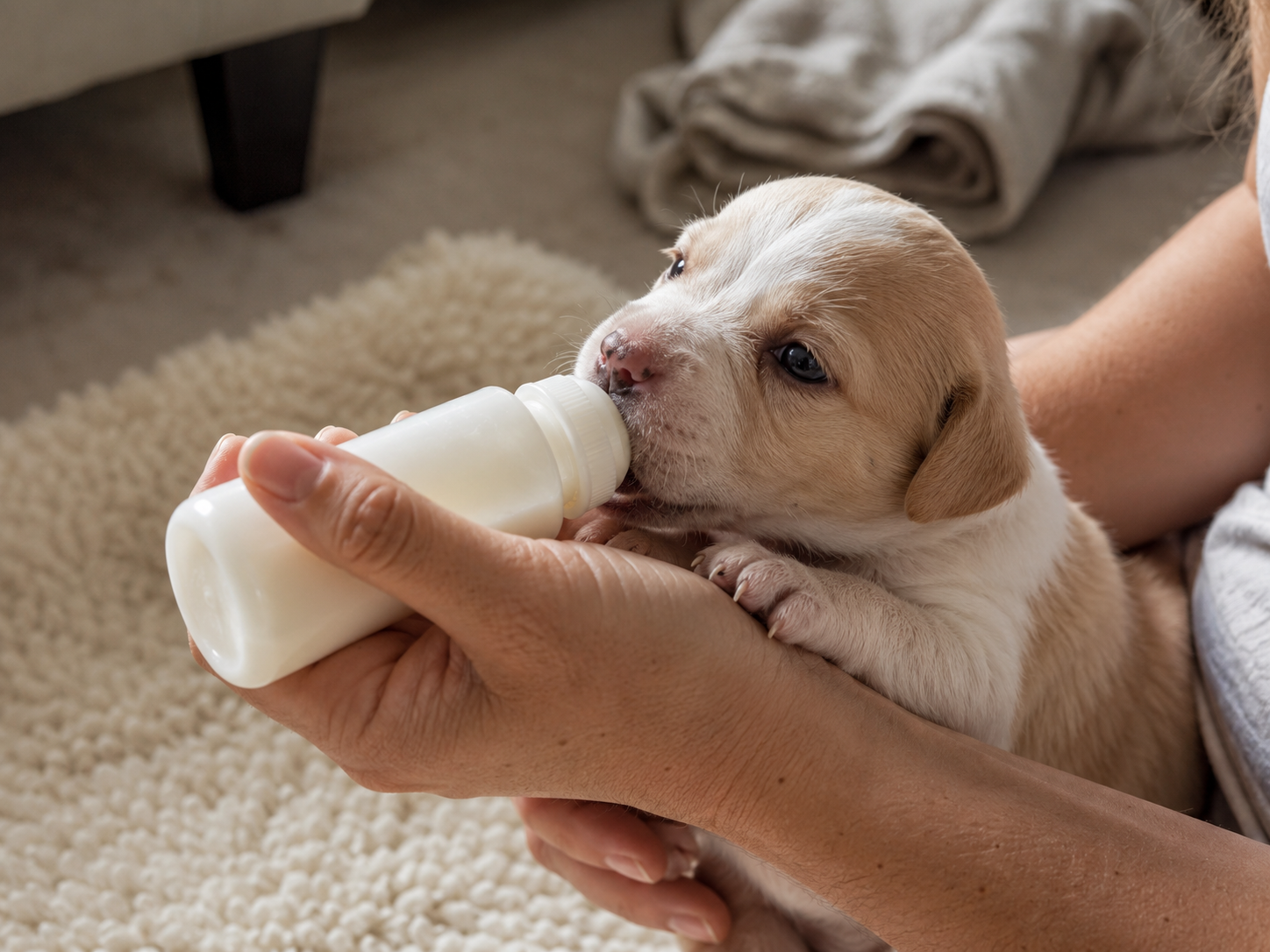
Most people reach for cow’s milk with the kindest of intentions. A puppy shows up hungry, the mother isn’t around, and the fridge has milk in it. The instinct feels obvious. It’s also one of the more consequential feeding mistakes you can make, and the reason isn’t only the upset stomach everyone warns about. The deeper problem is timing.
A puppy’s first weeks are the fastest growth it will ever do. During that window it needs a very specific mix of protein, fat, calcium, DHA, and other nutrients, and cow’s milk doesn’t come close to supplying them. So a puppy raised on cow’s milk faces two hits at once: the lactose it can’t handle well, and the nutrition it isn’t getting during the one phase where nutrition is hardest to make up later. Get this stretch wrong and you’re not risking a bad afternoon, you’re risking slow weight gain, poor organ development, and stunted bones. That’s the real stakes, and it’s why “what to pour instead” matters so much.
Start here: what’s actually feeding the puppy
For the first three to four weeks, puppies nurse almost exclusively from their mother. That milk is doing two jobs at once, delivering complete nutrition and passing along antibodies that give the puppy temporary immunity it can’t make on its own yet. Nothing you buy replaces the antibody half of that equation, which is exactly why an orphaned puppy is a more delicate situation than it looks.
When mom is in the picture and healthy, the best thing you can usually do is let her work and not interfere with milk of any kind.
When mom isn’t available: the only two real options
If the mother has rejected the litter, is too sick to nurse, or has died, you have two legitimate paths, and they are the only two.
The first is a surrogate. A nursing dog willing to accept the puppy provides complete nutrition, actual nursing care, and a bit of early social learning in one package, which is hard to beat.
The second is a commercial puppy milk replacer formula. It’s engineered to mimic canine milk in its nutrient ratios, so it delivers complete nutrition, and it has a practical advantage: you can measure exactly how much the puppy is taking and adjust portions as it grows. Either path carries the puppy safely until it’s time to begin weaning onto solid food. Everything else on the shelf is a downgrade.
“The mistake I see isn’t cruelty, it’s improvising with what’s in the kitchen,” says Dr. Nina Kohl. “During those first weeks a puppy is building its whole body on a tight nutrient budget. Formula or a surrogate meets that budget. Cow’s milk doesn’t, and you don’t get that growth window back.”
Why the popular substitutes fall short
Cow’s milk is lower in protein, fat, and essential minerals than canine milk and higher in lactose, the sugar many dogs can’t process well. Fed to a puppy, it manages to be both nutritionally inadequate and gut-irritating, which is a rare feat.
Goat’s milk gets a health halo it hasn’t earned for puppies. It’s easy to find in processed form and gets talked up as highly digestible, but that digestibility claim is about people, not puppies. Goat’s milk still falls short on the protein and fat a puppy needs, and its slightly lower lactose isn’t low enough to prevent upset. Raw goat’s milk adds a real hazard on top: unpasteurized, it can carry E. coli, Salmonella, or Listeria straight to an animal with almost no immune reserve.
Plant milks, oat, soy, rice, almond, can be safe for an adult dog in small amounts, but they can’t support a puppy’s requirements, and some carry active dangers. Many contain added sugars or artificial sweeteners like xylitol, which can cause a dangerous blood sugar crash and liver injury, and some include ingredients like macadamia. Always read the full label before any dog gets these, and keep them away from puppies entirely.
A quick way to spot lactose intolerance in your dog
Nobody knows the exact share of dogs that are lactose intolerant, but it’s common, and it tends to increase with age as the body makes less lactase, the enzyme that breaks lactose down. The tell is usually obvious within hours of a dairy snack. Watch for diarrhea, gas, bloating, abdominal discomfort, and vomiting. Some dogs handle a little cheese or yogurt fine but react to milk specifically; others get “bubble guts” from any dairy at all.
What about the adult dog?
Once a dog is grown, the question shifts from harm to point. Some adult dogs tolerate milk in moderation, but it offers little nutritional benefit, and dogs fed milk regularly risk digestive trouble or weight gain. If you want to offer a liquid treat, plain water is still the best drink by a wide margin; a little diluted low-sodium beef, chicken, or bone broth is a safer novelty than milk. Plain, unsweetened yogurt is generally better tolerated than milk for dogs that aren’t lactose intolerant, since some of the lactose is already broken down.
What’s new since this was written
The strongest recent evidence is comparative: nutrient-profile analyses of commercial dog milk replacers versus real dog milk, and studies lining up canine milk against bovine and caprine milk, keep landing on the same conclusion. Formulas designed for puppies track dog’s milk far more closely than cow’s or goat’s milk do, especially on the protein and fat that drive early growth. This is the science behind the plain advice: for an orphan, a purpose-built replacer isn’t a nicety, it’s the point.
The other shift is around raw goat’s milk, which has gained a following in wellness circles. Veterinary reviewers continue to caution that “raw” and “healthy” aren’t the same thing, and that skipping pasteurization trades a modest digestibility talking point for a real bacterial risk, one a neonatal puppy is least equipped to survive. The safe move hasn’t changed.
References
- Comparison of the Nutrient Composition of Commercial Dog Milk Replacers With That of Dog Milk, Journal of Animal Physiology and Animal Nutrition
- Analysis and Comparison of Nutrition Profiles of Canine Milk with Bovine and Caprine Milk, Animals (MDPI)
- Management of the Neonate in Dogs and Cats, Merck Veterinary Manual
- Xylitol Toxicity in Dogs, VCA Animal Hospitals
- Raw or Undercooked Animal-Source Protein in Cat and Dog Diets, AVMA policy