


"Pit Bull" Isn't a Breed. That One Fact Dismantles Almost Every Myth
The case against pit-bull fear doesn't need eight separate rebuttals. It needs one: 'pit bull' is a look, not a breed, so nearly every sweeping claim about their temperament is a category error from the start.

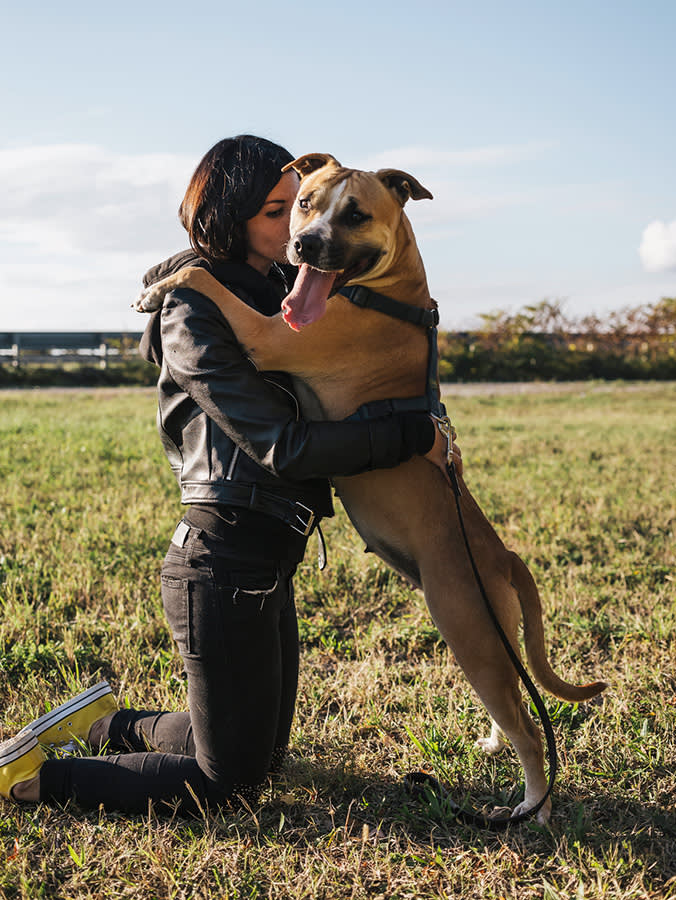
There is a tidy way to argue that pit bulls are not dangerous, and it usually runs to seven or eight separate myths, each knocked down in turn. That works, but it buries the strongest point under a pile of smaller ones. The whole edifice of pit-bull fear rests on a single shaky assumption, and once you remove it, most of the myths collapse together rather than one at a time.
The assumption is that “pit bull” names a breed with a fixed, heritable temperament you can generalize about. It doesn’t. “Pit bull” is a look, not a breed, a blocky head and a muscular build that show up across several distinct breeds and a vast number of mixes. Almost every frightening claim about pit bulls, that they’re inherently vicious, that they bite most, that they can’t be trained, is a statement about a category that doesn’t biologically exist. That is not a rhetorical trick; it is the actual root of the confusion, and it is where this article starts. Then we’ll follow it through the specific myths it dissolves, ending with the one place the misunderstanding turns genuinely deadly for the dogs.
The root error: a label masquerading as a breed
Start here because everything else depends on it. The American Kennel Club does not recognize “pit bull” as a breed, because it isn’t one. It’s an umbrella term, and people apply it by appearance. The breeds most often swept under it include the American Pit Bull Terrier, the American Staffordshire Terrier, the Staffordshire Bull Terrier, the American Bulldog, and the American Bully, plus an enormous population of mixed-breed dogs that simply look the part.
That has a consequence people rarely sit with: when you sort dogs by how they look rather than what they are, every behavioral generalization is built on sand. Shelter and animal-control staff routinely identify “pit bulls” by sight, and studies comparing visual identification to DNA have found that guess to be wrong a large share of the time. So a “pit bull bit someone” headline may describe a boxer mix, a mastiff cross, or a dog with no bull-breed ancestry at all.
“Once you’re grouping several breeds together by appearance, the idea of a single ‘pit bull temperament’ stops meaning anything,” says Dr. Ravi Mehta, a veterinary behaviorist who consults for Pet Times. “Each of those breeds carries its own tendencies, and a mixed-breed dog that merely resembles them may carry none of them. Behavior in front of you tells you about that dog, not about a category we invented by silhouette.”
Hold that thought, because it is the solvent for the myths below.
Myth: pit bulls are inherently vicious
This is the category error in its purest form. If “pit bull” isn’t a breed, “born violent pit bull” is incoherent before we even discuss temperament. But the temperament evidence makes the point even more bluntly.
The American Temperament Test Society runs a standardized evaluation of how dogs react to strangers, noises, and odd situations. In its breed statistics, the American Pit Bull Terrier passes at about 86 percent, and the American Staffordshire Terrier scores similarly high. For comparison, the much-beloved Golden Retriever passes at roughly 85 percent, slightly lower than the pit-bull-type dogs. (One honest caveat: the test measures sociability and stability in specific scenarios, not “aggression,” and it tests dogs whose owners opt in. It is not the last word, but it is real, standardized data, and it points the opposite direction from the stereotype.)
No dog is born violent. As the ASPCA’s position on pit bulls puts it, genetics may nudge tendencies, but behavior emerges from the interaction of genes with environment, socialization, training, and individual history. The blocky head predicts none of it.
Myth: most dog bites come from pit bulls
A natural sequel to “inherently vicious,” and it falls apart on data quality. There is no trustworthy national database of bites by breed. The CDC deliberately stopped tracking bites by breed, because breed identification at the scene is unreliable and the agency judged it unhelpful for actually preventing bites. The American Veterinary Medical Association is direct: “Any dog can bite, regardless of its breed,” and what predicts a serious bite is the individual dog’s history, behavior, size, and the situation, not its label.
Layer the misidentification problem on top, dogs are guessed to be pit bulls by sight and logged that way, and the inflated numbers explain themselves. You cannot pin “most bites” on a category that gets assigned by appearance and recorded without verification.
Myth: pit bulls have “lockjaw”
Bigger and sillier than its predecessor, and refreshingly easy to settle with anatomy. There is no jaw-locking mechanism in any dog. Pit-bull-type skulls and jaw muscles are structurally ordinary; nothing latches shut.
“There’s no anatomical structure that locks a dog’s jaw, in pit bulls or anyone else,” Dr. Mehta says. “It’s a mechanical impossibility that somehow became folklore.”
Bite-force measurements actually rank several other breeds above the American Pit Bull Terrier, including Rottweilers, German Shepherds, and other large dogs. The fearsome-jaw image survives on vibes, not measurement.
Myth: they can’t be around kids or other pets
This one needs a careful answer rather than a cheerful dismissal, because the responsible message about any dog and children is the same. Plenty of pit-bull-type dogs are gentle, patient family dogs; some even work as service dogs. The ATTS sociability scores reinforce that these dogs, on average, are not the outliers the stereotype claims.
But the right unit is the individual dog and the management around it. No dog of any breed should be left unsupervised with young children, and introductions to other animals should be gradual and supervised. The accurate claim is not “pit bulls are always safe with kids and pets,” nor the myth’s “pit bulls can’t be,” but “this depends on the individual dog, its socialization, and your supervision, exactly as it does for a Lab or a poodle.”
Myth: pit bulls are hard to train
The opposite is closer to the truth. Pit-bull-type dogs tend to be smart, eager, and highly motivated, which makes them very trainable with the same methods that work for any dog: positive reinforcement and figuring out what the individual dog will work for.
“They’re extremely teachable,” Dr. Mehta says. “The work is finding the motivator and clearing away anything in the way of learning, fear, anxiety, pain, or trouble with impulse control. What they don’t need is a ‘firm hand.’ Heavy-handed correction backfires with these dogs the same way it backfires with every dog.”
Myth: breed-specific legislation makes communities safer
Here the misunderstanding stops being a debate and starts costing dogs their lives, so it gets the most weight. Breed-specific legislation (BSL) bans or restricts dogs based on breed or appearance. The evidence that it reduces bites is essentially absent; veterinary and public-health reviews repeatedly find no measurable drop in bite rates where breed bans are enacted, which is why the AVMA and many governments oppose them.
It fails for reasons that trace straight back to the root error. BSL depends on identifying “pit bulls” by sight, the very identification that is demonstrably unreliable, so enforcement is arbitrary and shaped heavily by media coverage. It manufactures anxiety for owners of perfectly behaved dogs, who must fear their dog being blamed for any incident nearby. And it floods shelters with surrendered family pets.
The downstream toll is the part that should land hardest. PETA has called pit-bull-type dogs among the most abused dogs in the country. The Humane Society notes that they are consistently among the most common dogs in shelters, in part because BSL discourages their adoption, and the longer a dog sits in a shelter, the more likely it is to be euthanized. The anti-pit narrative is not just unfair; through BSL it is lethal.
What follows from getting it right
Strip the category error out and a coherent picture remains. There is no single “pit bull temperament” to fear, because there is no single pit bull. Standardized testing puts these dogs at or above America’s sweetheart breeds for sociability. There’s no lockjaw, no breed-level bite epidemic, no training curse, and no evidence that banning a silhouette protects anyone. What predicts a dog’s behavior is the individual dog, raised, trained, and treated well or badly, just like every other dog on the planet.
So the practical ask is simple. Judge the dog in front of you, support shelters and rescues working against breed bias, and push back on breed bans where you live. These dogs are not a category; they are individuals, and they have been counting on the rest of us to notice the difference.
References
- “ATTS Breed Statistics.” American Temperament Test Society. https://atts.org/breed-statistics/
- “Position Statement on Pit Bulls.” ASPCA. https://www.aspca.org/about-us/aspca-policy-and-position-statements/position-statement-pit-bulls
- “Why Breed-Specific Legislation Is Not the Answer.” American Veterinary Medical Association. https://www.avma.org/resources/pet-owners/petcare/why-breed-specific-legislation-not-answer
- “Dog Bites.” Centers for Disease Control and Prevention. https://www.cdc.gov/healthy-pets/about/dog-bite-prevention.html
- “Breed-Specific Legislation Fact Sheet.” The Humane Society of the United States. https://www.humanesociety.org/resources/breed-specific-legislation
Common questions
Are pit bulls aggressive?
Not as a category, because 'pit bull' is not a single breed but a loose visual label covering several breeds and countless mixes. Temperament testing tells a striking story: in American Temperament Test Society data, American Pit Bull Terriers pass at roughly 86 percent, slightly higher than the Golden Retriever's rate. A dog's individual history, training, health, and socialization predict its behavior far better than its blocky head does.
Do pit bulls have locking jaws?
No. There is no anatomical jaw-locking mechanism in pit-bull-type dogs or any dog; their skulls and jaw muscles are structurally ordinary. Bite-force studies actually place several other breeds, including Rottweilers and German Shepherds, above the American Pit Bull Terrier. The 'lockjaw' idea is a myth with no anatomical basis.
Do most dog bites come from pit bulls?
There is no reliable breed-level bite data to support that claim. The CDC stopped tracking bites by breed because breed identification is unreliable and the agency considered it unhelpful for prevention, and the AVMA states that any dog can bite, with individual factors mattering far more than breed. Bite reports also misidentify breed constantly, which inflates pit-bull numbers.
Does breed-specific legislation reduce dog bites?
The evidence says no. Reviews by veterinary and public-health bodies have found that breed bans do not reduce bite rates, which is why the AVMA and many governments oppose them. Bans are expensive to enforce, rely on unreliable visual breed identification, and crowd shelters with surrendered family dogs, without making communities safer.
Are pit bulls good with kids and other pets?
Many are wonderful family dogs, but the right framing is individual, not breed-wide. As with any dog, good outcomes come from proper socialization, training, supervision around children, and thoughtful introductions to other animals. No breed, pit-bull-type or otherwise, should be left unsupervised with young children, and any blanket claim that pit bulls 'can't' live with kids or pets isn't supported by the temperament data.
Nina Vasquez writes about life at home with pets and the relationships at the heart of it. Her work covers day-to-day living, people-and-pet stories, and the products that fit into a real household, with a warm, grounded take on everyday pet ownership.
Meet our experts ↗Keep reading
 TrainingYour Dog's Toy Stash Is Adorable. The Growl Over It Isn't.Marcus Webb · 7 min
 TrainingYour Dog Isn't Trying to Be 'Alpha.' The Science Buried That Idea.Dr. Amara Solis · 7 min
 TrainingYour Dog Pulls Because Pulling Works. Stop Paying for It.Dr. Mara Chen · 6 min
 TrainingYour Dog Isn't Wrecking the Yard. They're Doing a Job. Name It.Dr. Mara Chen · 8 min
 Health & WellnessYour Dog Eating Dirt Is Usually Boredom. Sometimes It's Their Blood.Dr. Mara Chen · 7 min
 TrainingFace Bites Are Almost Always Our Fault, Not the Dog'sDr. Amara Solis · 5 min