
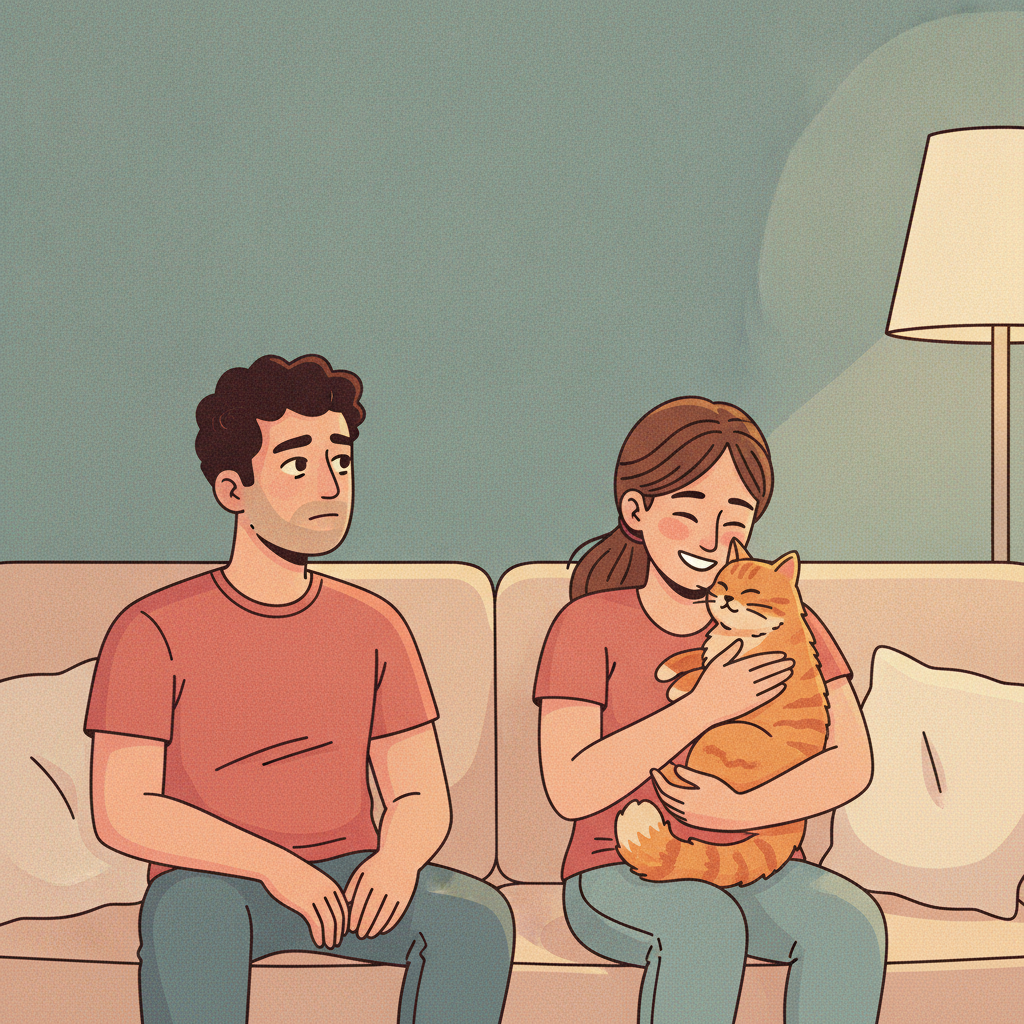
Most people who feel jealous of their own pet do one of two unhelpful things: they pretend they don’t (because being jealous of a cat sounds ridiculous), or they quietly let it curdle into resentment. Both are mistakes, and they come from the same wrong assumption, that the feeling is silly and therefore meaningless. It isn’t. Jealousy that your pet prefers your partner is a small, reliable signal pointing at something real, usually a need in the human relationship that isn’t being met. Read it as data, and it becomes useful. Dismiss it, and it festers. This piece is about how to read it, and what to do once you have.
The feeling is rarely about the animal
Relationship therapist Sara Lim has watched plenty of pet-directed jealousy surface in her practice, though never as the stated reason anyone books a session. “The pet is almost never the real issue,” she says. “Jealousy usually traces back to a feeling of scarcity, the sense that love and attention are in limited supply, and that the animal is siphoning off a share that should have been theirs.”
Here is the reframe that defuses it: love isn’t a finite resource. Your time and energy for caregiving are limited, sure, but your capacity to love isn’t, and neither is your partner’s. When someone feels they aren’t getting enough, though, they start treating affection as if it were scarce, often without noticing, and they resent whoever appears to be drawing it down. The dog is the visible target. The actual shortage is somewhere else.
I watched this play out at a friend’s dinner table. “The dogs get better treatment than I do,” Dave said to his wife, half-joking. Everyone laughed; Dave laughed a beat too late. Earlier that weekend I’d caught him trying to get the dogs’ attention while they waited by the door for her, muttering something about being worthless to them anyway, with a laugh that didn’t land, and later watching her stroke the dogs with a strange, wan look on his face. The joke wasn’t really a joke. It was scarcity, surfacing the only way he’d let it.
Why pets are the perfect thing to blame
Pets make ideal scapegoats precisely because they can’t argue back. They depend on us entirely, they can’t explain themselves, and so much of what we label their “personality” is really us projecting onto them. Where a spouse will challenge your account of events, a pet simply won’t. That imbalance is exactly why they’re so lovable, and so easy to resent, since you can pin whatever motive you like on them and they’ll never set the record straight. Recognizing that is half the work: the story you’re telling about the pet’s “preference” is partly a story about you.
Childish feelings are still real feelings, so stop disqualifying yours
The biggest obstacle to fixing this is embarrassment. Several people I asked treated the very idea as too dumb to consider. “That is so stupid, who’d be jealous of a cat?” one friend said about her husband and her cat, before adding, almost in the same breath, “He didn’t even like her.” Which made me wonder, don’t dislike and jealousy often travel together? Another friend regularly pouts when the cat picks her boyfriend’s lap over hers, while insisting “I’m not jealous, I just want him to cuddle with me, and he only ever cuddles with my boyfriend.” That is jealousy wearing a disguise.
I’m not above it either. As a kid I resented my mother’s cat for choosing her lap over my company, and I’d like to think I’ve outgrown that, but adults feel childish things constantly. A feeling being embarrassing, or clashing with how you’d like to see yourself, does not make it less real, and judging yourself for it only drives it underground where it does the most damage. “The self-judgment is the trap,” Lim says. “The moment you tell yourself ‘I can’t be jealous of a dog, that’s stupid,’ you’ve stopped being able to look at the feeling, and you can’t address what you won’t examine.”
Why it won’t fix itself
There’s a tempting belief that resentment fades on its own if you ignore it long enough. It doesn’t. “Left unaddressed, with no talking it through or digging into it, resentment just grows louder,” Lim says. “In my experience it’s genuinely rare for someone to simply ‘get over’ it. It’s a sticky feeling. It’s corrosive in a relationship, and it needs attention.” Left alone, jealousy of a pet quietly becomes distance from a partner. The animal is not the thing being damaged.
The short conversation that usually does it
Here is the part the original conversation tends to skip, the actual move. Once you’ve stopped disqualifying the feeling, it resolves through a fairly simple sequence, and often in a single talk.
- Name it to yourself, without the apology. “I feel jealous when the dog chooses you” is a complete, legitimate sentence. Drop the “which is so stupid” rider; it’s the thing blocking you.
- Translate the jealousy into the underlying need. Ask what you’re actually short on. More physical affection? More of your partner’s attention in general? Reassurance that you’re wanted? The pet’s preference is the symptom; this is the cause.
- Open it with curiosity, not accusation. Lim’s framing: “These situations are usually built on misunderstandings and quiet assumptions on both sides. A lot of the time, one honest conversation clears it.” Lead with the need (“I’ve been wanting more time with you lately”) rather than the grievance (“you love the dog more than me”).
- Make a small, concrete ask. Not “love me more,” but something doable: a few unhurried minutes together when one of you gets home, before the dog gets the first hello.
- If you can’t have the conversation alone, that’s the signal to get help. Not because the problem is huge, but because the difficulty in talking about it is itself the thing worth understanding.
The pet, in the end, was never the problem, and was never going to be the solution. The conversation you’ve been avoiding is both.
References
- Gottman Institute. “The Sound Relationship House: Building Love Maps and Turning Toward.” https://www.gottman.com/blog/
- American Psychological Association. “How to recognize and manage jealousy.” https://www.apa.org/topics/relationships