


Van Life With a Dog Isn't a Vibe. It's a Heat-Management Job.
The road looks like freedom on Instagram. With a dog in the van, it's really a daily job of managing heat, routine, and a very small metal box. Here's how full-timers actually make it work.

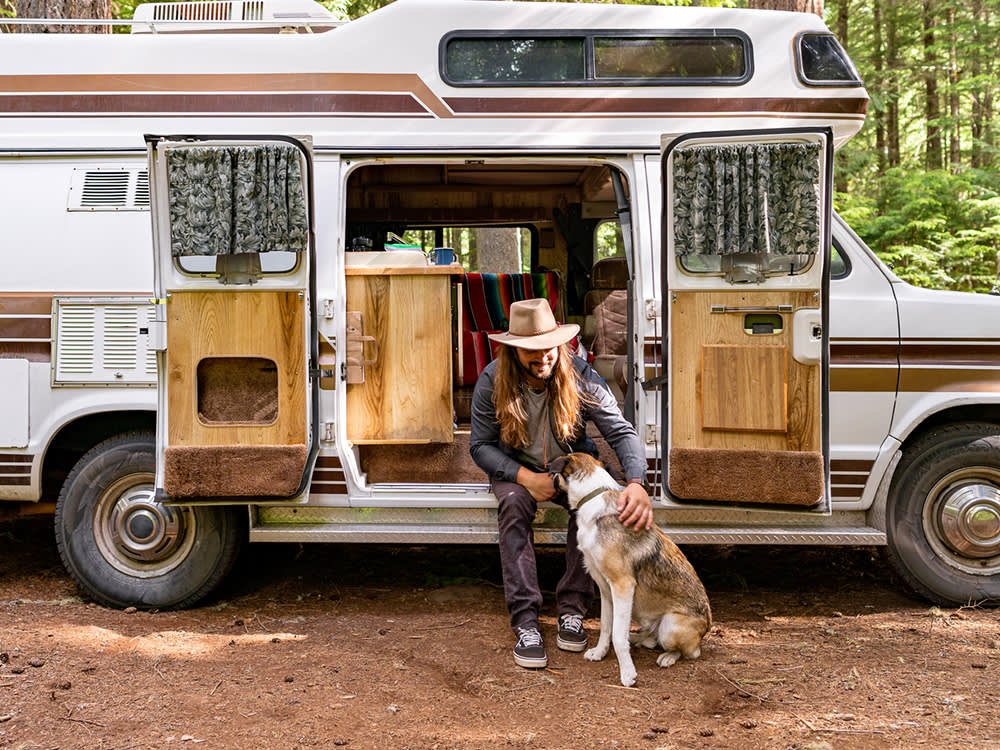
Scroll far enough through van-life photos and you start to believe the story they are selling: a dog with its head out the window, a mountain in the mirror, nowhere to be. It is a good story. It is also missing the part that actually decides whether the whole thing works, which is that you are now responsible for a living animal inside a small metal box that heats up faster than any apartment ever could.
That is the real shape of van life with a dog. Not the sunsets. The logistics. The people who do it well for years are not more romantic than everyone else. They are better at managing temperature, routine, and risk, and they have quietly organized their entire day around a creature who cannot roll down a window.
Get that part right and the postcard version follows. Get it wrong and the trip ends at an emergency vet in a town you have never heard of.
The reason people love it is real
Start with why anyone does this at all, because the appeal is not fake. A dog on the road is genuinely good company, and full-timers say the same things over and over: the dog gives the day structure, raises the alarm when a stranger gets too close to the van at 2 a.m., and on a cold night turns into a furnace you are grateful to share a bed with.
Dogs also tend to take the small space in stride. What reads as cramped to us reads as cozy and den-like to them, and most settle into a rolling home more easily than their humans expect. The problem was never whether the dog would be happy in the van. The problem is everything outside the dog’s control, and almost all of it comes back to heat.
The rule that outranks every other rule
Here is the one that is not negotiable: do not leave your dog alone in a parked van, especially in warm weather. Treat “I’ll just be twenty minutes” as the sentence that gets dogs killed, because a vehicle in mild sun can climb into dangerous territory in well under half an hour, and a van full of insulation and windows is worse, not better, than a car.
The working solution most full-timers land on is almost annoyingly simple: the dog goes where you go. You plan your life around dog-friendly stops, and when you truly cannot bring them somewhere, you pay for a sitter or a daycare rather than gambling on the parking lot. It is less convenient. It is also the whole job.
“In a van, heat is not a weather problem, it is a math problem, and the numbers move fast,” says Dr. Nina Kohl. “By the time a dog is panting hard and can’t settle, you are already behind. The pet parents who never have an emergency are the ones who treat an empty, parked van in the sun as simply off-limits, full stop.”
When you cannot avoid heat entirely, stack your defenses. A powered roof vent or fan, reflective covers on the windows, and a cooling mat all buy you margin, and a bowl of water should never not be within reach. Then plan your route around the thermometer, chasing mild days and avoiding both the desert at noon and the mountains in a cold snap. The van has no thermostat. You are the thermostat.
Structure is the thing that keeps everyone sane
The second quiet truth of life on the road is that a rhythm matters more than a destination. Dogs are creatures of routine, and so, it turns out, are the humans who are happiest out there. A predictable loop of morning walk, drive, midday break, big afternoon exercise, and evening wind-down does more for a dog’s behavior than any amount of scenery.
That afternoon exercise is not optional. A dog who has burned real energy at a dog park, on public land, on a beach, or up a trail is a dog who rides calmly and sleeps through the night. A dog who has been cooped up is a dog who chews the upholstery and barks at every gravel crunch. “A tired dog is an easy roommate” is the closest thing van-lifers have to a founding principle.
Training is the security blanket underneath all of it. Reliable recall, sit, and stay are not tricks out here, they are safety equipment, the difference between a dog who bolts at a rest stop toward a highway and one who turns on a dime and comes back. Practice them until they are boring, then keep practicing.
The paperwork nobody photographs
Two unglamorous habits separate prepared travelers from the ones who learn the hard way.
Keep your dog’s medical records and vaccination history with you, digitally and on paper, because a boarding facility, a campground, or a new vet three states over may ask for proof and you will not have your usual clinic to call. And keep identification airtight: a collar tag with a current number and a microchip whose registration actually points to a phone you still answer. A dog who slips a leash in an unfamiliar town is every road-tripper’s worst afternoon, and up-to-date ID is what turns it back into a good story.
The gear that earns its shelf
Space is currency in a van, so the packing list is short and every item has to justify itself.
A long leash and a tether give your dog room to exist outside the van without wandering into a neighbor’s site or a road. A lightweight carrier or sling helps with small or tired dogs on rougher ground. Collapsible water carriers keep everyone hydrated between towns, and a wipeable mat under the food bowl saves you from scrubbing kibble out of the one rug you own. A good brush and a real first-aid kit handle the daily reality of ticks, foxtails, and small cuts that come with living outdoors.
Two additions the old road-trip checklists miss are worth the space. A crash-tested travel harness or a secured crate matters, because an unrestrained dog in a sudden stop is a projectile, and independent testing by groups like the Center for Pet Safety has shown that most “safety” harnesses on the shelf are not built for a real collision, so it is worth buying one that was actually tested. And a battery-powered temperature monitor that pings your phone when the van gets too warm is now cheap and, given rule number one, close to essential.
A reality check before you sell the couch
None of this is meant to talk you out of it. Plenty of people and dogs live this way for years and would not trade it. But the honest version of the pitch is that van life with a dog trades a fixed set of chores for a different, more constant set. Instead of a yard, you have a route to plan. Instead of central air, you have a fan, some reflective panels, and your own judgment. Instead of a fenced backyard, you have recall you had better mean.
If that sounds like a fair trade, it probably is one for you. The dogs, for their part, mostly just want to be wherever you are, in whatever size box that turns out to be.
What newer gear adds
The biggest change since the early van-life boom is that heat safety stopped relying on vigilance alone. Wireless RV and van temperature monitors that text or call you the moment the interior crosses a threshold you set are now inexpensive and widely used, and they turn the single most dangerous variable of dog van life into something you can actually watch from across a parking lot.
Restraint has gotten smarter too. As independent crash testing has become more common, a small number of harnesses and travel crates have been shown to hold up in real impact tests, while many popular ones have not. If you are buying one thing new before you hit the road, make it the tested restraint and the temperature alarm. They protect against the two failures that turn a dream trip into a tragedy, and neither existed in a usable form a decade ago.
References
Marcus Webb writes about the gear, gadgets, and everyday choices that make life with a pet easier. His coverage runs from product picks to training and the causes worth paying attention to, always with an eye on what actually earns a place in your home.
Meet our experts ↗Keep reading
 LivingSkip the Dog Park. San Francisco's Presidio Has 8 Better Stops.Marcus Webb · 8 min
 LivingBARK Wants to Sell You a $150 Dog Concierge. When It's Actually Worth ItMarcus Webb · 4 min
 LivingA Dallas Insider's Dog-Friendly Map: 7 Spots, and Who Each Is Really ForMarcus Webb · 5 min
 LivingThe 10 Most Dog-Friendly Cities, and the Tradeoff Buried in the RankingsNina Vasquez · 5 min
 LivingHow to Vet a Dog Hiking Service (and 8 Around the Country That Pass)Sasha Ford · 9 min
 LivingHe Raised Two Dogs in a Van. His Small-Space Rules Beat Most Apartments.James Okafor · 6 min