


8 Absurdly Pampered Pets, Ranked by Whether the Money Bought Them Anything
A $125,000 catio and a $2,500 dog wardrobe are not the same act. One of them makes an animal's life measurably longer and better. The other makes a human happy. Here is where eight of the world's most spoiled pets actually land.
Rent is up, groceries are absurd, and somewhere in Paris a cat is eating out of Chinese porcelain.
The easy move here is to gawk, and we will gawk. But sorting through the most lavishly spoiled animals on earth, a much more interesting line keeps appearing, and it has nothing to do with how much anybody spent. It is this: did the money buy the animal anything, or did it buy the human something?
Some of these fortunes translate directly into things a veterinarian would prescribe if you had unlimited funds. Safe outdoor access. Daily exercise. Space to move. Constant medical attention. Those animals are not just spoiled, they are, by any honest measure, healthier for it.
And some of it is a wardrobe.
Both are here. In order.
The spending that a vet would actually endorse
1. Ebony, and the $125,000 catio
The YouTuber Ryan Lapinski spent an estimated $125,000 building a custom catio for Ebony, a formerly feral cat, along with her six siblings and three fosters. It is three separate wooden structures, wrapped in predator-proof fencing, connected to each other and to the main house by around a hundred feet of aboveground tunnel.
It is a ridiculous amount of money. It is also, functionally, the single most life-extending purchase on this entire list. Outdoor and indoor-outdoor cats face risks that indoor cats simply do not, meaning cars, predators, infectious disease, and vanishing. A catio is the only known way to give a cat the smells, the birds, the sun, and the territorial patrolling their brain is built for, without any of that. Most of us build a version of this out of a screened balcony and a shelf. Lapinski built the cathedral. The principle is identical.
2. Sylar, and the $500,000 mansion with a training yard
Celebrity dog trainer Zhou Tianxiao’s story is genuinely something. His parents left. His grandmother brought him up in an alleyway in Beijing. He was out of school before middle school ended, and he disappeared into video games. Then he met his dog, Sylar, taught himself to train, practiced everything on him, and posted the results. The videos built an online shop that made him hundreds of thousands of dollars.
Half a million of that went into a house for Sylar, out past the edge of the city. There is a pool, painted with a mural of the dog himself, and a sprawling outdoor training area kitted out with purpose-built equipment. Technically the property doubles as a business, hosting other dogs for training, grooming, swimming lessons, and short stays. Tianxiao considers it Sylar’s house.
Strip away the price tag and what you have is a dog with unlimited space, a job, daily structured training, and water to swim in, which is roughly the ideal life for a working-type dog. The money bought the dog exactly what a dog wants.
3. Artemis, and the two-hour morning walk
Artemis started as a stray on the streets of Miami. Now she flies first class, has taken lavish trips to Stockholm, Berlin, and Paris, took private swimming lessons in New York, and attends Doggy Afternoon Tea at the Egerton House Hotel in London. Her human, the pet care CEO Noel Duan, estimates spending around £10,000 a year, comfortably over $13,000, and has said in print that the dog eats better than she does.
The food is not a joke: home-cooked meals of pork shoulder, chicken thigh, venison, beef, root vegetables, pears, apples, flax, chia, and nutritional yeast. There are three beds, one memory foam, one carved from wood and upholstered in blue velvet.
But the line item that matters is the least glamorous one. Duan walks Artemis for two hours every single morning. That is more structured exercise than the vast majority of dogs on earth receive, and it does more for a dog’s body and brain than the velvet bed, the tea service, and the first-class cabin combined.
4. Oprah Winfrey’s dogs, and the $30 million safety net
Sadie, Sunny, Lauren, Layla, and Luke reportedly have a $30 million trust fund waiting for them should anything happen to Oprah. Against a fortune estimated around $3 billion, that is a rounding error, which is its own kind of statement.
What that money reportedly buys day to day: a personal chef, custom quarters in each of her homes, regular spa treatments, and on-call veterinarians who come to the dogs at the first sign of a sniffle.
That last one is the real luxury, and it is worth sitting with. Most owners queue for a specialist appointment and take whatever date they are given. These dogs have a medical team that comes to the house. Nothing on this list buys more actual health than immediate, unhesitating, cost-is-no-object veterinary access, because the single most common reason a treatable problem becomes a fatal one is that nobody looked in time.
The spending that is really about the human
To be clear, none of this is cruel, and all of these animals are loved. It just does not do anything for them.
5. Choupette, heiress
When Karl Lagerfeld died in 2019, he left the care of his cat, Choupette, to one of his longtime housekeepers, Françoise Caçote. Nearly fourteen now, she lives in Caçote’s Parisian apartment with the housekeeper’s family. Her meals come out of delicate Chinese porcelain. She flies in the front of the plane, in Louis Vuitton luggage of her own. She is groomed every day, whenever she feels like it, and she sleeps where she has always slept, on heaps of Chanel. For her thirteenth birthday, there was a party at Versailles.
Lagerfeld’s fortune was estimated around $300 million at his death. French law does not permit pets to inherit, but he made a point of telling an interviewer in 2018 that whoever ended up caring for her would not be left wanting, and described her, with total sincerity, as a rich girl.
Here is the thing. The cat cannot tell the difference between Chanel and a clean fleece blanket. What Choupette actually has, and what genuinely serves her, is a devoted primary caregiver in a stable home who grooms her daily and knows her habits. That is the same thing a well-loved cat in a walk-up gets. The Versailles birthday was for us.
6. Mochi, Milky, and Piggy, and the walk-in wardrobe
Three Shanghai Shih Tzus with a clothing collection that would embarrass a boutique. Their human estimates spending around 2,000,000 yuan, north of $280,000, on tweed jackets, cashmere sweaters, hand-knits imported from Italy, sunglasses, hair clips, bejeweled harnesses, dog-sized handbags, and a considerable amount of Disney. The buying trips run to Seoul and Tokyo, and the overflow lives in a walk-in closet built specifically to house it.
For a genuinely cold-sensitive small dog, a coat is real welfare equipment. Nine hundred coats are a hobby, and the hobby belongs to the human.
7. Bao, and the matching outfits
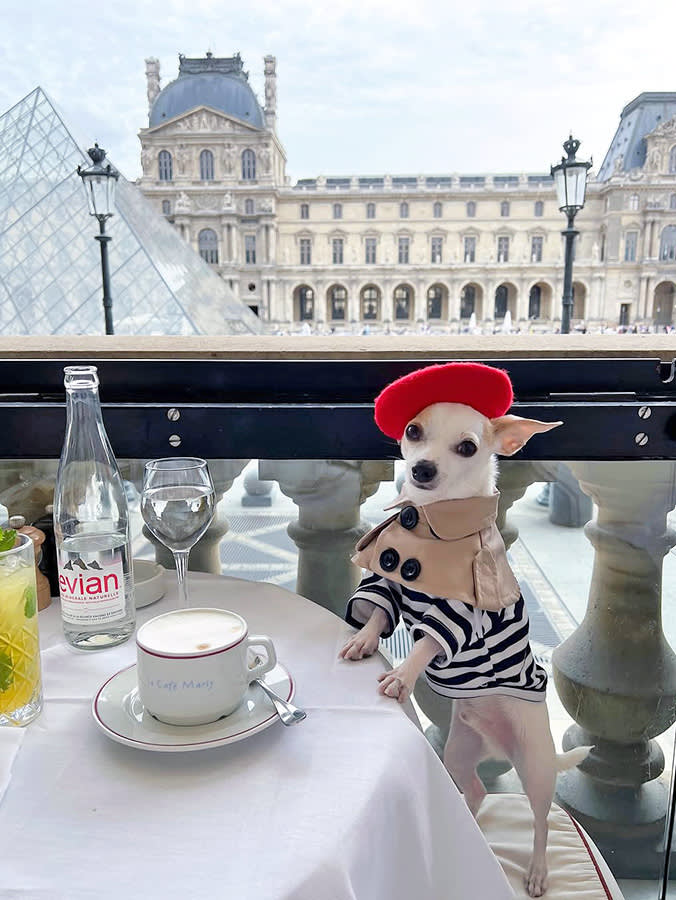
A four-year-old Chihuahua in Toronto with a 75-piece wardrobe that cost around $2,500 as of spring 2024, and has undoubtedly grown since, frequently coordinated with his human’s outfits. He flies constantly, turning up in Beverly Hills, in Mexico, and in Paris, on vacations and on shoots.
Bao is at least in the one category where clothing has a defensible function, because Chihuahuas genuinely do get cold. And he eats a raw diet including homemade bone broth for his joints, which is where I would gently note that raw feeding has been linked to bacterial infection risk and is not something most veterinarians would sign off on, bone broth or not.
8. In memory of Tika the Iggy
No dog has done more to invent the job of fashion influencer than this Italian Greyhound, and few have done it for as long. Tika worked the international circuit for years, front row at the shows, photographed beside Heidi Klum, Tracee Ellis Ross, Julia Fox, and Drew Barrymore, wearing gowns made for her by Moschino, Christian Siriano, and Dolce & Gabbana.
In November 2025, Tika died at fourteen. Her dads wrote that they hoped she knew how deeply she was loved, by them and by the enormous number of people who came to know her, and that she was larger than life.
Fourteen is a good long run for an Iggy. And this is the point at which the whole framework I have been running collapses a little, because what kept Tika going that long was not the Moschino. It was two people who structured their lives around her, took her everywhere rather than leaving her behind, and paid close attention for fourteen years.
What the money can and cannot buy
“If a client walked in and told me they had unlimited funds for their pet, I would not spend a cent of it on clothing,” says Dr. Amara Solis. “I would spend it on space to move, safe outdoor access, daily exercise, keeping them lean, and a veterinarian who can see them the same day. That is the entire list. It is also, uncomfortably, a list most people can approximate for free.”
That is the honest summary of eight fortunes. The catio, the training yard, the two-hour walk, and the on-call vet are doing real work. The wardrobes, the porcelain, the trust funds, and the Versailles birthday parties are doing something for the humans, which is not nothing, but it is not for the animal.
The good news is which half of that list is actually expensive. Attention is free. So is a long walk.
References
- Overweight and Obesity in Dogs and Cats: An Exploration of Animal Welfare and Behaviour Impacts, and Recommendations for Management in Veterinary Primary Care
- Get the Facts! Raw Pet Food Diets Can Be Dangerous to You and Your Pet (U.S. Food and Drug Administration)
- Indoor cats and outdoor risk: keeping cats safe (American Veterinary Medical Association)
Nina Vasquez writes about life at home with pets and the relationships at the heart of it. Her work covers day-to-day living, people-and-pet stories, and the products that fit into a real household, with a warm, grounded take on everyday pet ownership.
Meet our experts ↗Keep reading
 LivingAnyone Can Feed a Cat. Great Pet Sitters Do These Four ThingsNina Vasquez · 6 min
 LivingYour Pet Interrupting You Isn't Rude. It's a Wellbeing Nudge.Dr. Lena Park · 6 min
 LivingGive Your Pet a Job: The Case for a Capricorn-Season ResetNina Vasquez · 6 min
 LivingThere's a Grief Ritual for Pets. Most Americans Have Never Been Told About It.Sara Lim · 8 min
 LivingYour Pet Probably Won't Go Viral. Chase This Instead.Sasha Ford · 6 min
 LivingThe Weird Little Rituals Pet Parents Refuse to SkipMarcus Webb · 5 min